

Pull to refresh
Logo
Daily Brief
Following
Why Ranks Sign Up
Climate scientists drop worst-case warming scenario from new model framework

Climate scientists drop worst-case warming scenario from new model framework

New Capabilities

ScenarioMIP removes SSP5-8.5 from CMIP7 as projected 2100 warming converges near 2.3–2.7°C

7 days ago: Pielke Jr. on Human Progress podcast

Overview

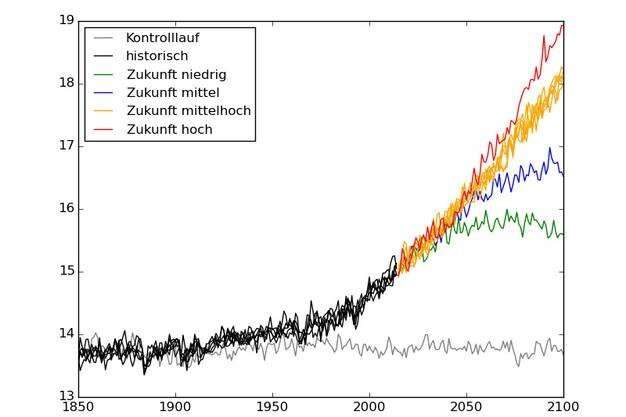
The scenario long used as climate change's 'business as usual' no longer counts. In April 2026, the team building the next generation of global climate models removed SSP5-8.5 — the high-emissions track behind most '4-5°C by 2100' headlines — from the CMIP7 framework that will feed the IPCC's seventh assessment report.

The shift confirms six years of pushback that the high-emissions track assumed a coal-heavy future no longer in motion. Current national pledges put 2100 warming near 2.3–2.7°C, not the 4–5°C trajectories that dominated coverage. Policy debates now run on different numbers.

Why it matters

Climate policy was priced against a 4–5°C worst case. The new model framework caps the worst case lower, changing the math on how fast to act and at what cost.

Play on this story Voices Debate Predict

Key Indicators

6.7 W/m²
CMIP7 HIGH radiative forcing in 2100
The new high-end scenario, down from 8.5 W/m² under SSP5-8.5.
2.3–2.7°C
Projected 2100 warming under current pledges
UNFCCC 2025 NDC synthesis range, down from 3.7–4.8°C a decade ago.
0.9°C
Gap between CMIP7 HIGH and SSP5-8.5
Apples-to-apples temperature difference at 2100 between the new and old high scenarios.
71 Gt
Annual CO₂ in 2100 under CMIP7 HIGH
Compared with 128 Gt under SSP5-8.5, the now-retired high scenario.
7
Scenarios in CMIP7 framework
Range from Very Low to High, plus overshoot pathways.

Voices

Curated perspectives — historical figures and your fellow readers.

Ever wondered what historical figures would say about today's headlines?

Sign up to generate historical perspectives on this story.

Play

Exploring all sides of a story is often best achieved with Play.

Log in to play. Track your picks, climb the leaderboards. Log in Sign Up
Predict 4 ways this could play out. Contrarian picks score more — points lock when the scenario resolves. Log in to play

People Involved

Organizations Involved

Timeline

  1. Pielke Jr. on Human Progress podcast

    Commentary

    Discusses revised projections, walks through what IPCC concludes by impact category, and frames climate policy as a subset of energy policy.

  2. CMIP7 paper drops SSP5-8.5

    Science

    Van Vuuren et al. publish ScenarioMIP-CMIP7 framework in Geoscientific Model Development. New HIGH scenario caps at 6.7 W/m².

  3. UNFCCC narrows 2100 projection

    Report

    NDC Synthesis Report puts warming under full pledge implementation at 2.3–2.7°C, down from earlier estimates.

  4. ScenarioMIP begins CMIP7 design

    Process

    Working group starts building new integrated assessment model scenarios for the next round of climate models.

  5. Pielke, Ritchie, Burgess paper on plausibility

    Science

    Peer-reviewed paper argues high-emissions scenarios rely on coal trajectories no longer in motion.

  6. AR6 calls SSP5-8.5 outcomes 'low likelihood'

    Report

    IPCC Sixth Assessment Report Working Group I retains the high scenario but caveats it. Opens the door to the CMIP7 redesign.

  7. Nature commentary calls RCP8.5 misleading

    Science

    Hausfather and Peters publish 'Emissions — the business as usual story is misleading.' Argues researchers and journalists overuse RCP8.5 as a default.

  8. AR5 builds on RCP framework

    Report

    IPCC Fifth Assessment Report uses RCP8.5 as the standard high-emissions case. The scenario becomes shorthand for 'business as usual' in media coverage.

  9. RCP scenarios published

    Science

    Climate modelers publish four Representative Concentration Pathways for CMIP5. RCP8.5 is designed as a high-end stress test.

Historical Context

Limits to Growth (1972)

March 1972

What Happened

The Club of Rome published a computer-model study projecting that economic growth would collide with resource limits within a century. Reactions split between treating the runs as forecasts and treating them as illustrations of how trends could compound. The 'standard run' showing collapse mid-21st century became the public takeaway.

Outcome

Short Term

Sold over 12 million copies and reshaped 1970s environmental policy. Critics including William Nordhaus argued the model assumed away technological substitution and resource discovery.

Long Term

Became a cautionary case in scenario interpretation. The original 'standard run' was repeatedly cited as a forecast for fifty years despite the authors describing it otherwise.

Why It's Relevant Today

Same dynamic as RCP8.5: a scenario built as one possibility among many got treated as the central projection. The current scenario reset is climate science trying not to repeat that pattern.

Acid rain projections vs. cap-and-trade outcomes (1990s)

1990–2010

What Happened

EPA projections in 1990 estimated that the Clean Air Act amendments' sulfur dioxide cap would cost $4–6 billion a year. The actual cost ran closer to $1–2 billion. Emissions fell faster than baseline projections assumed.

Outcome

Short Term

Acid rain damage in the Northeast U.S. and eastern Canada dropped sharply. Power sector switched to lower-sulfur coal and scrubbers faster than analysts modeled.

Long Term

Became the standard case for how policy plus technology can outrun pessimistic baselines. Often cited in arguments that climate emissions trajectories also bend faster than models assume.

Why It's Relevant Today

Part of what made SSP5-8.5 implausible was the same dynamic playing out for coal: renewables scaled, costs collapsed, and the high-emissions path stopped being where the world was actually heading.

Ozone hole and Montreal Protocol (1987)

September 1987

What Happened

Forty-six countries signed the Montreal Protocol to phase out CFCs after Joseph Farman's team detected the Antarctic ozone hole in 1985. Industry projections at the time argued substitutes would be expensive and slow to deploy.

Outcome

Short Term

DuPont and others moved to HFCs within five years. Global CFC production fell roughly 95% by 2000.

Long Term

The ozone layer is on track to recover by mid-century. Most-cited example of policy plus industry response invalidating worst-case projections.

Why It's Relevant Today

The pattern matters here: a scenario built on continued growth in a pollutant became implausible once policy and technology changed the trajectory. Climate scenarios are now undergoing the same revision in slower motion.

Sources

(8)