
Pull to refresh
Logo
WMO reports record-high greenhouse gas concentrations for 2025

WMO reports record-high greenhouse gas concentrations for 2025

New Capabilities

Carbon dioxide averaged 426.8 ppm, 153% of the pre-industrial baseline

Overview

Updated 1 hour ago

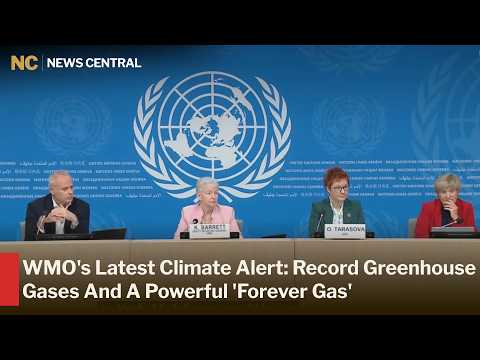
The World Meteorological Organization's annual greenhouse gas bulletin confirms that carbon dioxide, methane, and nitrous oxide all reached record global concentrations in 2025. CO2 averaged 426.8 parts per million, 153% of the pre-industrial baseline and up from 377.5 ppm when the bulletin began in 2004.

Because CO2 stays in the atmosphere for centuries, these readings lock in years of additional warming. The report arrives three weeks before COP 31 in Antalya, Türkiye, where negotiators are trying to turn climate pledges into action. WMO warns that a developing El Niño in 2026 could push CO2 growth even higher.

Why it matters

Every year of record concentrations locks in decades more warming, since CO2 persists in the atmosphere for centuries.

Questions about this story

Free account needed to ask — your question is kept and asked for you right after sign-up. Answers are public.

No questions yet — be the first to ask.

Key Indicators

426.8 ppm
2025 average CO2 concentration
The global surface average, 153% of the 1750 pre-industrial level.
2.8 ppm
CO2 increase, 2024 to 2025
Above the 2.63 ppm decadal average, but below the exceptional 2023/2024 El Niño surge.
153%
CO2 vs. 1750 baseline
Up from the 377.5 ppm recorded in the first bulletin in 2004.
267%
Methane vs. 1750 baseline
Methane reached 1948 parts per billion in 2025.
56%
Radiative forcing increase since 1990
CO2 accounts for about 81% of the added warming effect, per NOAA data.

Voices

Curated perspectives — historical figures and your fellow readers.

Sign up to generate historical perspectives on this story.

People Involved

Organizations Involved

Timeline

2004 October 2026

5 events Latest: Yesterday
Tap a bar to jump to that date
  1. WMO publishes 22nd Greenhouse Gas Bulletin

    Latest Publication

    Report confirms record 2025 concentrations and warns a developing El Niño could raise CO2 growth in 2026.

  2. CO2, methane, nitrous oxide all set records

    Measurement

    CO2 hit 426.8 ppm, methane 1948 ppb, nitrous oxide 339.1 ppb — all record highs.

  3. CO2 rises 2.8 ppm, above the decadal average

    Measurement

    Growth moderated after 2023/2024 El Niño, as recovering land sinks absorbed more carbon.

  4. CO2 growth rate triples since the 1960s

    Measurement

    Annual CO2 increase averaged 2.4 ppm, up from 0.8 ppm in the 1960s.

  5. WMO publishes first Greenhouse Gas Bulletin

    Publication

    The inaugural bulletin recorded a global CO2 average of 377.5 ppm.

Scenarios

1

El Niño pushes 2026 CO2 growth above 3 ppm

Possible Resolves by Oct 31, 2027

Discussed by: WMO scientists including senior scientific officer Oksana Tarasova

A powerful El Niño developing in 2026 could repeat the 2023–2024 pattern, bringing drought and wildfires that weaken land carbon sinks. Combined with ongoing fossil fuel burning, that would push atmospheric CO2 growth above the 2.8 ppm recorded for 2024–2025. The next annual bulletin, due around October 2027, will show whether this materializes.

2

COP 31 produces quantified emissions commitments

Unlikely Resolves by Nov 20, 2026

Discussed by: WMO frames the bulletin as reference data for COP 31 negotiators

The report lands three weeks before COP 31 in Antalya, Türkiye (November 9–20, 2026), where delegates are trying to convert climate pledges into concrete measures. If the final agreement includes quantified reduction targets binding on all major emitters, it would mark the first such commitment since Paris. Historical precedent suggests the final text is more likely to restate existing pledges.

3

Ocean carbon sink shows measurable weakening

Possible Resolves by Oct 31, 2027

Discussed by: WMO warns of rising risks of reduced ocean CO2 uptake

Oceans absorb roughly a quarter of annual CO2 emissions. WMO's Tarasova said the risk of declining ocean uptake is growing as the climate warms. The next bulletin's airborne fraction — the share of emitted CO2 staying in the atmosphere — will reveal whether more carbon is escaping the ocean sink.

Historical Context

3 moments from history that rhyme with this story — and how they unfolded.

November 2004

First WMO Greenhouse Gas Bulletin (2004)

WMO launched its annual Greenhouse Gas Bulletin with a global CO2 average of 377.5 ppm, already 135% of the pre-industrial level. Methane and nitrous oxide readings were also documented for the first time in a coordinated global assessment.

Then

The bulletin became the standard scientific reference for UN climate negotiations, updated every year since.

Now

Twenty-two editions later, CO2 has risen by roughly 49 ppm, from 377.5 to 426.8 ppm, a steady climb with no reversal.

Why this matters now

The 2004 baseline shows the scale of the two-decade accumulation that the 2025 record extends.

Mid-2023 to mid-2024

2023–2024 El Niño

A strong El Niño brought drought and wildfires across tropical regions, stressing vegetation and reducing how much CO2 forests and wetlands absorbed. The result was an exceptional surge in atmospheric CO2 growth that exceeded the already-rising trend.

Then

CO2 growth in 2023–2024 spiked well above the decadal average; wildfire methane emissions changed the global methane fingerprint for the first time.

Now

The episode demonstrated how natural climate variability can temporarily accelerate greenhouse gas accumulation.

Why this matters now

WMO warns a powerful El Niño developing in 2026 could produce the same sink-weakening effect.

December 2015

Paris Agreement (2015)

195 nations adopted the Paris Agreement, committing to hold warming well below 2°C and pursue 1.5°C, with each country setting its own emissions targets, reviewed every five years.

Then

The agreement's pledge-and-review structure produced national climate plans but no binding enforcement mechanism.

Now

A decade on, atmospheric CO2 has risen from roughly 400 ppm to 426.8 ppm despite the pledges.

Why this matters now

COP 31 is the latest test of whether the Paris framework can convert record concentration data into binding action.

Sources

(5)