



Pull to refresh
Logo
AI longevity discovery toolkit opens to researchers worldwide

AI longevity discovery toolkit opens to researchers worldwide

New Capabilities

Insilico Medicine's Cell cover study releases LongevityBench, five open models, and an agentic target-hunting platform

Yesterday: Cell cover study opens AI longevity toolkit to researchers

Overview

Updated Yesterday

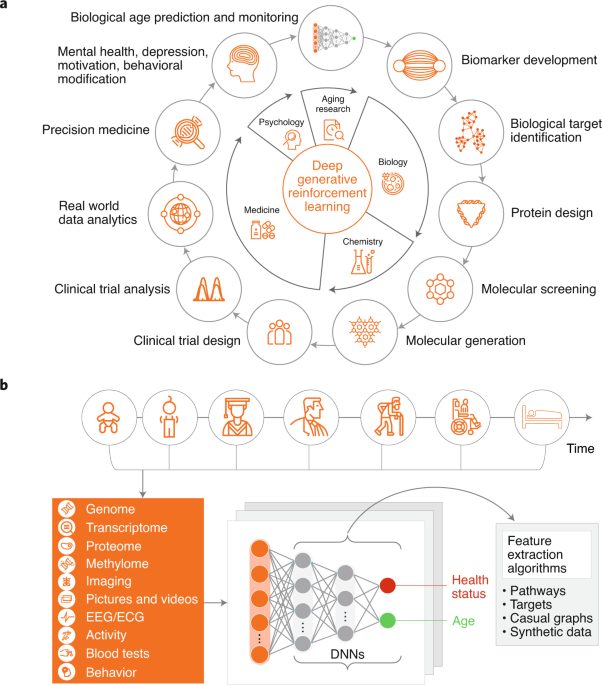
Insilico Medicine put its aging-research AI tools in anyone's hands on September 17, 2026. The Cell cover study releases LongevityBench, a 17-task benchmark that tests how well AI systems reason about aging biology, along with Longevity-LLMs, five compact open-source language models trained on clinical and multi-omics aging data. Multi-omics means combining data from genomics, proteomics, and other biological measurement layers.

The third piece, LongevityClaw, is an agentic platform that pairs the models with research tools to hunt therapeutic targets on its own. Run across 14 hallmarks of aging, it nominated 328 genes as potential targets, a list enriched up to 5.6-fold against experimentally supported aging genes. All three tools are openly available to researchers.

The surprise: the compact 0.6B–9B parameter Longevity-LLMs matched or beat the 18 frontier AI systems benchmarked from six developer teams, most of them far larger. If that holds, serious aging research no longer demands frontier-scale compute—any lab with a mid-range GPU can participate. The work was done with Liquid AI, the Buck Institute for Research on Aging, Harvard Medical School, and Brigham and Women's Hospital.

Why it matters

Any aging researcher can now test AI-driven target hypotheses with free open tools—sharply lowering the barrier to longevity drug discovery.

Questions about this story

Free account needed to ask — your question is kept and asked for you right after sign-up. Answers are public.

No questions yet — be the first to ask.

Key Indicators

17
Benchmark tasks spanning five biodata domains
LongevityBench covers DNA methylation, transcriptomic, proteomic, and clinical age-prediction tasks.
5
Open models released (0.6B–9B parameters)
Longevity-LLMs matched or beat far larger frontier systems on benchmark tasks.
328
Genes nominated as aging targets
LongevityClaw's autonomous workflow across 14 hallmarks of aging produced the list.
5.6x
Enrichment of nominated targets vs. experimental reference
Statistically significant overlap with an independently published set of aging-related targets.
18
Frontier AI systems benchmarked
From six developer teams; none dominated all LongevityBench tasks.

Voices

Curated perspectives — historical figures and your fellow readers.

Ever wondered what historical figures would say about today's headlines?

Sign up to generate historical perspectives on this story.

People Involved

Organizations Involved

Timeline

2 events Latest: Yesterday
  1. Cell cover study opens AI longevity toolkit to researchers

    Latest Publication

    Insilico and collaborators release LongevityBench, open Longevity-LLMs, and the LongevityClaw agentic platform.

  2. AI-designed drug shows biological age reversal

    Research

    Nature Biotechnology publishes Phase IIa data showing rentosertib reverses biological age on six independent clocks.

Scenarios

1

LongevityBench becomes aging research's shared yardstick

Likely Resolves by Mar 17, 2028

Discussed by: Cell study authors and Nature's coverage of the study

Adoption follows the ImageNet pattern: academic and industry teams start reporting AI model results against the 17 LongevityBench tasks, and grant reviewers come to expect benchmark numbers. Success looks like independent groups using the tasks to train, fine-tune, and compare their own models, with citations spreading across the literature.

2

Frontier-scale models reclaim the lead on LongevityBench

Possible Resolves by Sep 17, 2028

Discussed by: Frontier AI labs and model evaluation watchers

Larger closed models, newer generations, or purpose-built omics models post higher average scores than Insilico's open 9B-parameter L-Qwen3.5-9B. That would confirm that on structured omics tasks, scale still buys accuracy once the obvious gains from domain fine-tuning are exhausted.

3

LongevityClaw-nominated targets validate in the lab and advance

Possible Resolves by Q2 2029

Discussed by: Insilico Medicine researchers and academic collaborators

One or more of the 328 genes nominated by LongevityClaw is experimentally validated as an aging intervention target in a peer-reviewed study, and at least one target advances into a drug discovery program. This is the strongest test of whether the agentic platform finds biology that matters, not just patterns in data.

Historical Context

3 moments from history that rhyme with this story — and how they unfolded.

2009-2012

ImageNet (2010)

Fei-Fei Li and colleagues at Princeton launched ImageNet in 2009, a database of millions of labeled images, and created the ImageNet Large Scale Visual Recognition Challenge (ILSVRC) in 2010. Teams competed each year to classify images with the lowest error.

Then

Error rates fell year over year; AlexNet's 2012 win kicked off the deep learning boom and reshaped the field's research agenda.

Now

ILSVRC became the default way to compare vision systems, and beating it became a bar for publishing and investment.

Why this matters now

LongevityBench aims to give aging biology the same thing ImageNet gave computer vision: a shared set of tasks every AI system can be judged on.

2020-2021

AlphaFold open release (2021)

DeepMind's AlphaFold2 won the protein-folding competition CASP14 in late 2020, predicting structure from sequence with near-experimental accuracy. In July 2021, DeepMind released the model's code and predicted structures for nearly the entire human proteome.

Then

Researchers worldwide began using AlphaFold predictions daily, transforming structural biology and drug target work.

Now

Open access was central to that impact, setting a precedent for AI tools in biology.

Why this matters now

It is the closest precedent for releasing a powerful AI tool openly to a biology community—the exact move Insilico is making for aging.

February 2023

Meta's LLaMA open weights (2023)

Meta released LLaMA, a family of open-weight language models up to 65B parameters, in February 2023. Academic groups quickly fine-tuned the smaller 7B and 13B versions into capable assistants.

Then

The open-weight releases triggered the open-source LLM wave and showed that compact models fine-tuned on specific data can match far larger closed systems on those tasks.

Now

It established a research culture of fine-tuning small models for domains, lowering the compute barrier.

Why this matters now

The Longevity-LLMs follow this playbook exactly: compact models fine-tuned on aging data that held their own against frontier systems.

Sources

(6)