


Pull to refresh
Logo
Daily Brief
Following
Why Sign Up
FDA approves second-ever treatment for Alzheimer's agitation

FDA approves second-ever treatment for Alzheimer's agitation

New Capabilities
By Newzino Staff |

Axsome's Auvelity joins Rexulti in a treatment category that did not exist three years ago

Yesterday: FDA approves Auvelity for Alzheimer's agitation

Overview

Until May 2023, no drug was approved in the United States to treat the agitation that affects up to three-quarters of people with Alzheimer's disease. Doctors reached for antipsychotics off-label, a class of medicines that carries a black-box warning for increased death risk in older dementia patients. On April 30, 2026, the Food and Drug Administration (FDA) approved Axsome Therapeutics' Auvelity for the indication, doubling the menu of approved options from one to two.

Why it matters

If a parent develops Alzheimer's agitation, the doctor now has two approved treatments to try—up from zero in 2022.

Key Indicators

2nd
FDA-approved treatment for Alzheimer's agitation
Joins brexpiprazole (Rexulti), approved in May 2023 as the first ever.
~76%
of Alzheimer's patients experience agitation
Symptoms range from restlessness and pacing to aggression and shouting.
8.4% vs 28.6%
relapse rate on Auvelity vs placebo
ACCORD-2 randomized withdrawal trial measured time to agitation relapse.
~7M
Americans living with Alzheimer's
Population that defines the addressable patient pool for the new indication.
0
approved treatments before May 2023
Off-label antipsychotics carried a black-box warning for increased death risk.

Interactive

Exploring all sides of a story is often best achieved with Play.

Ever wondered what historical figures would say about today's headlines?

Sign up to generate historical perspectives on this story.

Sign Up

Debate Arena

Two rounds, two personas, one winner. You set the crossfire.

People Involved

Organizations Involved

Timeline

  1. FDA approves Auvelity for Alzheimer's agitation

    Approval

    On the assigned action date, the FDA clears Auvelity as the second-ever approved treatment for agitation associated with dementia due to Alzheimer's disease.

  2. Axsome submits supplemental New Drug Application

    Regulatory

    Company files for the Alzheimer's agitation indication; FDA accepts the submission and assigns a 2026 action date.

  3. ACCORD-2 relapse-prevention trial reports

    Clinical Trial

    Patients stabilized on Auvelity relapsed at 8.4 percent versus 28.6 percent on placebo, providing the relapse-prevention evidence the FDA reviewed.

  4. ADVANCE-1 Phase 3 results published

    Clinical Trial

    Axsome reports that Auvelity significantly reduced agitation versus placebo in patients with Alzheimer's, supporting the regulatory filing.

  5. Rexulti becomes first-ever Alzheimer's agitation treatment

    Approval

    FDA approves brexpiprazole for agitation associated with dementia due to Alzheimer's disease, ending decades without an approved option.

  6. Auvelity wins first FDA approval, for depression

    Approval

    FDA clears Axsome's dextromethorphan-bupropion combination for major depressive disorder, establishing the safety and pharmacology base for later indications.

  7. FDA black-box warning shapes off-label landscape

    Regulatory

    The FDA warns that atypical antipsychotics increase mortality in elderly dementia patients, leaving clinicians with no approved option and a dangerous off-label one.

Scenarios

1

Auvelity captures meaningful share as non-antipsychotic option

Discussed by: BioWorld, sell-side analysts covering Axsome (AXSM)

Prescribers, particularly geriatric psychiatrists and primary-care clinicians serving long-term-care facilities, gravitate toward Auvelity for patients whose families resist antipsychotics. Coupled with Axsome's existing depression sales force, the launch builds a multi-hundred-million-dollar revenue stream within the first two years and pressures Rexulti's growth trajectory.

2

Real-world use reveals limits of trial-stage efficacy

Discussed by: Independent dementia researchers, payer formulary committees

Trial populations were carefully selected and staff-supported. In nursing homes with high turnover and complex polypharmacy, response rates fall short of trial figures, and side effects—dizziness, falls, somnolence—drive discontinuation. Adoption stalls and clinicians revert to familiar off-label regimens.

3

A third entrant enters the category within two years

Discussed by: Pipeline trackers at Evaluate Pharma, Alzheimer's Association researchers

Competitors with mid-stage agitation programs—including investigational serotonin and cannabinoid-pathway candidates—accelerate trials in light of two FDA approvals demonstrating a clear regulatory path. By 2028, a third drug joins the category and price competition begins to emerge.

4

Insurance coverage gates adoption

Discussed by: Caregiver advocacy organizations, Medicare Part D analysts

Payers require step therapy through generic antipsychotics or Rexulti before authorizing Auvelity, citing cost differentials. The approval expands what is medically possible without expanding what is practically accessible, and access becomes the next contested terrain.

Historical Context

Rexulti approved as first Alzheimer's agitation treatment (2023)

May 2023

What Happened

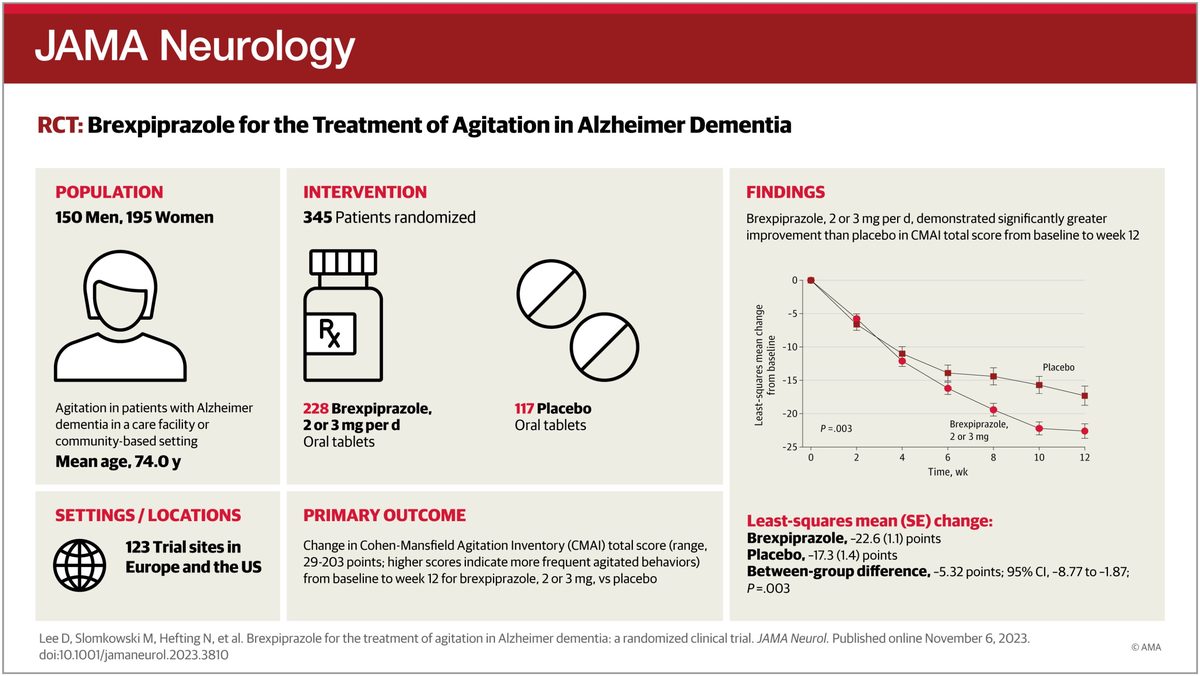
After more than a decade of failed trials by multiple sponsors, the FDA approved Otsuka and Lundbeck's brexpiprazole for agitation in dementia due to Alzheimer's disease. Two pivotal trials showed modest but statistically significant reductions in agitation scores versus placebo.

Outcome

Short Term

The approval established the first FDA-cleared option in a category where doctors had relied on off-label antipsychotics carrying mortality warnings.

Long Term

It validated the regulatory pathway for dementia-symptom drugs and incentivized other sponsors—including Axsome—to push their own programs to filing.

Why It's Relevant Today

Rexulti's approval created the category that Auvelity now expands. Without that 2023 precedent, the regulatory and reimbursement frameworks Auvelity steps into would not exist.

FDA black-box warning on antipsychotics for dementia (2005)

April 2005

What Happened

The FDA required a black-box warning on atypical antipsychotics—including risperidone, olanzapine, and quetiapine—after pooled trial data showed elderly patients with dementia-related psychosis faced roughly 1.6 to 1.7 times the mortality risk of those on placebo. The warning was extended to all antipsychotics in 2008.

Outcome

Short Term

Off-label prescribing dropped initially but rebounded because clinicians had no approved alternatives for severe agitation.

Long Term

The warning created a durable regulatory and ethical incentive to develop dementia-specific drugs without antipsychotic mechanisms—the gap Auvelity now partially fills.

Why It's Relevant Today

Auvelity's value is defined by what it is not: an antipsychotic. The black-box warning is the policy backdrop that makes a non-antipsychotic mechanism commercially and clinically meaningful.

Aduhelm conditional approval and rollback (2021–2024)

June 2021 to early 2024

What Happened

The FDA granted accelerated approval to Biogen's Aduhelm for Alzheimer's disease over the objections of its own advisory committee, citing reductions in amyloid plaques rather than clear cognitive benefit. Medicare restricted coverage, sales collapsed, and Biogen discontinued the drug in early 2024.

Outcome

Short Term

The approval triggered congressional investigations and damaged trust in the FDA's accelerated approval pathway.

Long Term

Subsequent Alzheimer's-related approvals have faced sharper scrutiny on trial design and clinical meaningfulness, raising the evidentiary bar that Auvelity's program had to clear.

Why It's Relevant Today

Auvelity entered FDA review in the post-Aduhelm environment, where dementia drug approvals attract heightened scrutiny. Its replicated, placebo-controlled trial package reflects what the agency now requires to act in this space.

Sources

(4)