


Pull to refresh
Logo
Daily Brief
Following
Why Sign Up
Arm shifts from chip licensor to chipmaker for AI data centers

Arm shifts from chip licensor to chipmaker for AI data centers

Money Moves
By Newzino Staff |

Q4 FY26 results formalize a $15 billion chip-revenue target by 2031 as the company's first in-house silicon ramps with Meta and OpenAI as launch customers.

Today: Record Q4 results and $15B chip target by FY2031

Overview

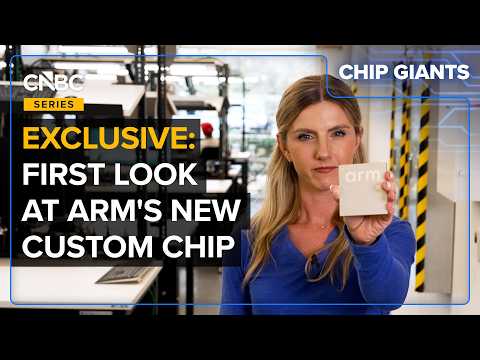
For 35 years, Arm Holdings sold blueprints, not chips. Apple, Qualcomm, Nvidia and Amazon paid Arm to license its processor designs, then made the silicon themselves. On May 6, 2026, Arm formalized a different future: a $15 billion direct chip-sales business by fiscal 2031, anchored by an in-house data center processor called the Arm AGI CPU.

Why it matters

The architecture choice inside AI data centers shapes the cost and energy footprint of every product built on top — from search to chatbots to autonomous agents.

Key Indicators

$15B
Chip revenue target by FY2031
Direct silicon sales from the Arm AGI CPU line, a business that did not exist six weeks ago.
$1.49B
Q4 FY2026 revenue
Up 20% year-over-year; data center royalties more than doubled on AI workload demand.
136
Neoverse V3 cores per AGI CPU
Dual-die package on TSMC 3nm, claimed at twice the performance-per-watt of comparable x86 racks.
35 yrs
Since Arm last made a chip
The AGI CPU is the first production silicon in company history; Arm previously only sold designs.
$2B
Customer signups, 2027–2028
Doubled from the $1 billion announced at the March 24 launch as more cloud buyers committed.
$10B
Capex savings per gigawatt claimed
Arm's pitch to hyperscalers: lower data center build costs by replacing x86 racks with AGI CPUs.

Interactive

Exploring all sides of a story is often best achieved with Play.

Ever wondered what historical figures would say about today's headlines?

Sign up to generate historical perspectives on this story.

Sign Up

Debate Arena

Two rounds, two personas, one winner. You set the crossfire.

People Involved

Organizations Involved

Timeline

  1. Record Q4 results and $15B chip target by FY2031

    Earnings

    Arm posts $1.49 billion in quarterly revenue (up 20%) and $4.9 billion for the year. The investor day formalizes long-term targets: $15 billion in AGI CPU revenue, $10 billion in IP/CSS licensing, and over $9 in non-GAAP EPS by fiscal 2031.

  2. Arm stock jumps 16% on AGI CPU reception

    Market

    Investors reprice the company on the strength of the customer list and the pivot's strategic coherence with AI infrastructure spending.

  3. Arm unveils AGI CPU, breaks 35-year licensing-only model

    Product Launch

    Arm announces a 136-core Neoverse V3 data center processor on TSMC 3nm with Meta as co-developer. Launch customers include OpenAI, Cloudflare, SAP, Cerebras, F5, Positron, Rebellions and SK Telecom.

  4. Nvidia exits Arm stake

    Corporate

    Nvidia sells its remaining position in Arm, ending the residual entanglement from the failed 2020 acquisition attempt and freeing Arm to compete in silicon.

  5. Arm returns to public markets

    IPO

    Arm lists on Nasdaq at $51 per share. SoftBank retains roughly 90% of the company, making the float small and the stock highly sensitive to AI narratives.

  6. Nvidia acquisition collapses, Haas named CEO

    Corporate

    Regulators in the US, UK and EU block Nvidia's $40 billion bid for Arm. Rene Haas, formerly head of Arm's IP business, takes over as CEO the same day.

  7. SoftBank buys Arm for $32 billion

    Acquisition

    SoftBank acquires Arm and takes it private, beginning a decade of strategic experimentation that ultimately produces the IPO and chipmaker pivot.

Scenarios

1

Arm hits $15B chip target, x86 share erodes meaningfully by 2031

Discussed by: Motley Fool, TechRadar, sell-side analysts upgrading on the AGI CPU thesis

If hyperscaler signups continue at the current pace and AGI CPU performance claims hold up in production, Arm becomes a third major data-center CPU vendor alongside Intel and AMD. Energy-constrained AI build-outs accelerate the shift, and the licensee-versus-customer tension stays manageable because Arm only competes in data centers, not phones.

2

Licensee revolt: Qualcomm and others pull back from Arm IP

Discussed by: Tom's Hardware, semiconductor industry analysts citing the Qualcomm-Arm legal dispute

Licensees that compete with Arm in servers — Nvidia (Grace), Qualcomm, Ampere — view the AGI CPU as a competitive threat and accelerate alternatives, including RISC-V designs. Royalty growth slows as the IP business is squeezed even while chip revenue grows, leaving the FY2031 IP target of $10 billion unreachable.

3

x86 incumbents respond, AGI CPU stalls below target

Discussed by: Industry analysts watching Intel's foundry roadmap and AMD's Zen 6 EPYC line

Intel's process improvements and AMD's chiplet designs close the performance-per-watt gap. Customers that signed early continue with limited deployments but full hyperscaler adoption stalls. Arm hits $5–8 billion in chip revenue rather than $15 billion, and the pivot is rebranded as a complement to licensing rather than a transformation.

4

SoftBank uses higher Arm valuation to fund AI infrastructure deals

Discussed by: Financial press covering SoftBank's Stargate and OpenAI commitments

A re-rated Arm gives SoftBank a more valuable balance sheet asset to borrow against or partially monetize, funding broader AI infrastructure investments. The float grows, governance loosens, and Arm operates more independently of SoftBank.

Historical Context

Intel founds the x86 era (1978)

June 1978

What Happened

Intel released the 8086, the processor whose instruction set became x86. IBM picked a derivative for its 1981 PC, and the architecture compounded into a multi-decade lock on personal and server computing through Intel's vertical model — designing and manufacturing its own chips.

Outcome

Short Term

Intel and a small number of x86 licensees, eventually narrowing to AMD, captured nearly all server and PC CPU revenue.

Long Term

x86's dominance lasted four decades and shaped software, compilers and data center economics. Breaking it has required both architectural alternatives and a credible business model — exactly what Arm is now attempting.

Why It's Relevant Today

The AGI CPU is Arm's bid to do in AI data centers what Intel did in the PC era: own both the architecture and the silicon. Whether that vertical model wins again depends on whether AI workloads reward integration the way 1980s software rewarded x86 compatibility.

Apple's M1 transition (2020)

November 2020

What Happened

Apple shipped the M1, replacing Intel x86 chips in its Mac line with an Arm-based system-on-chip designed in-house. The M1 delivered significantly better performance-per-watt than the Intel parts it replaced and forced a rewrite of the x86-vs-Arm performance debate.

Outcome

Short Term

Apple completed its Mac transition within two years and demonstrated that Arm could match or exceed x86 in mainstream computing on a leading-edge process.

Long Term

The M1 shifted industry assumptions about Arm's performance ceiling. Cloud providers accelerated their own Arm server programs (AWS Graviton, Azure Cobalt, Google Axion), creating the demand environment Arm is now monetizing directly.

Why It's Relevant Today

The M1 proved Arm could win on performance-per-watt at the high end. The AGI CPU is the data center analogue, but with Arm — not its licensee — capturing the chip-level economics.

AMD's EPYC comeback (2017)

June 2017

What Happened

After more than a decade of marginal share, AMD launched EPYC server processors based on its Zen architecture. Hyperscalers initially dabbled, then committed at scale, and AMD's data center share rose from low single digits to roughly a third of the market by the mid-2020s.

Outcome

Short Term

Intel's data center pricing power eroded; AMD's stock multiplied as EPYC became a credible second source.

Long Term

Hyperscalers proved willing and able to qualify a new server CPU vendor when the economics were compelling, breaking the assumption that Intel switching costs were prohibitive.

Why It's Relevant Today

EPYC showed that data center buyers will adopt a challenger CPU at scale when performance-per-watt and total cost of ownership justify the qualification work. Arm is now making the same pitch, with AI energy consumption as the lever.

Sources

(8)