Pull to refresh
Logo
Daily Brief
Following
Why Ranks Sign Up
Building a permanent U.S. presence on the Moon

Building a permanent U.S. presence on the Moon

Built World

NASA awards first surface hardware contracts as Artemis shifts from flag-planting to construction

Today: NASA awards $627M for moon base hardware

Overview

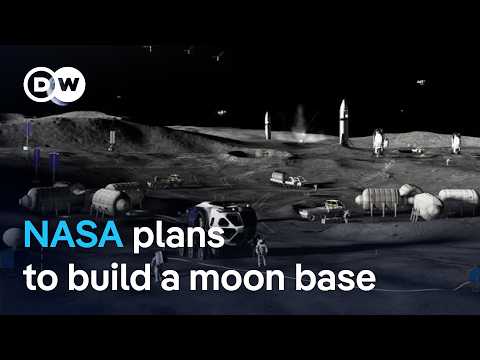
NASA awarded $627 million on May 27 to four U.S. companies for the first hardware of a permanent moon base. The contracts cover rovers, crewed terrain vehicles, and drones meant to land on the Moon before astronauts arrive.

No human has stood on the lunar surface since December 1972. The hardware ordered this week is the buildout phase of Artemis: the program shifts from a single flag-planting mission to a construction effort with permanent infrastructure as its goal.

Why it matters

If this hardware lands on schedule, the United States will have a permanent moon base before 2030, the first sustained human presence beyond Earth.

Key Indicators

$627M
Total contracts awarded
Combined value of the May 27 awards to Blue Origin, Astrolab, Lunar Outpost, and Firefly.
4
Companies selected
Each builds a different piece of the surface architecture.
54 years
Since the last lunar footprint
Gene Cernan walked off the surface in December 1972. No human has been back.
2028
Target year for crewed rovers
Astrolab and Lunar Outpost vehicles must be operational by then.

Voices

Curated perspectives — historical figures and your fellow readers.

Ever wondered what historical figures would say about today's headlines?

Sign up to generate historical perspectives on this story.

Play

Exploring all sides of a story is often best achieved with Play.

Log in to play. Track your picks, climb the leaderboards. Log in Sign Up
Predict 4 ways this could play out. Contrarian picks score more — points lock when the scenario resolves. Log in to play
Higher or Lower Two numbers from this story. Guess which is bigger. 5 rounds to set a streak. Log in to play
Timeline Five events from this story — drag them oldest to newest. Log in to play
Connections Sixteen names from the news. Find the four hidden groups of four. Log in to play

People Involved

Organizations Involved

Timeline

December 2017 May 2026

8 events Latest: Today
Tap a bar to jump to that date
  1. NASA awards $627M for moon base hardware

    Today Contract

    Blue Origin gets $188M for rovers; Astrolab $219M and Lunar Outpost $220M for crewed terrain vehicles; Firefly selected for lunar drones.

  2. NASA names three companies for the Lunar Terrain Vehicle

    Contract

    Intuitive Machines, Lunar Outpost, and Astrolab enter the LTV development phase.

  3. NASA delays Artemis II and III

    Schedule

    Artemis II crewed flyby pushed to September 2025; Artemis III crewed landing pushed to September 2026.

  4. Orion returns to Earth

    Mission

    The capsule splashes down in the Pacific, completing the first end-to-end test of the Artemis hardware stack.

  5. Artemis I launches around the Moon

    Launch

    The Space Launch System sends an uncrewed Orion capsule on a 25-day flight around the Moon and back.

  6. SpaceX wins sole Human Landing System contract

    Contract

    NASA awards SpaceX $2.9 billion to develop the Starship-based lander. Blue Origin and Dynetics lose.

  7. NASA names the program Artemis

    Announcement

    Administrator Jim Bridenstine announces the program will land humans on the Moon by 2024, named for Apollo's twin sister.

  8. Space Policy Directive 1 redirects NASA back to the Moon

    Policy

    President Trump signs the directive ordering NASA to plan a crewed lunar return and prepare for Mars.

Historical Context

3 moments from history that rhyme with this story — and how they unfolded.

December 1972

Apollo 17 (December 1972)

Gene Cernan and Harrison Schmitt landed in the Taurus-Littrow valley on December 11, 1972. They spent three days on the surface, drove 22 miles in the lunar rover, and collected 243 pounds of rock samples. Cernan was the last human to walk on the Moon.

Then

Apollo 18, 19, and 20 were cancelled. NASA shifted its budget to the Space Shuttle program.

Now

Fifty-four years passed with no human returning to the Moon. The institutional knowledge of how to land humans on another body had to be rebuilt from scratch.

Why this matters now

Artemis is the first credible attempt to restore that capability. The May 2026 contracts buy surface infrastructure Apollo never had: a base camp instead of a campsite.

February 2010

Constellation Program cancellation (February 2010)

President Obama cancelled Constellation in February 2010. The program aimed to return astronauts to the Moon by 2020 using the Ares I and Ares V rockets. NASA had spent roughly $9 billion before cancellation. The Augustine Commission found the program was over budget and behind schedule.

Then

Thousands of contractors lost work. NASA had no government rocket for crewed flight from 2011 until SLS reached orbit in 2022.

Now

SLS and Orion are essentially Constellation hardware that survived the cancellation. The 16-year gap between Constellation's launch and Artemis III shows how long lunar programs take to mature, and how fragile they are to political change.

Why this matters now

Artemis could meet the same fate if cost overruns continue. The fixed-price contracts awarded May 27 are designed to transfer overrun risk from NASA to the contractor, a structural change from how Constellation was funded.

November 1998 - July 2011

ISS construction (1998-2011)

The International Space Station's first module launched in November 1998. Construction took 13 years and 36 Space Shuttle missions. The U.S., Russia, ESA, Japan, and Canada all contributed modules. Total program cost is roughly $150 billion.

Then

Continuous human presence in orbit began November 2000 and has run more than 25 years without a gap.

Now

ISS proved that international partnership can sustain a permanent off-world habitat. It also proved how expensive that is, and how dependent the operation becomes on a small number of vehicles and supply chains.

Why this matters now

The moon base is the next test of whether humans can sustain a permanent presence further from Earth. Artemis is built around international partners (Canada, Japan, ESA, UAE) the way ISS was, but the supply chain is much longer.

Sources

(3)