Anchor

Bitcoin miners consolidate and pivot to AI compute
Money MovesSmall operators merge as power access becomes the binding constraint for AI buildout
June 1st, 2026: Sphere 3D closes Cathedra mergerNew here? Follow stories to track developments over time. Create a free account to get updates when stories you care about change.
Overview
Updated Jun 1Sphere 3D closed its all-stock merger with Cathedra Bitcoin on June 1, 2026, creating a debt-free company with 53 megawatts of power capacity across five sites in Iowa, Kentucky, and Tennessee. The combined platform plans to chase a different customer than the one that built the industry: artificial intelligence and high-performance computing workloads that need vast amounts of electricity.
Sphere and Cathedra are small players in a much larger shift. Public bitcoin miners have announced more than $70 billion in cumulative AI and HPC contracts. Power, not chips, is the choke point on AI growth, and miners already own megawatts under utility contracts that take years to permit.
Why it matters
Whoever controls the megawatts controls the AI rollout. Bitcoin miners are quietly becoming the landlords of the next compute boom.
Questions about this story
Free account needed to ask — your question is kept and asked for you right after sign-up. Answers are public.
No questions yet — be the first to ask.
Key Indicators
53 MW
Sphere 3D operating capacity
Power capacity across the merged company's five data centers in Iowa, Kentucky, and Tennessee.
100+ MW
Project pipeline
Additional capacity Sphere 3D says it has under development beyond the operating 53 MW.
$70B+
AI/HPC contracts signed by miners
Cumulative contracted revenue announced across publicly listed bitcoin miners through early 2026.
70%
Projected AI share of miner revenue
Share of total revenue that listed miners could derive from AI by end of 2026, up from about 30% today.
5
Operating data centers
Number of Sphere 3D and Cathedra sites under common ownership after the merger.
Related Media

a bitcoin on top of a computer motherboard
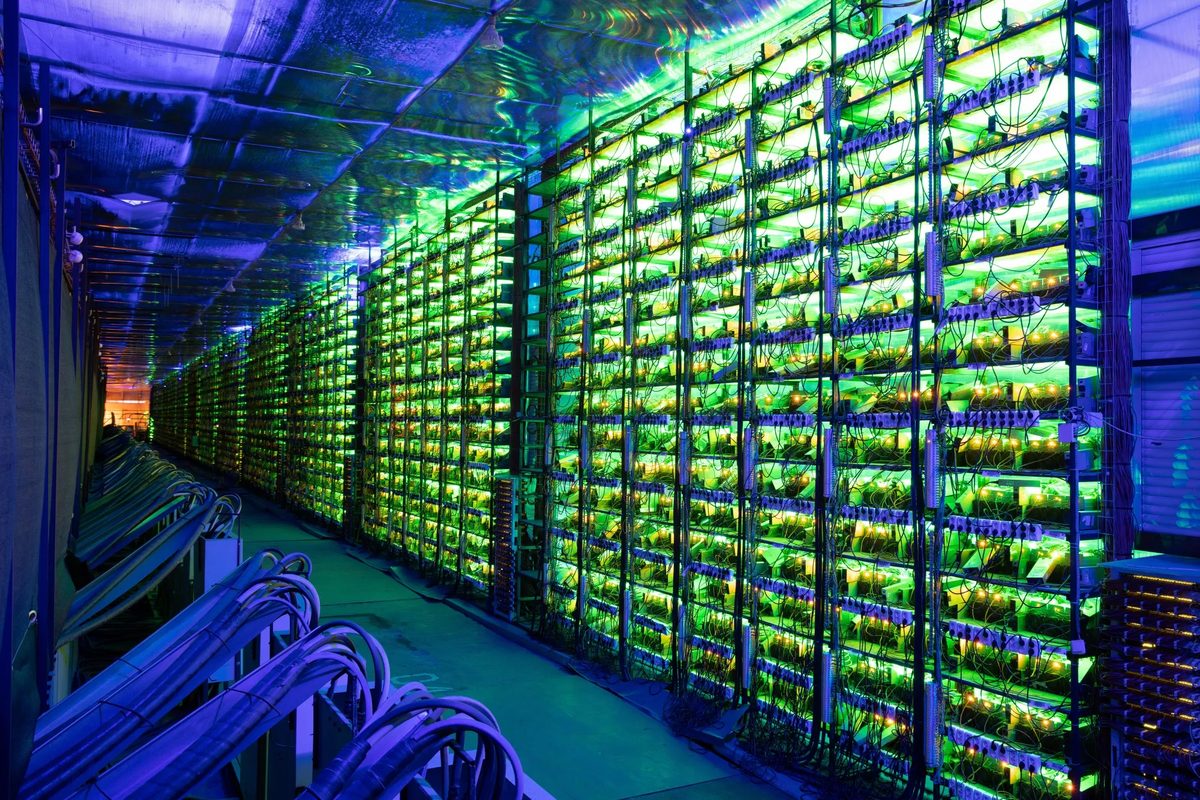
Bitcoin Miner TeraWulf Buys 15,000 Computers for Upstate N.Y. Facility - Bloomberg

a bitcoin sitting on top of a computer chip

742 views
8:52
Crypto Corner: Explaining Bitcoin Mining Pivot to AI ...
Schwab Network

693 views
46:06
Why Bitcoin Miners Have a Head Start in the Race for AI ...
Bitcoin Magazine

6.0K views
5:42
Bitcoin miners pivot to power AI future
Yahoo Finance
Images from Openverse under Creative Commons licenses. Videos from YouTube.
Voices
Curated perspectives — historical figures and your fellow readers.
Play
Exploring all sides of a story is often best achieved with Play.
Most of these play right now — no account needed. Sign up to save scores, keep a streak, and unlock Debate and Predict.
Log in
Sign Up
Higher or Lower
A number from this story, against one from elsewhere in the news — guess which is bigger, then keep the chain going. 5 rounds, 3 strikes; a miss costs a strike and resets your streak.
Example
Anchor
EU tariff revenue
$52B
Big for this kind of number
Mystery
Pentagon AI contract
?
Round 1
Streak: 0
Mystery
?
Keyboard: ↓/L lower · ↑/H higher
0 pts
Best streak: 0 · Rounds: 0
0 points — sign up to put that on the leaderboard.
Now try on this story
Timeline
Bitcoin miners consolidate and pivot to AI compute
Order five events from this story, oldest at top. Each in the right slot scores 1 — neighbours within one slot count too. Your previous result — green ✓ for exact slots, yellow ~ for off by one. Cards now in true chronological order.
Loading puzzle…
Tap 💡 Free hint to lock the oldest into slot 1 — that leaves just four to order. Type pills are clues.
0/5
Exact slot
0/5
Within 1
Sign up to save your score and track a streak across stories.
Now try on this story
Connections
Sixteen names from the news. Find the four hidden groups of four. Four mistakes max.
Loading today's puzzle…
0/4 groups
Mistakes
Sign up to keep a daily streak — a new puzzle lands every day.
Now try on this story
Exit debate?
Your progress in this debate will be lost.
How it works
- 1 Two AI personas square off on this story.
- 2 You predict who'll win each round — correct picks earn XP.
- 3 One crossfire question is yours to fire. Pick it carefully.
Couldn't generate a topic
Select Your Champions
Choose one persona for each side of the debate
DEBATE TOPIC
Choose personas with different perspectives for a more dynamic debate.
SIDE A (PRO)
Select debater for this side:
No debate personas available right now.
SIDE B (CON)
Select debater for this side:
No debate personas available right now.
VS
Get ready to make your prediction...
Round of
Claim
Evidence
Stakes
Crossfire Answer
Closing Statement
Claim
Evidence
Stakes
Crossfire Answer
Closing Statement
Your Crossfire Question
Generating arguments...
Who's Got This Round?
Make your prediction before the referee scores
The referee scores both sides on
Correct predictions earn +20 XP
· Press 1 or 2 to pick
Evidence
40%
Logic
30%
Detail
20%
Style
10%
Round Results
Your Pick
Not this time
(%)
Overall Score
/10
Your Pick
Not this time
(%)
Overall Score
/10
Set the Crossfire
Pick the question both personas must answer in the final round
Crafting crossfire questions...
Choosing a question earns +10 XP crossfire bonus
🏆
Total XP Earned
Cred Change
Predictions
Debate Oracle! You called every round!
Sharp Instincts! You know your debaters!
The Coin Flip Strategist! Perfectly balanced!
The Contrarian! Bold predictions!
Inverse Genius! Try betting the opposite next time!
XP Breakdown
Base completion
+20 XP
Rounds played ( rounds x 5 XP)
+ XP
Correct predictions ( correct x 20 XP)
+ XP
Crossfire bonus
+10 XP
Accuracy
%
Prediction History
Round
You picked:
✓
✗
Now try on this story
Keep debating to level up your credibility and unlock achievements
People Involved
Joel Block
CEO of combined Sphere 3D
Took over as chief executive on June 1, 2026
Kurt Kalbfleisch
CFO of combined Sphere 3D
Stayed on as CFO and joined the board
Marcus Dent
Board member, combined Sphere 3D
Joined the board on close
Nicholas Gates
Board member, combined Sphere 3D
Joined the board on close
Organizations Involved
Sphere 3D Corp.
Public data infrastructure company
Acquirer in the combination, trades on Nasdaq as ANY
A Nasdaq-listed bitcoin miner repositioning as a power and data infrastructure platform.
Cathedra Bitcoin Inc.
Bitcoin mining and hosting company
Now a wholly owned subsidiary of Sphere 3D
A Canadian bitcoin miner that ran four hosting sites totaling 45 megawatts in Tennessee and Kentucky.
Timeline
April 2024 June 2026
9 events
Latest: June 1st, 2026 · 3 months ago
Tap a bar to jump to that date
-
Sphere 3D closes Cathedra merger
Latest M&ADeal closes, creating a debt-free 53 MW platform with a 100+ MW pipeline. Joel Block takes over as CEO.
-
Court approves arrangement
LegalCathedra receives final court approval for the plan of arrangement, with closing set for June 1.
-
Sphere 3D shareholders approve the deal
Corporate governanceSphere holders sign off on the Cathedra combination, clearing the largest remaining hurdle before close.
-
Sphere 3D and Cathedra announce merger
M&AThe two small miners announce a plan of arrangement to combine, targeting AI and HPC services as a growth lane.
-
S&P Global maps the miner-to-AI shift
AnalysisS&P documents the industry-wide pivot, with mining revenue projected to fall below 20% of sector total by year-end.
-
CleanSpark wins Wyoming AI data center bid
AI pivotA bitcoin miner beats Microsoft for a Wyoming AI site, showing power access can outweigh hyperscaler scale.
-
Hut 8 signs $7B Google-backed AI lease
AI pivotHut 8 commits its River Bend campus to a fifteen-year AI infrastructure deal, signaling miners can monetize sites for compute.
-
Core Scientific signs $3.5B Coreweave AI deal
AI pivotA bankrupt bitcoin miner becomes one of the first to sign a multi-billion-dollar AI hosting contract, setting the playbook.
-
Bitcoin halving cuts miner revenue in half
Industry shiftBlock rewards drop from 6.25 to 3.125 BTC, squeezing margins and forcing miners to look beyond block rewards for income.
Historical Context
3 moments from history that rhyme with this story — and how they unfolded.
2001-2005
Dot-com fiber overbuild and the Equinix rollup (2001-2005)
Telecoms and colocation startups overbuilt fiber and data center capacity during the dot-com boom, then collapsed when traffic forecasts missed. Equinix and a handful of survivors bought distressed sites at cents on the dollar and rented them back to enterprise customers a few years later as cloud demand arrived.
Then
Dozens of operators went bankrupt and consolidation took out most of the field by 2004.
Now
The survivors became the backbone of the modern cloud era. Equinix is now worth more than $80 billion.
Why this matters now
Bitcoin miners are doing the inverse: they built power and shells during one demand cycle and are now selling that infrastructure to the next one. The lesson is that owning the physical site outlasts owning the original customer.
2012-2019
Aluminum smelter conversions (2010s)
Several old aluminum smelters in the Pacific Northwest and Iceland were shut by their owners as power prices and aluminum margins shifted. Bitcoin miners and later data center developers bought the sites for their substations and grid interconnects.
Then
Hundreds of megawatts of stranded interconnect capacity were absorbed within a few years.
Now
Interconnect-ready industrial sites became one of the most valuable real estate categories in North American power markets.
Why this matters now
The story keeps repeating: when grid interconnection takes five-plus years to permit, whoever already has the substation wins. Sphere and Cathedra are betting that their existing 53 MW and 100+ MW pipeline are worth more to an AI tenant than to bitcoin alone.
2018-2020
Post-halving miner shakeout (2018-2020)
After the 2016 halving and the 2018 crypto bust, dozens of small bitcoin miners shut down or merged. Marathon, Riot, and Core Scientific used the downturn to buy distressed machines and contracts, setting up the public-miner cohort that dominated the next cycle.
Then
Network hash rate dropped sharply in late 2018 as inefficient miners unplugged.
Now
The handful of survivors grew into multi-billion-dollar companies by the 2021 peak.
Why this matters now
Halvings reliably trigger consolidation. The Sphere-Cathedra deal fits that pattern, but with a new twist: this time the survivors are pivoting hardware to a different customer rather than waiting for bitcoin to rebound.
Sources
(9)Related Stories
AI cloud providers turn to debt markets to fund the compute buildout
Money Moves
Updated 6 days ago
The race to build non-Nvidia AI inference chips
Money Moves
Updated 6 days ago
Nvidia backstops OpenAI's bills as AI data-center buildout deepens
Money Moves
Updated 7 days ago
AMD ships MI400 GPUs and Helios rack to challenge Nvidia
New Capabilities
Updated Aug 5
Microreactor startups draw record capital as AI power demand climbs
Money Moves
Updated Jul 10
Big tech's half-trillion-dollar AI bet
Money Moves
Updated May 26