


Pull to refresh
Logo
Daily Brief
Following
Why Ranks Sign Up
The AI capital expenditure cycle

The AI capital expenditure cycle

Money Moves

Nvidia's quarterly earnings have become Wall Street's primary read on global AI infrastructure spending

4 days ago: Q1 fiscal-2027 earnings release

Overview

Nvidia reports first-quarter fiscal-2027 earnings after the U.S. market close. Wall Street expects about $78 billion in revenue, with $73 billion of that coming from data centers — roughly one quarterly print equal to the entire annual revenue of Intel.

The number matters because four companies — Microsoft, Google, Meta, and Amazon — are on pace to spend more than $400 billion on AI infrastructure in 2026, and most of that capital flows through Nvidia's GPUs. If the print holds, the build-out continues. If guidance softens, the largest capital cycle in tech history starts to look like a peak.

Why it matters

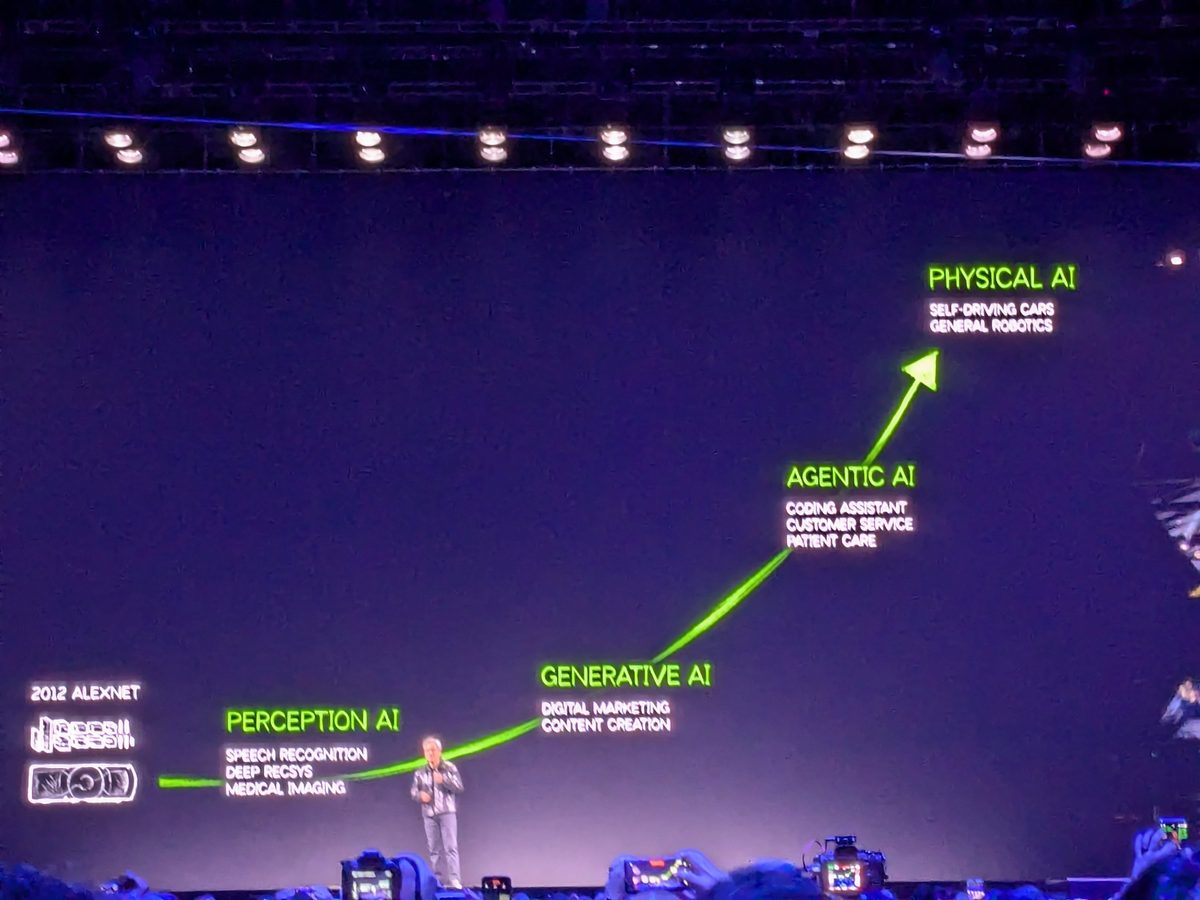
Hyperscaler AI spending is the largest single capital cycle in tech history. Nvidia's quarterly numbers tell you whether it's still accelerating or starting to plateau.

Key Indicators

$78B
Q1 FY27 revenue consensus
Analyst consensus for the quarter being reported tonight, up from $44 billion a year earlier.
78%
Expected year-over-year growth
Consensus implies revenue nearly doubled from Q1 fiscal-2026.
$73B
Data center segment consensus
Roughly 93% of expected total revenue. The single segment that drives the stock.
$400B+
2026 hyperscaler capex plan
Combined Microsoft, Google, Meta, and Amazon capital spending guidance for calendar 2026.
$1.77
Non-GAAP EPS consensus
Per-share earnings expectation for the quarter.

Voices

Curated perspectives — historical figures and your fellow readers.

Ever wondered what historical figures would say about today's headlines?

Sign up to generate historical perspectives on this story.

Play

Exploring all sides of a story is often best achieved with Play.

Log in to play. Track your picks, climb the leaderboards. Log in Sign Up
Predict 4 ways this could play out. Contrarian picks score more — points lock when the scenario resolves. Log in to play
Higher or Lower Two numbers from this story. Guess which is bigger. 5 rounds to set a streak. Log in to play
Timeline Five events from this story — drag them oldest to newest. Log in to play
Connections Sixteen names from the news. Find the four hidden groups of four. Log in to play

People Involved

Organizations Involved

Timeline

November 2022 May 2026

8 events Latest: 4 days ago
Tap a bar to jump to that date
  1. Q1 fiscal-2027 earnings release

    Latest Earnings

    Nvidia reports Q1 fiscal-2027 results after market close, with a conference call at 5 p.m. Eastern. Consensus calls for $78 billion revenue and $73 billion in data center revenue.

  2. H20 China export license required

    Regulatory

    U.S. government imposes licensing on H20 sales to China. Nvidia takes multi-billion dollar inventory writedown.

  3. Blackwell Ultra and Rubin announced

    Product

    Nvidia previews Blackwell Ultra for late 2025 and the Rubin platform for 2026.

  4. Blackwell delay reports surface

    Supply

    Mask defects at TSMC push initial Blackwell shipments from Q3 to Q4 calendar 2024.

  5. Blackwell unveiled at GTC

    Product

    Jensen Huang announces the Blackwell architecture, successor to Hopper, with roughly 4x training performance.

  6. U.S. tightens China export controls

    Regulatory

    The Commerce Department restricts sales of H800 and A800 chips designed to comply with earlier rules. Nvidia designs the H20 for the China market in response.

  7. Nvidia guides Q2 revenue to $11 billion

    Earnings

    The guide is roughly 50% above consensus and starts the AI infrastructure rally in earnest. Nvidia's market cap doubles within months.

  8. ChatGPT launches

    Market trigger

    OpenAI releases ChatGPT publicly. Demand for AI training compute begins climbing immediately.

Historical Context

2 moments from history that rhyme with this story — and how they unfolded.

March 2000

Cisco at the dot-com peak (March 2000)

Cisco Systems briefly became the most valuable company in the world at $555 billion market cap. It supplied the routers and switches building out the commercial internet. Within two years its stock fell roughly 86% as telecom and dot-com customers cut capex.

Then

Carriers and startups stopped ordering. Cisco took its first major inventory writedown and laid off thousands.

Now

Cisco survived and remained profitable, but never regained its 2000 valuation in real terms. The infrastructure cycle ended faster than supplier guidance suggested.

Why this matters now

Cisco's customers were funding a real, lasting build-out — the internet — but pulled spending forward and overshot demand. Nvidia investors watch this parallel because the buyer concentration and capex acceleration look similar.

1999-2002

Lucent Technologies and the telecom bust

Lucent reached a $258 billion market cap in late 1999 supplying optical gear to telecom operators racing to build fiber networks. The company financed customer purchases to keep growth going. When carriers like WorldCom and Global Crossing collapsed, Lucent's revenue fell over 60% in two years.

Then

Lucent took massive writedowns on vendor financing, laid off more than half its workforce.

Now

Lucent was acquired by France's Alcatel in 2006 at a fraction of its peak value. The fiber it helped lay sat dark for years before demand caught up.

Why this matters now

Lucent shows the risk when a hardware supplier's customers are concentrated and their spending depends on access to cheap capital. AI hyperscalers fund capex from cash flow, but the structural concentration is similar.

Sources

(3)