Anchor

Child suicide-related ER visits rose 74% from 2016 to 2022
New CapabilitiesStudy of 5 million pediatric mental health visits finds half occurred at hospitals treating fewest children
3 days ago: Findings go publicNew here? Follow stories to track developments over time. Create a free account to get updates when stories you care about change.
Overview
Updated 2 hours agoSuicide-related emergency department visits among US children rose 74% between 2016 and 2022, according to a study of more than 5 million pediatric mental health visits published in Annals of Emergency Medicine. The crisis landed hardest at hospitals that see few children each year.
Half of suicide-related visits occurred at facilities treating fewer than 10,000 children annually. At those low-volume sites, nearly 30% of children with mental health conditions were transferred to other hospitals, sometimes spending days in the emergency department waiting for a bed.
Why it matters
Half of children in mental health crisis land in emergency departments that lack pediatric psychiatric resources, and the burden keeps growing.
Questions about this story
Free account needed to ask — your question is kept and asked for you right after sign-up. Answers are public.
No questions yet — be the first to ask.
Key Indicators
74%
Increase in suicide-related ED visits, 2016 to 2022
Cumulative rise across the six-year study window, the study's headline finding.
5 million+
Pediatric mental health ED visits analyzed
Visits by children ages 5-17 at US emergency departments, 2016-2022.
24%
Increase in all pediatric mental health ED visits
Growth across all mental health diagnoses, versus 74% for suicide-related visits alone.
~30%
Transfer rate at lowest-volume EDs
Share of children at EDs under 10,000 annual visits who were moved to other hospitals for definitive care.
Related Media
An inside look at Rady Children’s Mental Health Emergency Department

A candid moment during a family therapy session with parents and a child engaging in discussion.

Children Emergency Room: Infant & Pediatric Emergency Care
2.1K views
1:42
US Sees Surge in Child Mental Health Crisis | WION Pulse
WION
375 views
3:06
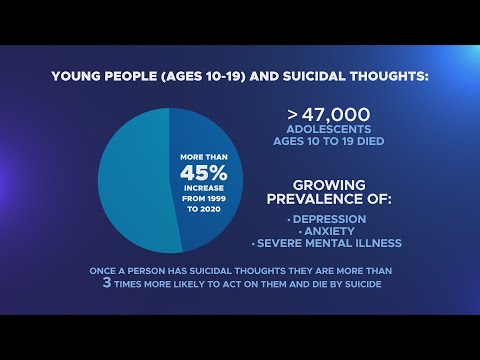
Doctors warn as data shows suicide threat among kids is swelling
WGN News

3.3K views
2:02
Study: More Children Need Urgent Mental Health Care, But ...
NationwideChildrens
Images from Openverse under Creative Commons licenses. Videos from YouTube.
Voices
Curated perspectives — historical figures and your fellow readers.
Play
Exploring all sides of a story is often best achieved with Play.
Most of these play right now — no account needed. Sign up to save scores, keep a streak, and unlock Debate and Predict.
Log in
Sign Up
Higher or Lower
A number from this story, against one from elsewhere in the news — guess which is bigger, then keep the chain going. 5 rounds, 3 strikes; a miss costs a strike and resets your streak.
Example
Anchor
EU tariff revenue
$52B
Big for this kind of number
Mystery
Pentagon AI contract
?
Round 1
Streak: 0
Mystery
?
Keyboard: ↓/L lower · ↑/H higher
0 pts
Best streak: 0 · Rounds: 0
0 points — sign up to put that on the leaderboard.
Now try on this story
Connections
Sixteen names from the news. Find the four hidden groups of four. Four mistakes max.
Loading today's puzzle…
0/4 groups
Mistakes
Sign up to keep a daily streak — a new puzzle lands every day.
Now try on this story
Exit debate?
Your progress in this debate will be lost.
How it works
- 1 Two AI personas square off on this story.
- 2 You predict who'll win each round — correct picks earn XP.
- 3 One crossfire question is yours to fire. Pick it carefully.
Couldn't generate a topic
Select Your Champions
Choose one persona for each side of the debate
DEBATE TOPIC
Choose personas with different perspectives for a more dynamic debate.
SIDE A (PRO)
Select debater for this side:
No debate personas available right now.
SIDE B (CON)
Select debater for this side:
No debate personas available right now.
VS
Get ready to make your prediction...
Round of
Claim
Evidence
Stakes
Crossfire Answer
Closing Statement
Claim
Evidence
Stakes
Crossfire Answer
Closing Statement
Your Crossfire Question
Generating arguments...
Who's Got This Round?
Make your prediction before the referee scores
The referee scores both sides on
Correct predictions earn +20 XP
· Press 1 or 2 to pick
Evidence
40%
Logic
30%
Detail
20%
Style
10%
Round Results
Your Pick
Not this time
(%)
Overall Score
/10
Your Pick
Not this time
(%)
Overall Score
/10
Set the Crossfire
Pick the question both personas must answer in the final round
Crafting crossfire questions...
Choosing a question earns +10 XP crossfire bonus
🏆
Total XP Earned
Cred Change
Predictions
Debate Oracle! You called every round!
Sharp Instincts! You know your debaters!
The Coin Flip Strategist! Perfectly balanced!
The Contrarian! Bold predictions!
Inverse Genius! Try betting the opposite next time!
XP Breakdown
Base completion
+20 XP
Rounds played ( rounds x 5 XP)
+ XP
Correct predictions ( correct x 20 XP)
+ XP
Crossfire bonus
+10 XP
Accuracy
%
Prediction History
Round
You picked:
✓
✗
Now try on this story
Keep debating to level up your credibility and unlock achievements
People Involved
AB
Audrey Brewer
Corresponding author of the study; assistant professor, Northwestern Feinberg School of Medicine
Pediatrician and researcher at Ann & Robert H. Lurie Children's Hospital of Chicago
JH
Jennifer Hoffmann
Senior author of the study; assistant professor of pediatric emergency medicine and medical social sciences
Pediatric emergency medicine physician and researcher at Lurie Children's Hospital
Organizations Involved
Northwestern University Feinberg School of Medicine
Medical school
Research institution behind the study
Northwestern University's medical school, based in Chicago.
Ann & Robert H. Lurie Children's Hospital of Chicago
Pediatric hospital
Research partner on the study
One of the largest pediatric hospitals in the US, based in Chicago.
Timeline
January 2016 September 2026
6 events
Latest: 3 days ago
Tap a bar to jump to that date
-
Findings go public
Latest AnnouncementNorthwestern announces the results; coverage and online discussion spread, including on r/science.
-
Study published
PublicationAnnals of Emergency Medicine publishes the 5-million-visit analysis by Northwestern and Lurie Children's researchers.
-
Study period closes
DataSuicide-related pediatric ED visits end 74% above the 2016 baseline.
-
Suicidality visits hit record high
DataParallel analysis finds suicidality ED visits at 1,160 per 100,000 youth, up from 760 in 2016.
-
Pandemic disrupts seasonal patterns
ContextSpring 2020 school closures suppress April and May suicide-related visit rates before they rebound.
-
Study period opens
DataResearchers begin tracking pediatric mental health ED visits across US hospitals; baseline established.
Historical Context
3 moments from history that rhyme with this story — and how they unfolded.
October 2004
Garrett Lee Smith Memorial Act (2004)
Congress named the law after Garrett Lee Smith, a 24-year-old who died by suicide in 2003. It was the first federal program specifically funding youth suicide prevention.
Then
It created the National Suicide Prevention Lifeline and funded campus, tribal, and state-level prevention programs.
Now
It established a template for translating youth suicide surveillance into federal action, later expanded under the 2020 National Suicide Hotline Designation Act.
Why this matters now
The current study's findings may drive a similar federal response, this time aimed at emergency department capacity rather than school programs.
2013-present
National Pediatric Readiness Project (2013)
Launched by the Emergency Medical Services for Children program, the project assesses how prepared US emergency departments are to treat children and publishes readiness scores.
Then
Found fewer than half of general emergency departments were considered ready for pediatric emergencies at launch; scores improved in the years that followed.
Now
Demonstrated that emergency departments can measurably improve pediatric capacity through checklists, training, and equipment standards, without building new children's hospitals.
Why this matters now
Researchers point to it and similar toolkits as the model for raising mental health care standards in low-volume emergency departments.
October 2021
National emergency declaration for child mental health (October 2021)
The American Academy of Pediatrics, American Academy of Child and Adolescent Psychiatry, and Children's Hospital Association jointly declared a national state of emergency in children's mental health, citing rising suicide attempts and strained emergency departments.
Then
The declaration preceded federal moves including 988 crisis line implementation and new school mental health grants.
Now
It marked the first time leading pediatric bodies formally called the crisis an emergency, shaping federal framing of child mental health policy.
Why this matters now
The declaration anticipated the rising ED visit trends this 2026 study now quantifies with detailed hospital-level data.
Sources
(6)Related Stories
988 crisis hotline linked to fewer youth suicide deaths
Rule Changes
Updated May 31
College mental health reverses course
New Capabilities
Updated May 26
Federal pressure shutters pediatric gender clinics nationwide
Rule Changes
Updated May 22
The 44% drop in maternal deaths
New Capabilities
Updated May 22
The century that stopped burying babies
New Capabilities
Updated May 22
The 34-year retreat of cancer death rates
New Capabilities
Updated May 22