

Pull to refresh
Logo
Anthropic's Claude computes nine-loop quantum physics amplitude

Anthropic's Claude computes nine-loop quantum physics amplitude

New Capabilities

An LLM ran a week of symbolic math with little supervision for a few thousand dollars, while a Beijing group published an independent match days earlier.

3 days ago: Anthropic publishes 'Yes, Claude can do Nine Loops'

Overview

Updated 1 hour ago

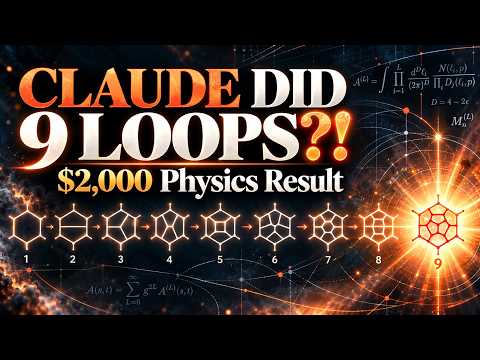
A small physics calculation just became a marker for AI capability. The six-particle scattering amplitude in planar N=4 super-Yang-Mills, a favorite testing ground for theorists, had sat at eight loops since 2023—until Anthropic's Claude pushed it to nine in late August 2026, running unsupervised for days at a cost of a few thousand dollars.

Claude executed the existing bootstrap method in Python, no new physics, and matched an independent route on all 107,053 nonzero coefficients. A Beijing group led by Song He reached nine loops independently the same week and published first. The milestone is reliability, not new insight: an LLM carried a fragile, error-prone multi-day computation to the end without a scientist watching each step.

Why it matters

An LLM that runs a multi-day physics calculation with only 'keep going' as supervision makes AI-assisted original research a working tool, not a demo.

Questions about this story

Free account needed to ask — your question is kept and asked for you right after sign-up. Answers are public.

No questions yet — be the first to ask.

Key Indicators

9
Loop order reached
Six-particle amplitude in planar N=4 super-Yang-Mills; the prior record was eight loops, set in 2023.
107,053
Coefficients matched between two methods
The direct bootstrap and form-factor routes agreed on every nonzero word coefficient defining the result.
$1,000–$2,000
Total cost of the run
Includes model inference; the numerical bootstrap portion alone cost roughly $100, using 96 CPUs for a week.

Voices

Curated perspectives — historical figures and your fellow readers.

Ever wondered what historical figures would say about today's headlines?

Sign up to generate historical perspectives on this story.

People Involved

Organizations Involved

Timeline

January 2023 September 2026

5 events Latest: 3 days ago
Tap a bar to jump to that date
  1. Anthropic publishes 'Yes, Claude can do Nine Loops'

    Latest Publication

    Von Hippel's account goes live with Dixon's independent verification of the nine-loop result.

  2. Beijing group publishes nine loops first

    Publication

    Song He, Jirong Jing and Xiang Li post the nine-loop symbols on Zenodo, days before Anthropic's writeup.

  3. Claude finishes the nine-loop calculation

    Research

    Anthropic physicists tell von Hippel that Claude computed the nine-loop amplitude; Lance Dixon begins verifying it.

  4. Physicist issues AI challenge

    Challenge

    Matt von Hippel, writing as '4gravitons,' challenges AI to push past eight loops on an academic-grade compute budget.

  5. Dixon and Liu set the eight-loop record

    Research

    In 2023 (exact date not sourced), Lance Dixon and Andy Liu published the eight-loop six-particle amplitude in planar N=4 super-Yang-Mills, the prior record.

Scenarios

1

AI-led group publishes a ten-loop amplitude

Possible Resolves by Jan 1, 2028

Discussed by: Matt von Hippel on Anthropic's blog; Lance Dixon's team

The nine-loop result used known methods with more compute. Von Hippel names the open question: whether an LLM will invent a new physical principle before humans do. Groups with LLM harnesses are natural first movers on ten loops, since the cost and overhead of an AI-led run are now small. A ten-loop result would most likely come from such a harness within a year or two.

2

Human-led group reaches ten loops first

Possible Resolves by Jan 1, 2028

Discussed by: Song He's group at the Chinese Academy of Sciences, which published the nine-loop symbol first

Song He's team proved humans can move fast too, posting nine-loop symbols before Anthropic and using GPT-6 only for some constraints. Human-led groups with established amplitude pipelines may reach ten loops first, with AI as a helper rather than the driver. This would echo the nine-loop race, where the machine and the humans converged on the same result within days of each other.

3

Ten-loop calculation stalls

Unlikely Resolves by Jan 1, 2028

Discussed by: Implied by von Hippel's caution that each loop multiplies computation and the recipe is fragile

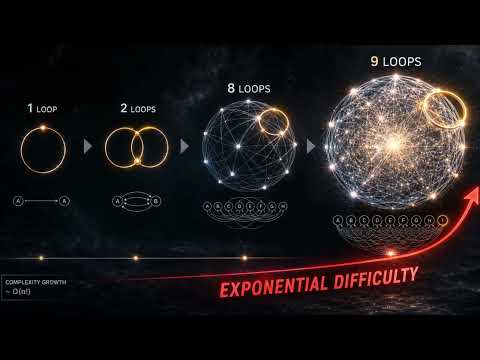
Every added loop multiplies the computational load, and the recipe is famously finicky. Von Hippel notes that any error collapses the whole construction. If ten loops demands compute beyond what academic groups can spend, or the bootstrap method hits a wall, the record could sit at nine loops until a genuinely new method appears.

Historical Context

2 moments from history that rhyme with this story — and how they unfolded.

May 1997

Deep Blue beats Kasparov (1997)

IBM's Deep Blue computer beat world chess champion Garry Kasparov 3.5-2.5 in a six-game match. Kasparov demanded a rematch and accused IBM of cheating; IBM declined and retired the machine.

Then

The match made machine computation a front-page story. Critics argued brute-force search, not intelligence, had won.

Now

Chess did not end. Human-plus-engine play became the norm, and the match set the template for every later 'AI beats expert' story. Kasparov went on to promote a form of chess where humans and engines compete together.

Why this matters now

Like Claude at nine loops, Deep Blue won with known methods and far more computation, not a new idea. The lasting change was collaboration, not replacement a plausible shape for AI in theoretical physics.

November-December 2020

AlphaFold cracks protein folding (2020)

DeepMind's AlphaFold won CASP14, the biennial protein-structure prediction contest, reaching near-experimental accuracy on a problem that had resisted fifty years of effort. Two of its predictions were judged better than anything from experimental groups.

Then

Structural biologists embraced the tool. AlphaFold2 was open-sourced in 2021 and is now used by researchers worldwide.

Now

Domain experts shifted from solving structures to checking and using them, an early large-scale example of an AI tool changing how a field works.

Why this matters now

AlphaFold came with a genuinely new method and beat all human teams. Claude needed no new method and merely matched humans within days, so the nine-loop result is a smaller claim, but it shows an LLM can perform long, fragile computations without supervision, which AlphaFold did not.

Sources

(8)