

Pull to refresh
Logo
MIT and UBC unveil WorldParticle, one AI model for many physical materials

MIT and UBC unveil WorldParticle, one AI model for many physical materials

New Capabilities

A single transformer simulates sand, fluids, cloth, and proteins, and the team says it beats numerical solvers on accuracy and speed.

Overview

Updated 57 minutes ago

For decades, simulating a physical process has meant building a dedicated program: one solver for water, another for cloth, another for how a protein folds. On Nov. 9, researchers at MIT and the University of British Columbia showed a single neural network that handles all of them.

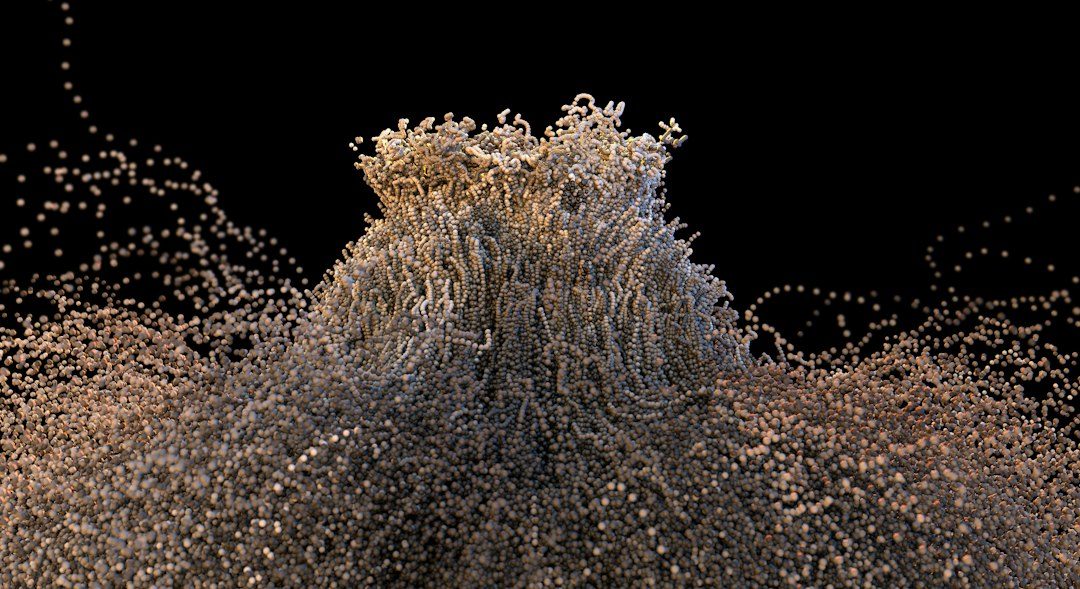
WorldParticle breaks matter into millions of tiny particles and predicts how they move one step at a time, an approach its authors compare to a language model predicting the next word. If it holds up, engineers could simulate interactions that today require separate programs, like oil sloshing against a flexible valve or a soft robot pressing into sand.

Why it matters

A single model for fluids, solids, and proteins could cut the cost and time of engineering design and molecular research.

Questions about this story

Free account needed to ask — your question is kept and asked for you right after sign-up. Answers are public.

No questions yet — be the first to ask.

Key Indicators

6
Physical phenomena modeled
The paper reports six dynamics categories, including cloth, elastic solids, fluids, granular materials, and molecular dynamics.
100×
Faster protein modeling
The team reports protein structure changes modeled about 100 times faster than numerical simulators.
1
Transformer architecture
A single model replaces separate hand-coded solvers for each phenomenon.
Millions
Particles per object
Objects are broken into up to millions of three-dimensional points.

Voices

Curated perspectives — historical figures and your fellow readers.

Sign up to generate historical perspectives on this story.

People Involved

Organizations Involved

Timeline

May 2026 November 2026

2 events Latest: Today
  1. MIT and UBC announce WorldParticle

    Today Announcement

    MIT News reports a single transformer model that simulates sand, fluids, cloth, and proteins.

  2. WorldParticle preprint posted to arXiv

    Research

    The paper describing the unified particle simulator appears as an open-access preprint.

Scenarios

1

WorldParticle anchors a new class of general physics simulators

Possible Resolves by Nov 9, 2028

Discussed by: The MIT and UBC research team, in MIT News and the paper

The team's stated goal is a general simulator that works out of the box. If other labs adopt the architecture and extend it across materials, it could become a shared base model for physics simulation, the way language models became a base for text tasks.

2

A commercial simulation vendor ships a WorldParticle-based product

Possible Resolves by Nov 9, 2029

Discussed by: Industry observers; no vendor has announced a product

Engineering software firms could integrate the architecture into released products. The trigger would be a proven speed or accuracy advantage on industrial workloads. None has been demonstrated publicly on commercial tasks.

3

Independent benchmarks expose limits, and numerical solvers stay standard

Possible Resolves by Nov 9, 2027

Discussed by: Simulation researchers who have not yet tested the model

The claims rest on the authors' benchmarks. If independent labs find the model breaks on new materials or forces, adoption could stall, and hand-coded solvers would remain the standard for safety-critical engineering.

Historical Context

3 moments from history that rhyme with this story — and how they unfolded.

2020

AlphaFold2 (2020)

At the 2020 CASP14 assessment, DeepMind's AlphaFold2 predicted protein structures with accuracy rivaling experimental methods. It showed a neural network could learn biological structure from data rather than simulate it from first principles.

Then

AlphaFold2 was released in 2021 and quickly became a standard tool for biologists.

Now

Protein structure prediction shifted from a laborious experimental task to a computational one, and DeepMind later released predicted structures for nearly all known proteins.

Why this matters now

WorldParticle applies a similar learned-dynamics idea to protein motion over time, and its authors aim for a comparable shift in simulation.

November 2023

GraphCast (2023)

DeepMind's GraphCast, published in Science, outperformed the European Centre for Medium-Range Weather Forecasts' operational high-resolution model on most medium-range predictions. It ran on a single Google tensor processing unit in under a minute.

Then

Weather agencies began testing learned models alongside physics-based ones.

Now

The result established learned models as credible competitors to numerical simulation in a major operational field.

Why this matters now

GraphCast is a clear precedent for a learned model beating a hand-coded numerical simulator, the claim WorldParticle makes across materials.

2020

Graph Network Simulator (2020)

DeepMind researchers published the Graph Network Simulator, which learned particle dynamics for fluids and granular materials from example simulations. It could roll out predictions but struggled with long-term stability and new scenarios.

Then

It became a baseline for learned physics simulation.

Now

Later work, including WorldParticle, built on particle-based learning while trying to fix generalization and stability.

Why this matters now

WorldParticle compares against the Graph Network Simulator and similar models, claiming more stable long rolls and better generalization.

Sources

(7)