



Pull to refresh
Logo
Rubin Observatory spots a possible sixth dwarf planet beyond Pluto

Rubin Observatory spots a possible sixth dwarf planet beyond Pluto

New Capabilities

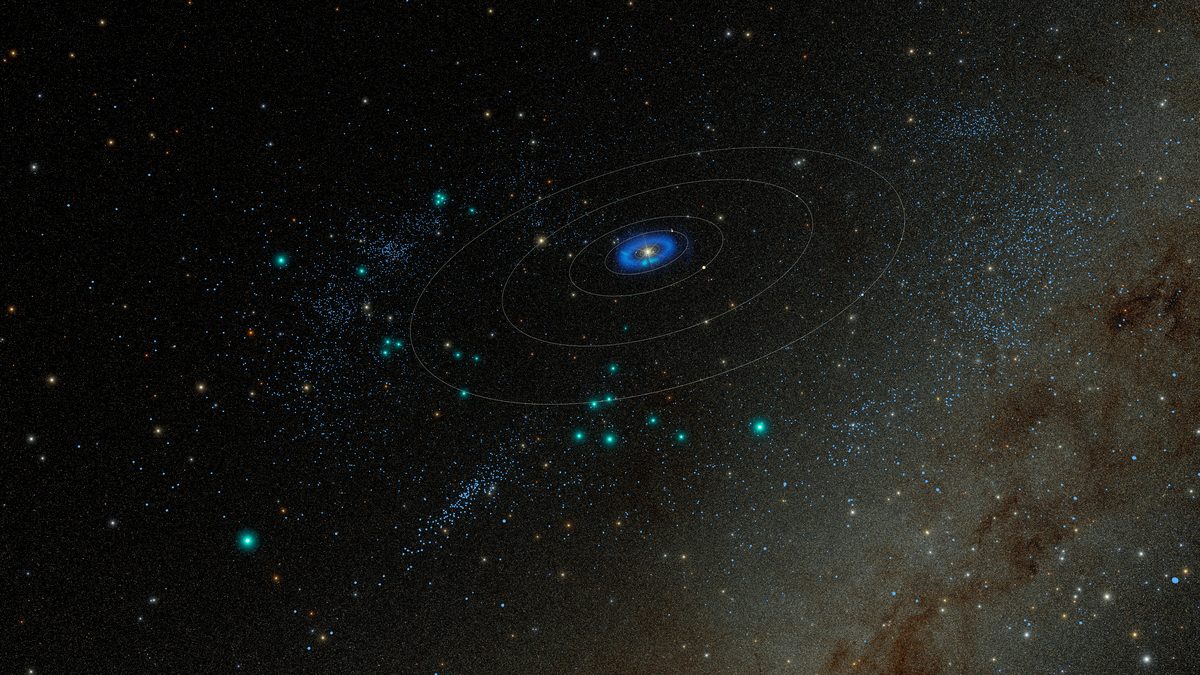
2026 ED138 sits 46 times farther from the Sun than Earth and takes about 281 years to circle it

Overview

Updated Yesterday

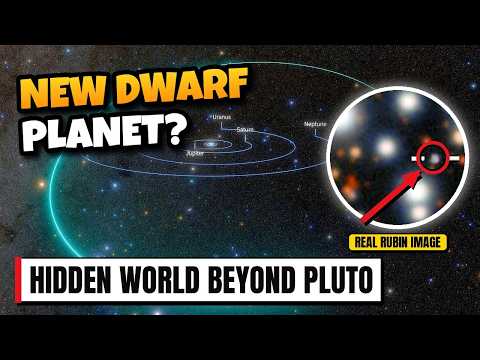
On October 13, 2026, Smithsonian Astrophysical Observatory researcher Matthew Holman ran a search program over early data from the Vera C. Rubin Observatory in Chile. One dot stood out: it was bright, and brightness at that distance usually means size. Follow-up searches found the same object in 30 Rubin images from March to July, then in Dark Energy Camera images going back to 2016, and finally on a photographic plate exposed in 1937.

The object, designated 2026 ED138, is now the leading candidate for a sixth recognized dwarf planet. Its size is estimated between 600 and 1,500 kilometers across, but brightness alone cannot settle that. A small, shiny body and a large, dull one look the same from Earth. Confirming it requires infrared measurements or catching it as it passes in front of a star.

Why it matters

If confirmed, it becomes only the sixth object known to be round enough to count as a dwarf planet.

Questions about this story

Free account needed to ask — your question is kept and asked for you right after sign-up. Answers are public.

No questions yet — be the first to ask.

Key Indicators

46 au
Distance from the Sun
One astronomical unit is the Earth-Sun distance; Pluto averages about 40.
281 years
Orbital period
The time 2026 ED138 takes to complete one trip around the Sun.
600–1,500 km
Estimated diameter
Range depends on how reflective the surface turns out to be.
5
Recognized dwarf planets
Pluto, Ceres, Eris, Haumea and Makemake are the current official list.
15
Predicted star occultations, 2027–2030
Six of these would occur over populated land, where telescopes can watch.
89 years
Archival record span
Observations stretch from a 1937 Harvard plate to 2026 Rubin images.

Voices

Curated perspectives — historical figures and your fellow readers.

Sign up to generate historical perspectives on this story.

People Involved

Organizations Involved

Timeline

1937 November 2026

6 events Latest: Yesterday
Tap a bar to jump to that date
  1. Archival study published with occultation forecasts

    Latest Research

    A paper traces 89 years of observations and predicts 15 stellar occultations.

  2. Minor Planet Center announces 2026 ED138

    Announcement

    The object is catalogued and described as a dwarf planet candidate.

  3. Search code flags an unusually bright dot

    Discovery

    Holman's program identifies the object as a candidate of unusual size.

  4. First Rubin observation

    Observation

    The survey telescope records the object without anyone noticing it yet.

  5. Dark Energy Camera images recovered

    Archival

    Precovery searches push the observation record back a decade before Rubin.

  6. A faint trace on a Harvard plate

    Archival

    A marginal detection on a 1937 photographic plate is later matched to the object.

Scenarios

1

Infrared or occultation data confirm 2026 ED138 as a dwarf planet

Likely Resolves by End of 2029

Discussed by: Rubin Observatory and the discovery team, who say infrared observations or a stellar occultation are the two routes to a size measurement

Thermal infrared observations with telescopes such as the Atacama Large Millimeter/submillimeter Array would reveal how much heat the object emits, which gives its size. Alternatively, watching it block a known star would time its silhouette. Either result above roughly 600 kilometers with a round shape would support dwarf planet status.

2

A highly reflective small body, and the dwarf planet label is dropped

Unlikely Resolves by End of 2029

Discussed by: The discovery team itself, which notes a bright icy surface can mimic a much larger object

If infrared data show a high albedo, the true diameter could fall well below the roundness threshold. The object would remain a notable trans-Neptunian body but lose its dwarf planet candidacy.

3

Occultation campaigns in 2027–2030 pin down the size from Earth

Possible Resolves by End of 2030

Discussed by: The archival study, which predicts 15 occultations of bright stars between 2027 and 2030

Six of the predicted events cross populated land, where networks of amateur and professional telescopes can time the star's disappearance. A single well-observed chord gives a direct diameter, bypassing the need for infrared time.

Historical Context

3 moments from history that rhyme with this story — and how they unfolded.

January 2005

Discovery of Eris (2005)

A team at Palomar Observatory found an object later named Eris, initially estimated as larger than Pluto. It orbits roughly three times farther from the Sun.

Then

The find forced astronomers to decide whether Pluto and Eris belonged in the same category.

Now

The International Astronomical Union redefined 'planet' in 2006, creating the dwarf planet class and demoting Pluto.

Why this matters now

2026 ED138 is being measured against the same roundness standard that Eris prompted, and its confirmation would add to the category Eris helped create.

February 1930

Clyde Tombaugh finds Pluto (1930)

Tombaugh compared photographic plates taken weeks apart at Lowell Observatory and spotted a moving point of light beyond Neptune.

Then

Pluto was announced as the ninth planet and remained so for 76 years.

Now

Pluto was reclassified as a dwarf planet in 2006 after similar objects turned up in the Kuiper Belt.

Why this matters now

The 1937 Harvard plate that recorded 2026 ED138 without anyone noticing is the same kind of evidence Tombaugh used, and it took modern software to read it.

September 2008

Haumea and Makemake added to the dwarf planet list (2008)

The International Astronomical Union formally named two Kuiper Belt objects as dwarf planets, bringing the recognized total to five with Pluto, Eris and Ceres.

Then

The list of dwarf planets stabilized at five for nearly two decades.

Now

No new object has been added since, largely because confirming size and shape is slow.

Why this matters now

2026 ED138 would be the first addition in 18 years, and the same size-confirmation bottleneck that slowed Haumea and Makemake is now the obstacle in front of it.

Sources

(5)