

Pull to refresh
Logo
A physics model of the telescope pulls a hidden planet out of Webb data

A physics model of the telescope pulls a hidden planet out of Webb data

New Capabilities

A Northwestern-led team's starlight-subtraction method beat the standard technique by 2 to 15 times and found 51 Eridani b at a wavelength where earlier processing saw nothing

Overview

Updated 1 hour ago

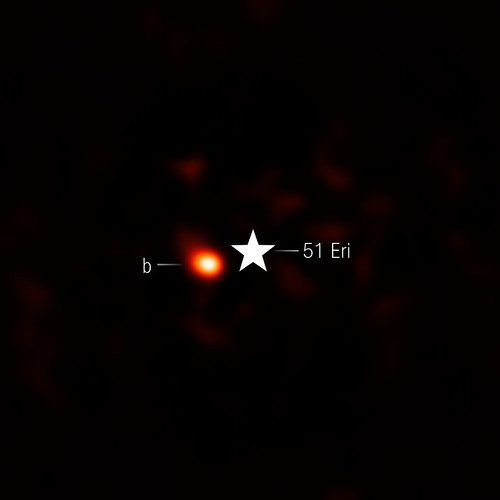
51 Eridani is a young star with a giant planet, spotted by ground-based telescopes in 2015. When the James Webb Space Telescope looked at the system, the star's glare swallowed the planet whole.

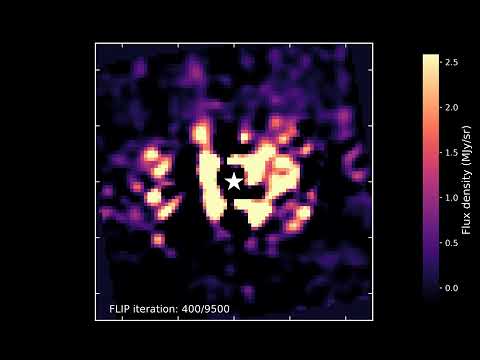
A Northwestern University-led team built a physics model of the telescope's optics instead, tuning it until its simulated glare matched the real frame. That model cleared starlight 2 to 15 times better than the standard technique. 51 Eridani b appeared at 4.3 micrometres, a wavelength where earlier processing found nothing.

Why it matters

Imaging an Earth-sized planet requires suppressing starlight about ten billion times. This is the first method to beat the standard technique on real telescope data.

Questions about this story

Free account needed to ask — your question is kept and asked for you right after sign-up. Answers are public.

No questions yet — be the first to ask.

Key Indicators

2–15×
Sensitivity gain over the standard method
The margin over KLIP, the reference-image technique used for most direct imaging since 2012.
6.3
Signal-to-noise of the 51 Eridani b detection
Measured at 4.3 micrometres, where the planet had previously gone undetected.
4.3 μm
Wavelength of the new detection
A carbon dioxide absorption band that Earth's atmosphere blocks from the ground.
10 billion
Contrast needed to image an Earth twin
The star-to-planet brightness ratio a future Habitable Worlds Observatory must reach.

Voices

Curated perspectives — historical figures and your fellow readers.

Sign up to generate historical perspectives on this story.

Organizations Involved

Timeline

2007 November 2026

4 events Latest: 3 days ago
Tap a bar to jump to that date
  1. Physics-based starlight model published

    Latest Publication

    The Nature paper reports 2 to 15 times better sensitivity and a first detection of 51 Eridani b at 4.3 micrometres.

  2. Webb images the 51 Eridani system

    Observation

    NIRCam coronagraph data collected roughly two years before the new analysis. The planet is not recovered.

  3. Ground telescopes find 51 Eridani b

    Discovery

    The Gemini Planet Imager resolves a young giant planet orbiting 51 Eridani.

  4. Reference-image subtraction becomes standard

    Method

    Locally Optimized Combination of Images, later joined by KLIP, models starlight from other frames and subtracts it.

Scenarios

1

FLIP becomes routine for Webb exoplanet surveys

Possible Resolves by End of 2027

Discussed by: The paper's authors and coverage in Science and Ars Technica

More than 100 Webb observations use other science targets as reference stars, sometimes taken months apart. Those are the datasets where the method showed its largest gains, up to about an order of magnitude. If survey teams adopt it, fainter and cooler giant planets become detectable in data already on disk, without new telescope time.

2

Follow-up measurements pin down 51 Eridani b's carbon chemistry

Possible Resolves by Q2 2028

Discussed by: The Nature paper's authors

The 4.3-micrometre detection sits in a carbon dioxide band that ground telescopes cannot see through the atmosphere. Turning that detection into photometry or a spectrum would test earlier evidence that the planet's atmosphere is enriched in heavy elements, roughly five times the star's. That in turn bears on how the planet formed.

3

Independent tests find the gains do not transfer to other instruments

Uncertain Resolves by End of 2027

Discussed by: Open question raised in the paper's own discussion of future improvements

The method needs an accurate optical model and wavefront-sensing data. Its performance on one camera does not guarantee similar results on other instruments or on ground-based telescopes, where the atmosphere changes between exposures. The authors also note the photon-noise limit was not reached in any observation.

Historical Context

3 moments from history that rhyme with this story — and how they unfolded.

November 2008

Fomalhaut b (2008)

NASA announced what looked like the first visible-light image of a planet orbiting another star, a bright point near the dust ring around Fomalhaut. Follow-up observations at other wavelengths found no corresponding planet.

Then

The candidate entered textbooks and press coverage as one of the first directly imaged exoplanets.

Now

By 2020, analysis showed the source was an expanding cloud of dust from a collision. The planet interpretation was withdrawn.

Why this matters now

It shows how a bright residual in a processed image can pass for a planet. A starlight model that matches the real optics is the check against that.

2007–2012

KLIP and LOCI become the standard (2007–2012)

Two image-processing methods, Locally Optimized Combination of Images and Karhunen–Loève Image Projection, took hold as the way to model a star's light from reference frames and subtract it. Nearly every directly imaged planet of the 2010s came out of one of them.

Then

They made faint companions visible in archival and new data at modest computing cost.

Now

Both depend on reference images taken at different times or wavelengths, so any drift between reference and science frame limits how much glare can be removed.

Why this matters now

KLIP is the baseline the new method beat by 2 to 15 times, and the drift it cannot correct is the exact problem the physics model targets.

August 2015

Gemini Planet Imager finds 51 Eridani b (2015)

An adaptive-optics instrument in Chile resolved a giant planet orbiting the young star 51 Eridani. It was among the lowest-mass planets imaged up to that point, in a system only about 20 million years old.

Then

The planet became a test case for models of how young giant planets cool and what their atmospheres contain.

Now

Its atmospheric metallicity stayed contested, partly because the relevant carbon-bearing bands are hard to measure from the ground.

Why this matters now

The planet was known for a decade but invisible at the wavelengths Webb observes, until this method pulled it out of data already collected.

Sources

(10)