

Pull to refresh
Logo
Envision moves its AI campus onto 800-volt DC power

Envision moves its AI campus onto 800-volt DC power

Built World

The company calls it the first commercial grid-to-rack DC deployment at a large AI campus, as the industry splits over voltage

Overview

Updated 1 hour ago

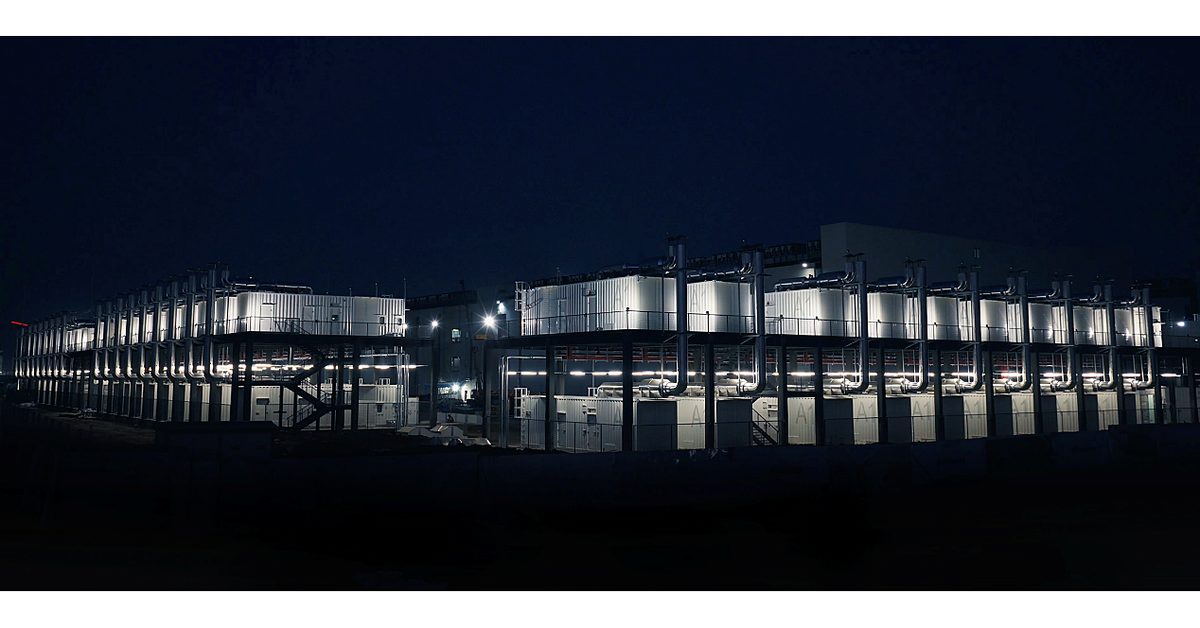
Envision says live AI workloads are now running on 800-volt direct current at its Galaxy campus in Ulanqab, Inner Mongolia. Power goes from the 10,000-volt grid straight to an 800V DC bus, skipping the line-frequency transformer and the AC uninterruptible supply that fill a conventional data centre's electrical room.

The company says its solid-state transformer stage converts at above 98.5% efficiency and cuts the floor space needed for power equipment by more than half. If that holds at scale, it changes what an AI campus buys per megawatt: less copper, fewer conversion stages, less building.

Why it matters

If 800V DC holds up, every megawatt of AI compute needs less copper, less floor space and fewer conversion losses.

Questions about this story

Free account needed to ask — your question is kept and asked for you right after sign-up. Answers are public.

No questions yet — be the first to ask.

Key Indicators

800V
DC bus voltage
Direct current delivered from the medium-voltage grid to computing hardware without an AC stage in between.
3 GW
Planned Galaxy campus capacity
Full build-out is designed for up to one million AI accelerators running in parallel.
98.5%
Solid-state transformer conversion efficiency
Envision's figure for the 10kV AC to 800V DC stage, measured above 98.5%.
80%
Planned direct renewable share
Envision's target for power coming from direct renewable connections at the campus.
1,000,000
AI accelerators at full build-out
Design capacity for the 3GW campus, according to the company.
200 kg
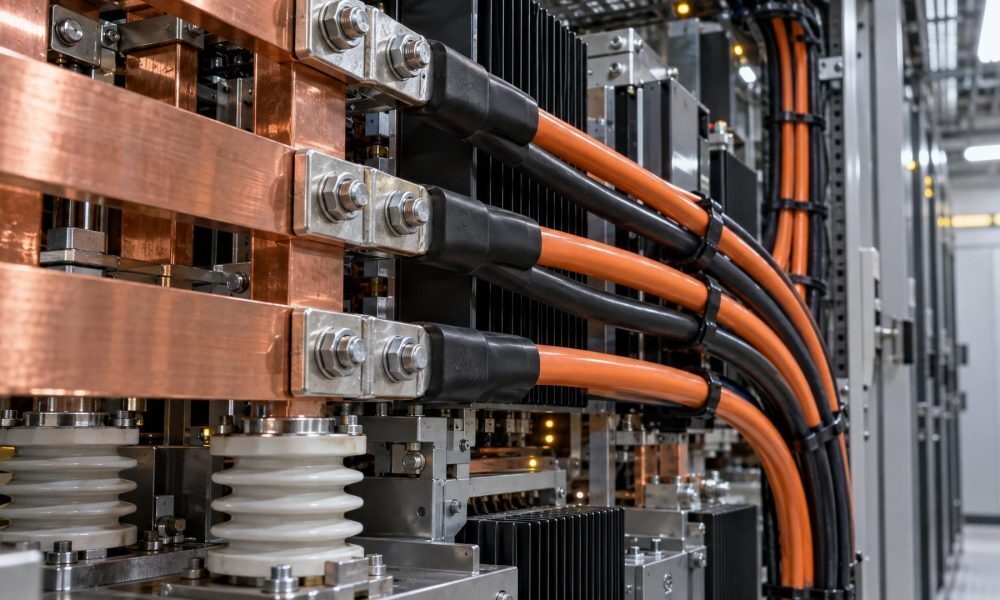
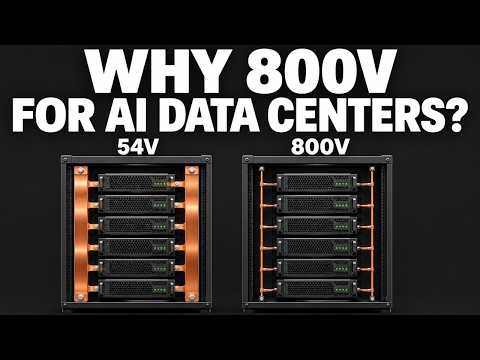
Copper in a 1MW cabinet busbar at 54V
Nvidia's figure for 54V DC distribution; the same cross-section carries about 85% more power at 800V.

Voices

Curated perspectives — historical figures and your fellow readers.

Sign up to generate historical perspectives on this story.

People Involved

Organizations Involved

Timeline

May 2026 November 2026

4 events Latest: Today
Tap a bar to jump to that date
  1. Second Galaxy phase targeted for Q2 2027

    Today Statement

    Caixin reports a 200MW second phase at the campus is expected to begin operating in the second quarter of 2027.

  2. Envision announces live 800V DC operation

    Announcement

    The company says solid-state transformers take 10kV grid power directly to an 800V DC bus, with batteries absorbing GPU load swings.

  3. Galaxy campus starts operating

    Launch

    Envision's Ulanqab campus begins operations. It is planned for 3GW and up to one million accelerators at full build-out.

  4. Grid regulator flags computing load swings

    Background

    The North American Electric Reliability Corporation issues its highest-level reliability alert, citing a computing centre that dropped more than 1,000MW off the grid.

Scenarios

1

A second operator commits to an 800V DC bus

Possible Resolves by End of 2027

Discussed by: Grid Innovation Hub and 36Kr's industry analysis, which both frame Envision's site as a reference for wider adoption

The strongest signal that 800V DC is more than one company's showcase is a rival running it commercially in a new-build campus. Retrofits cannot capture the gain, because existing line-frequency transformers and AC uninterruptible supplies stay in place. New construction is the only place the full copper and floor-space saving shows up.

2

Nvidia's 800V rack supplies ship and pull the market with them

Possible Resolves by End of 2027

Discussed by: Industry reporting on the Nvidia versus Open Compute Project voltage split

Nvidia backs a one-step jump to 800V, but its supporting cabinet power supplies are not due for mass production until 2027. If they arrive on schedule, server makers get a standard part to design around and the argument over sequencing weakens. A slip keeps 800V a custom engineering project.

3

±400V holds at the hyperscalers and 800V stays China-first

Possible Resolves by Q2 2028

Discussed by: Open Compute Project members Google, Microsoft and Meta, per 36Kr's account of the split

The hyperscalers' ±400V route keeps components at a lower voltage class and reuses more of the existing supply chain. If they standardise there and ship it, 800V ends up as a Chinese and perhaps Nvidia-aligned variant rather than the global default. Two voltage standards would fragment the equipment market.

4

Galaxy's second phase slips past its target

Uncertain Resolves by Q3 2027

Discussed by: Caixin Global, which reported the Q2 2027 target for the 200MW second phase

A first phase running live workloads is a demonstration. A second 200MW phase operating on schedule is evidence the design can be built repeatedly at a site with its own grid connection limits and its own weather. Delay would say more about permitting and construction than about the power electronics.

Historical Context

2 moments from history that rhyme with this story — and how they unfolded.

Early 1900s onward

Telephone exchanges standardise on -48V DC (20th century)

Telephone central offices ran on nominally -48V direct current, with lead-acid battery plants floated directly on the same bus as the switching equipment. The batteries carried the load through grid outages without any conversion step, and the whole plant stayed on one voltage.

Then

DC plants became the standard power architecture for telecom networks worldwide.

Now

Telecom kept DC distribution for a century while data centres standardised on AC, with uninterruptible supplies converting twice.

Why this matters now

Envision's pitch is close to the telecom model: put the battery on the same DC bus as the load, then let a controller decide when the transformer or the battery supplies the surge. The physics that made -48V work in exchanges is the physics behind 800V in an AI hall.

September 2019

Porsche moves production cars to 800 volts (2019)

Porsche launched the Taycan, the first volume production car with an 800V electrical architecture instead of the 400V systems used by most electric vehicles. Higher voltage meant lower current for the same power, which shrank cable cross-sections and let the pack recharge faster.

Then

The Taycan's charging speed became a marketing benchmark for the segment.

Now

Hyundai's E-GMP platform and several Chinese manufacturers adopted 800V, and the voltage class became normal in premium electric cars.

Why this matters now

The same arithmetic drives the data centre argument. Double the voltage and the current halves for a given power, so conductors get thinner and resistive losses fall. Nvidia's 200kg figure for a 1MW cabinet busbar at 54V is what that arithmetic looks like when you ignore it.

Sources

(7)