
Pull to refresh
Logo
Norway commits gas to Germany through 2044 in longest deal since 1986

Norway commits gas to Germany through 2044 in longest deal since 1986

Built World

Equinor will ship up to 15.3 terawatt-hours a year to VNG starting January 2027, the longest Norwegian gas sales tenor in 40 years

Overview

Updated 1 hour ago

Equinor will sell up to 15.3 terawatt-hours of natural gas a year to Leipzig-based VNG, with deliveries starting 1 January 2027 and running through 31 December 2044. The 18-year tenor is the longest gas sales agreement Norway has signed since the Troll agreements in 1986.

The volume is under 4% of the 409 terawatt-hours VNG imported in 2025. The length is the point: it keeps Norwegian pipeline gas moving into Europe's largest economy until the last full year before Germany's 2045 climate-neutrality deadline, and it follows a 15-year Equinor deal with Uniper signed in August.

Why it matters

Germany has now contracted Norwegian gas through 2044, keeping Europe's largest economy on pipeline fossil fuel until the eve of its climate-neutrality deadline.

Questions about this story

Free account needed to ask — your question is kept and asked for you right after sign-up. Answers are public.

No questions yet — be the first to ask.

Key Indicators

15.3 TWh
Annual contracted volume
Up to 15.3 terawatt-hours a year, about 1.4 billion cubic metres of gas.
18 years
Contract tenor
Longest Norwegian gas sales agreement since the Troll agreements of 1986.
44%
Norway's share of German gas imports
Norway is Germany's largest single gas supplier.
30+ TWh
Annual volume in Equinor's Uniper deal
A 15-year agreement signed in August 2026, running to 2041.

Voices

Curated perspectives — historical figures and your fellow readers.

Sign up to generate historical perspectives on this story.

People Involved

Organizations Involved

Timeline

1977 November 2026

7 events Latest: Today
Tap a bar to jump to that date
  1. Equinor and VNG sign 18-year agreement

    Today Deal

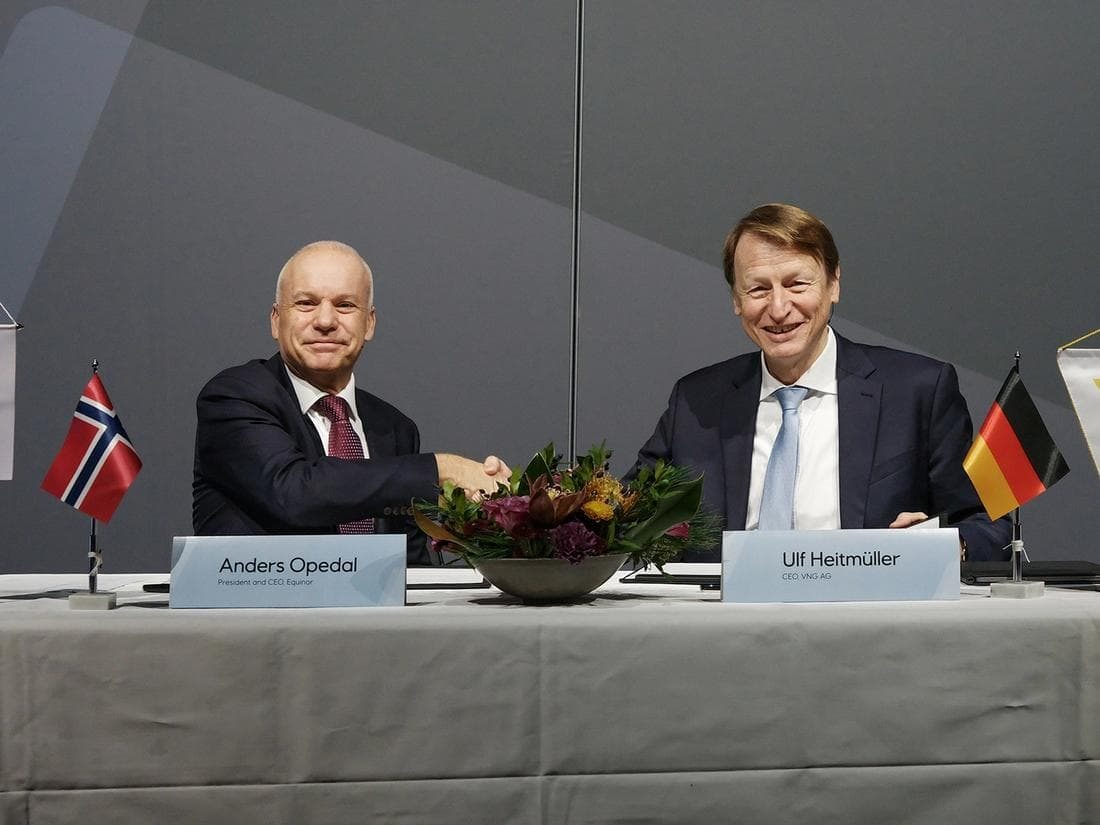
    Chief executives Anders Opedal and Ulf Heitmüller sign the contract in Oslo, with deliveries due to start on 1 January 2027.

  2. Equinor locks in Uniper for 15 years

    Deal

    Equinor signs a 15-year agreement with Uniper for more than 30 terawatt-hours a year through 2041.

  3. Russian gas cutoff reshuffles suppliers

    Energy

    Russia's invasion of Ukraine cuts most Russian pipeline gas to Europe, and Norway becomes the EU's largest single supplier.

  4. Norwegian consulate opens inside VNG

    Diplomacy

    Norway's honorary consulate for four eastern German states takes up residence at VNG's Leipzig headquarters.

  5. First Norwegian gas reaches eastern Germany

    Industry

    Deliveries begin to eastern Germany, starting the commercial relationship the new contract extends.

  6. Troll agreements set the tenor benchmark

    Industry

    The Troll gas sales agreements are signed, and remain Norway's longest until 2026.

  7. Norwegian gas exports begin

    Industry

    Norway starts exporting gas, with Germany becoming an anchor market that remains Equinor's largest.

Scenarios

1

Equinor signs another decade-plus supply deal with a German buyer

Likely Resolves by End of 2027

Discussed by: OilPrice and Handelsblatt, both of which frame the VNG contract as part of a run of long-dated German purchases after the August Uniper deal

Equinor has now signed two agreements this year with German buyers at tenors of 15 years or more. If German importers keep valuing supply certainty over spot-market flexibility, a third deal follows. Slower demand or cheaper LNG would weaken the case.

2

First VNG deliveries flow on 1 January 2027 as scheduled

Likely Resolves by Q1 2027

Discussed by: Both companies, which state the start date in their announcements

The contract names 1 January 2027 as the first delivery date at Trading Hub Europe. Meeting it requires only that the commercial and physical arrangements are in place, not new infrastructure, so delay would signal a contractual or operational problem.

3

Norway's share of German gas imports slips below 40% by 2029

Possible Resolves by Q2 2029

Discussed by: German energy trade press, which tracks import shares as LNG terminals and other suppliers scale up

Norway currently supplies 44% of Germany's gas. New LNG import capacity and purchases from other producers could dilute that share even as total volumes hold. A drop below 40% would show the long-term contracts are locking in a shrinking position rather than a growing one.

Historical Context

3 moments from history that rhyme with this story — and how they unfolded.

1986

Troll gas agreements (1986)

Norway's Troll field was developed around long-term sales contracts with continental European buyers. Equinor cites those agreements as the last time it signed gas sales deals with tenors this long.

Then

Committed large volumes of Norwegian gas to European buyers for decades.

Now

The 1986 agreements stood as Norway's longest gas contracts for 40 years, until the VNG deal.

Why this matters now

The 18-year VNG tenor is measured against them, and Equinor uses the comparison to show how unusual long-dated contracts had become.

1996

First Norwegian gas to eastern Germany (1996)

Norwegian gas began flowing to eastern Germany after reunification, opening the relationship between Equinor and what became VNG.

Then

Established Norway as a supplier to the former East German gas market.

Now

The partnership ran for three decades, with the consulate of Norway housed in VNG's Leipzig headquarters since 2005.

Why this matters now

The new contract is presented by both sides as an extension of that 1996 relationship, not a new one.

2022

Russian pipeline gas cutoff (2022)

Russia's invasion of Ukraine cut off most Russian gas to Europe. Norway moved into the gap and became the single largest gas supplier to the EU, and today supplies 44% of Germany's imports.

Then

European buyers scrambled for alternative pipeline and LNG supply, and prices spiked.

Now

Norway became the anchor supplier for German importers, who are now signing contracts that run into the 2040s.

Why this matters now

The VNG deal converts a short-term substitution into an 18-year commitment, which is the part that carries political weight as Germany's 2045 climate target approaches.

Sources

(7)