
Pull to refresh
Logo
EU sanctions four Haitian gangs over child recruitment and killings

EU sanctions four Haitian gangs over child recruitment and killings

Force in Play

Asset freezes and travel bans target 5 Segond, Gran Ravine, 400 Mawozo and Krazé Baryè, bringing the bloc's human rights list to 152 people and 49 entities.

Overview

Updated 1 hour ago

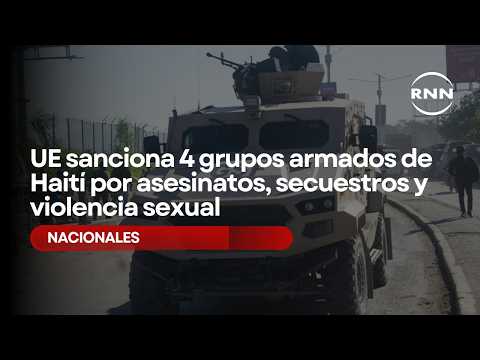
The European Union froze the assets and banned the travel of four Haitian armed groups on November 16. The targets are 5 Segond, Gran Ravine, 400 Mawozo and Krazé Baryè, which the Council says carried out killings, rape and the recruitment of children.

The listings bring the EU's human rights sanctions list to 152 people and 49 entities. They land as gangs control much of Port-au-Prince, about 1.5 million people have been displaced, and the UN's own panel says its Haiti arms embargo is broken "on a regular basis."

Why it matters

Asset freezes and travel bans only bite if banks and borders enforce them. Haiti's gangs mostly operate outside both.

Questions about this story

Free account needed to ask — your question is kept and asked for you right after sign-up. Answers are public.

No questions yet — be the first to ask.

Key Indicators

4
Haitian gangs listed by the EU
5 Segond, Gran Ravine, 400 Mawozo and Krazé Baryè were added on November 16, 2026.
152
People under EU human rights sanctions
The total across all countries covered by the bloc's Global Human Rights Sanctions Regime.
49
Entities under EU human rights sanctions
The four Haitian gangs are the newest additions to this list.
1.5 million
Haitians displaced by gang violence
Roughly 12 percent of the population, according to UN figures cited in November 2026.
1,160+
Deaths reported July to September 2026
The UN Integrated Office in Haiti counted more than 1,160 killings in the three-month period.

Voices

Curated perspectives — historical figures and your fellow readers.

Sign up to generate historical perspectives on this story.

People Involved

Organizations Involved

Timeline

December 2020 November 2026

6 events Latest: Yesterday
Tap a bar to jump to that date
  1. EU lists four Haitian armed groups

    Latest Sanctions

    The Council freezes assets and bans travel for 5 Segond, Gran Ravine, 400 Mawozo and Krazé Baryè.

  2. UN renews its Haiti sanctions regime

    Diplomacy

    The council extends an arms embargo, travel ban and asset freeze covering nine individuals and two groups.

  3. UN Security Council fails to add new Haiti sanctions

    Diplomacy

    The council does not impose new designations despite its panel's findings on officials' ties to gangs.

  4. UN reports surge in child recruitment by Haitian gangs

    Report

    The UN describes an "alarming increase" in children recruited into gangs, with devastating consequences.

  5. EU adopts a separate Haiti sanctions regime

    Policy

    The Council amends its Haiti measures to allow autonomous sanctions on gang leaders and others.

  6. EU creates its global human rights sanctions regime

    Policy

    The framework lets the EU target individuals and entities, including non-state actors, for serious human rights abuses.

Scenarios

1

EU adds another Haitian gang to its sanctions list

Likely Resolves by Q2 2027

Discussed by: European Council statements and the EU's stated practice of reviewing listings

The Council says it keeps its listings under constant review. Another round is plausible if violence continues or a group is tied to a mass-casualty attack. Each addition requires a new Council implementing regulation published in the Official Journal.

2

Sanctioned Haitians appear on the presidential ballot

Possible Resolves by Jul 31, 2027

Discussed by: Miami Herald reporting on candidate registration

Haiti's elections have been pushed from December 13 to July 2027. The Miami Herald reports that some sanctioned individuals have already registered as candidates. Whether the electoral council certifies them is a separate test of whether sanctions carry political weight.

3

UN Security Council expands Haiti sanctions

Possible Resolves by Q2 2027

Discussed by: UN Panel of Experts on Haiti and Security Council members

The Security Council renewed its Haiti sanctions in October 2026 but failed to add new designations in September. Its panel has accused former elected officials of backing gangs. A new resolution adding names would widen the pressure beyond the EU's list.

Historical Context

3 moments from history that rhyme with this story — and how they unfolded.

June 1993 – October 1994

UN embargo on Haiti's military junta (1993)

After the 1991 coup that ousted President Jean-Bertrand Aristide, the UN Security Council imposed an oil and arms embargo and froze junta assets. Talks failed and the council tightened the measures in 1994.

Then

The embargo squeezed the economy but did not dislodge the junta on its own. A US-led intervention restored Aristide in October 1994.

Now

Sanctions were lifted after his return. The episode set a pattern: outside pressure on Haitian armed actors works only alongside a political settlement.

Why this matters now

Today's EU listings face the same question: whether targeted measures can change behavior without a functioning Haitian state to enforce them.

October 2022

UN targeted sanctions on Jimmy Chérizier (2022)

The Security Council adopted Resolution 2653, imposing an arms embargo, travel ban and asset freeze on the gang leader Jimmy "Barbecue" Chérizier. It was the council's first Haiti sanctions resolution in nearly a decade.

Then

The council later expanded the regime to other individuals and groups.

Now

A UN panel has since reported regular arms embargo violations and few frozen assets, showing how hard targeted sanctions are to enforce against gangs.

Why this matters now

The EU's new listings mirror the UN approach and inherit its enforcement problem.

December 2020

EU Global Human Rights Sanctions Regime (2020)

The EU created a framework to sanction individuals and entities, including non-state actors, responsible for serious human rights abuses worldwide. It was modeled on the US Magnitsky Act.

Then

The bloc began listing suspects in 2021, mostly officials and security figures from Russia, China and elsewhere.

Now

The regime gave the EU a tool that did not depend on a UN Security Council resolution, which the US or Russia could veto.

Why this matters now

The Haiti listings use this framework, letting Brussels act without the UN route that stalled in September 2026.

Sources

(6)