


Pull to refresh
Logo
Nvidia-backed Firmus scraps Australia IPO after investor pushback

Nvidia-backed Firmus scraps Australia IPO after investor pushback

Money Moves

Data center operator withdraws $5 billion ASX listing, citing market conditions and a $30.6 billion valuation investors refused to pay

Today: Firmus withdraws IPO

Overview

Updated 55 minutes ago

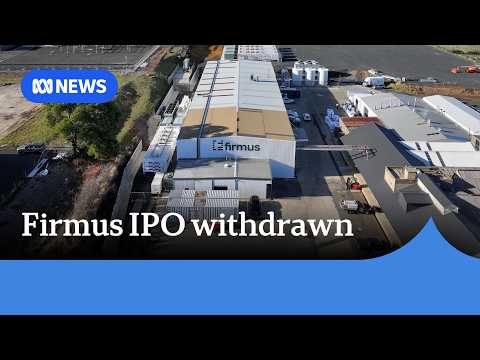
Firmus, an Australian data center operator backed by Nvidia, pulled its $5 billion initial public offering on October 9. Investors refused to pay the $30.6 billion valuation the company sought for a business running just 5% of its contracted computing capacity.

The withdrawal is the most conspicuous sign yet that investors are questioning whether AI infrastructure spending will convert into profits. But analysts note AI spending is still climbing: the scrapped listing reflects Firmus-specific problems, including its valuation tripling in three months, its debt load and a collapsed partnership, more than a broad market turn.

Why it matters

If AI infrastructure firms can't raise public money at boom valuations, the cost of the AI buildout falls on private markets and existing shareholders.

Questions about this story

Free account needed to ask — your question is kept and asked for you right after sign-up. Answers are public.

No questions yet — be the first to ask.

Key Indicators

$30.6B
Target IPO valuation
Market capitalization Firmus sought at AU$11 per share, up from $10.5 billion in August 2026.
5%
Signed capacity running
Just 46 of 912 megawatts of contracted computing capacity is operational across Firmus data centers.
$30B
Projected debt
Expected debt once data centers are built, roughly six times forecast 2028 operating earnings of $5 billion.
3x
Valuation jump in 3 months
Private valuation rose from $10.5 billion in August 2026 to the $30.6 billion IPO target in October 2026.

Voices

Curated perspectives — historical figures and your fellow readers.

Ever wondered what historical figures would say about today's headlines?

Sign up to generate historical perspectives on this story.

People Involved

Organizations Involved

Timeline

2019 October 2026

6 events Latest: Today
Tap a bar to jump to that date
  1. Firmus withdraws IPO

    Today IPO

    The company scraps its ASX listing, citing market volatility, and will pursue private capital and a possible Nasdaq listing.

  2. Investors pull orders after CDC partnership confirmed dead

    Market Signal

    CDC chief executive Greg Boorer says the $73 billion AI factory partnership is no longer underway; escrow terms allowing heavy early selling also spook buyers.

  3. Firmus launches IPO at AU$11 per share

    IPO

    The company seeks $5 billion at a $30.6 billion valuation, Australia's second-largest listing ever.

  4. Firmus valued at $10.5 billion

    Financing

    A private round led by Nvidia, Coatue and Blackstone values the company at $10.5 billion.

  5. Blackstone extends $10 billion debt financing

    Financing

    Blackstone provides $10 billion in debt as Firmus expands its AI factory buildout.

  6. Firmus founded

    Founding

    Cousins Oliver Curtis and Tim Rosenfield found Firmus to build Nvidia-powered AI data centers.

Scenarios

1

Firmus raises billions privately, pushes Nasdaq listing to 2027

Likely Resolves by End of 2026

Discussed by: Bloomberg (reporting a potential $3 billion private raise from existing investors); sources cited by the Australian Financial Review

Firmus taps Nvidia, Blackstone, Coatue and other existing backers for fresh equity to fund construction. Once the private round closes, it files for a Nasdaq listing in 2027, accepting a valuation well below the $30.6 billion it sought on the ASX.

2

Firmus files for a Nasdaq listing within a year

Possible Resolves by Q2 2027

Discussed by: The Australian, reporting Nasdaq plans; sources involved in the IPO

Having scrapped the ASX listing, Firmus moves to the US market, where AI infrastructure companies still command premium valuations. It files a registration statement and completes a listing by mid-2027, though at a valuation below its ASX target.

3

Anti-dilution clause shrinks founders' stakes as listing deadline passes

Likely Resolves by Nov 30, 2026

Discussed by: Australian Financial Review, reporting the November 30 contractual deadline

Firmus remains unlisted past November 30, 2026, triggering the anti-dilution provision in its 2026 agreement with Nvidia, Blackstone and Coatue. The investors receive additional shares, diluting co-founders Oliver Curtis and Tim Rosenfield. Each month of delay shrinks their control.

Historical Context

2 moments from history that rhyme with this story — and how they unfolded.

September 2019

WeWork's scrapped IPO (2019)

WeWork pulled its IPO in September 2019 after investors balked at a proposed $47 billion valuation for a money-losing office space company led by founder Adam Neumann. Its debt-heavy model, governance problems and founder control repelled buyers.

Then

WeWork later went public via a SPAC at a fraction of the valuation, then filed for bankruptcy in November 2023.

Now

The episode became a benchmark for overvalued, founder-driven tech listings meeting market skepticism.

Why this matters now

Like Firmus, WeWork sought a huge valuation for a business whose profits were years away and whose expansion depended on continuous financing. Its collapse showed how quickly investor enthusiasm can reverse when valuations outrun fundamentals.

March 2025 – 2026

CoreWeave's IPO and slide (2025–2026)

CoreWeave, the closest listed rival to Firmus, went public in March 2025 as the first big AI data center pure-play, with Nvidia as a major customer and backer. Within a year, its shares had halved as investors questioned the economics of its debt-funded Nvidia chip deployments.

Then

CoreWeave's weak trading cooled sentiment for AI infrastructure listings, including Firmus's.

Now

It became a reference point for pricing later AI data center IPOs.

Why this matters now

Firmus's scrapped listing follows the same investor doubt that halved CoreWeave's stock, showing the pattern is not company-specific.

Sources

(8)