
Pull to refresh
Logo
Astronomers watch a giant star swallow its companion in real time

Astronomers watch a giant star swallow its companion in real time

New Capabilities

The Andromeda eruption named Bao is the first direct look at a star spiraling inside another star's envelope, then merging with its core

Overview

Updated 1 hour ago

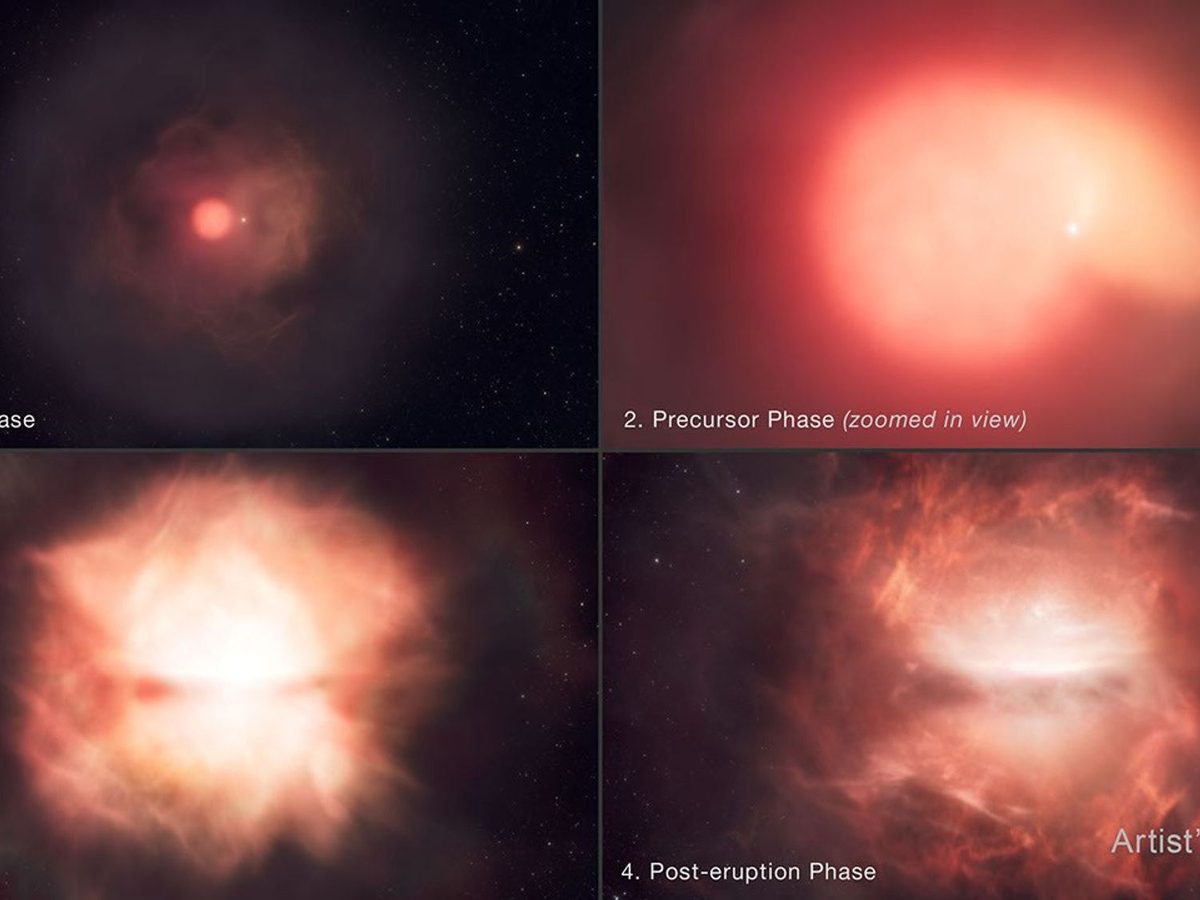
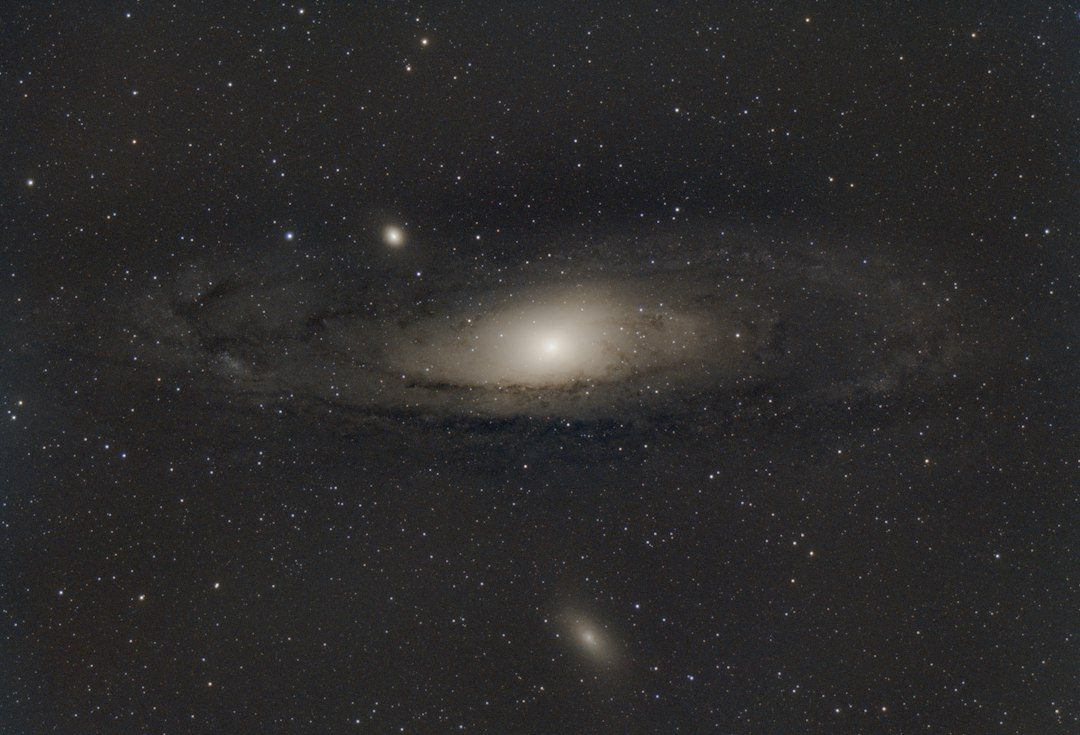
For about seven years, a star roughly 70% the mass of the Sun spiraled through the outer layers of a giant 350 times the Sun's radius. In October 2025 it reached the core. The giant threw off its outermost tenth of gas in a week-long eruption. Astronomers had never watched either stage happen before.

The system sits in the Andromeda galaxy and is catalogued as AT 2025abao, nicknamed Bao. A paper in Nature on 18 November 2026 reconstructs the whole sequence, from a slow pre-eruption brightening to the moment the small star hit the core. That record gives the first direct measurement of how much of the companion's orbital energy actually blows the giant's envelope away, a value models had only estimated.

Why it matters

Every tight black-hole and neutron-star pair passes through this stage. Astronomers had never measured it until now.

Questions about this story

Free account needed to ask — your question is kept and asked for you right after sign-up. Answers are public.

No questions yet — be the first to ask.

Key Indicators

7
Orbits before the companion merged
Roughly seven years of spiraling, against thousands of orbits in previously known mergers of smaller stars.
10%
Share of the giant's envelope ejected
The outermost tenth of the primary's gas was thrown off at about ten times its escape speed.
47 days
Gap between eruption peak and Webb's observation
The earliest follow-up ever made of this kind of event.
350
Primary's radius, in solar radii
The giant was also about seven times the Sun's mass and 18,000 times its brightness.
0.01–0.4
Range for alpha, the envelope-unbinding efficiency
The fraction of the companion's lost orbital energy that went into ejecting gas rather than into light.

Voices

Curated perspectives — historical figures and your fellow readers.

Sign up to generate historical perspectives on this story.

People Involved

Organizations Involved

Timeline

2018 November 2026

8 events Latest: 3 days ago
Tap a bar to jump to that date
  1. Nature publishes the reconstruction

    Latest Publication

    Karambelkar and colleagues report the drag phase, the merger and the envelope ejection, with an efficiency range of 0.01 to 0.4.

  2. Webb observes the aftermath

    Observation

    Webb observes Bao 47 days after the eruption peak, the earliest follow-up of such an event.

  3. Swift and Gemini North follow up

    Observation

    Rapid-turn ultraviolet and optical observations track the ejected gas.

  4. The eruption is detected

    Observation

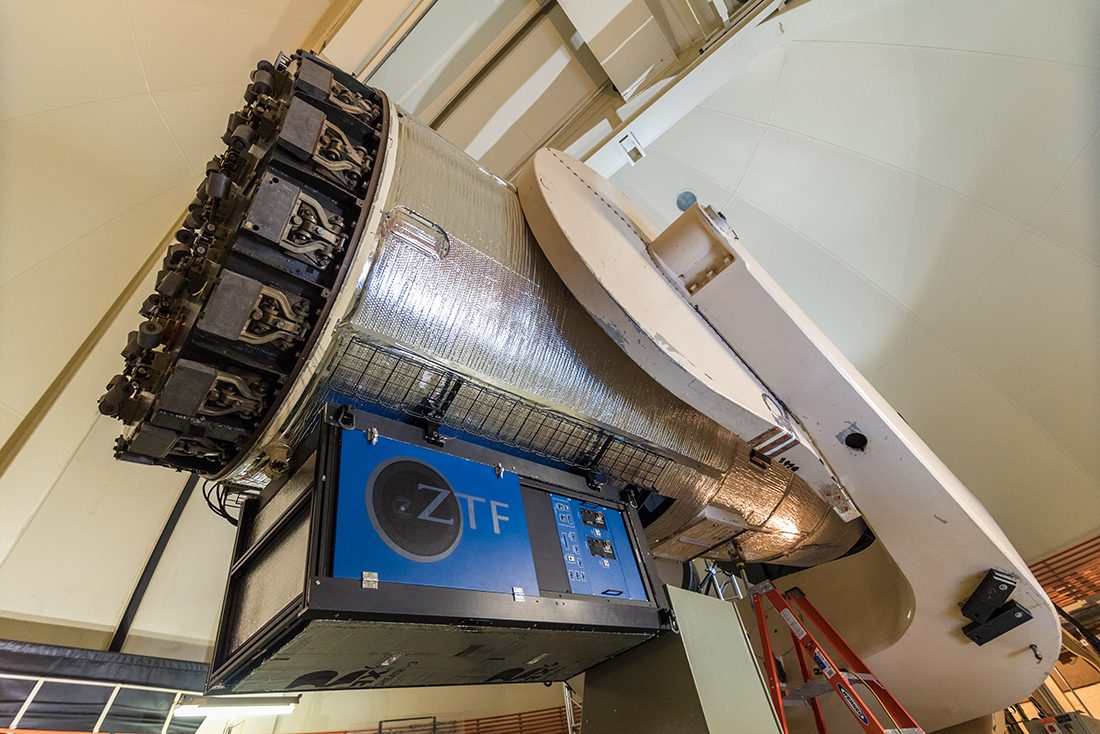
    The Zwicky Transient Facility records the outburst as the stars brighten and heat up within days.

  5. SPHEREx catches a visible fade

    Observation

    A routine survey sees Bao dim in visible light while brightening in infrared.

  6. Dust appears around the system

    Observation

    The Wide-field Infrared Transient Explorer records both brightening and newly formed dust.

  7. NEOWISE flags an unusual variable

    Observation

    Archived infrared data show Bao brightening in a pattern that does not fit a normal variable star.

  8. Bao's brightness holds steady

    Observation

    Infrared survey data show the binary with a steady, unchanging luminosity before 2018.

Scenarios

1

Bao settles into a single star, and its surface is mapped

Likely Resolves by Nov 18, 2029

Discussed by: The paper's authors, who say only future observations will show how the new star's mass settles

Dust currently blocks a clear view of the remnant. As it clears over the next few years, spectroscopy could show a single stellar surface with no companion, plus signs of material dredged up from the giant's core during the plunge. Confirming that would close the loop on the merger.

2

A second common-envelope merger is caught in real time

Possible Resolves by End of 2029

Discussed by: The paper's authors, who point to the Nancy Grace Roman Space Telescope's upcoming surveys

Bao was found because a survey happened to keep watching one object for years before it erupted. Wide, repeated surveys make that more likely. A second event with pre-eruption data and post-merger observations would show whether Bao's fast, radiatively efficient inspiral is typical or unusual.

3

The merger interpretation is challenged

Unlikely Resolves by Nov 18, 2028

Discussed by: Independent researchers, once other groups model the same photometric and spectroscopic data

The claim rests on interpreting a slow brightening followed by a fast outburst. A different model, such as an unusual dust-driven ejection from a single star, would have to explain the pre-eruption light curve and the Webb mid-infrared data at the same time. No such challenge has been published.

Historical Context

3 moments from history that rhyme with this story — and how they unfolded.

2008–2010

V1309 Scorpii (2008–2010)

A star in Scorpius brightened sharply in 2008 and then faded. Two years later, astronomers examining archival data found the signature of a contact binary whose orbital period was shrinking, ending in a merger.

Then

V1309 Sco became the best-studied example of a stellar merger pieced together after the fact.

Now

It established how a merger looks in old light curves, but nobody had watched one happen.

Why this matters now

Bao is the same event read forward: spotted before the eruption, then followed through it.

2017–2018

KIC 9832227 merger prediction (2017–2018)

A team announced that a contact binary in Cygnus would merge around 2022, based on an apparently accelerating orbital period. In 2018 the prediction was withdrawn after reanalysis of the same data.

Then

The retraction removed the field's only dated merger forecast.

Now

It showed that timing a merger in advance is much harder than timing one once the inspiral has started.

Why this matters now

Bao did not need a forecast. It was caught partway through, which is why the seven-year drag phase could be measured.

August 2017

GW170817 neutron-star merger (2017)

The LIGO and Virgo detectors recorded gravitational waves from two neutron stars colliding about 130 million light-years away, and telescopes caught the light that followed.

Then

The event tied a gravitational-wave signal to visible light for the first time.

Now

It made the formation of tight compact binaries a measurable question rather than a theoretical one.

Why this matters now

Pairs that produce such mergers are built by the phase Bao went through, which is why measuring its efficiency matters beyond one star.

Sources

(10)