
Pull to refresh
Logo
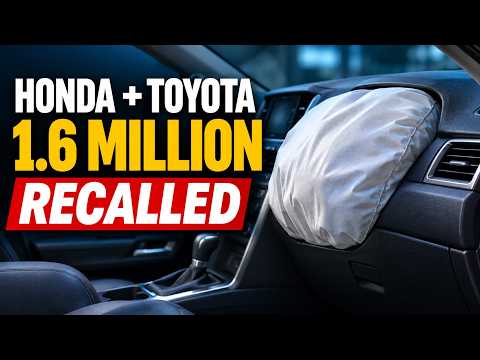
Honda and Toyota recall 1.6 million vehicles over Takata airbag inflators

Honda and Toyota recall 1.6 million vehicles over Takata airbag inflators

Built World

Desiccated inflators, designed to resist moisture, show early signs of propellant degradation in hot and humid states.

Overview

Updated 20 minutes ago

Honda and Toyota are recalling about 1.6 million cars, trucks and SUVs because their Takata airbag inflators could rupture. These inflators contain a moisture-absorbing desiccant, which was supposed to keep the propellant from breaking down the way it did in the earlier recalls.

Honda's long-term monitoring found signs of degradation anyway, in hot and humid places. No inflator has ruptured, and no one has been hurt. But the recall covers vehicles never included in the earlier campaigns, and it arrives about six weeks before 2027, the earliest year Honda's consultants modeled for a rupture in South Florida.

Why it matters

If the desiccant fails in hot, humid states, the recall could spread to millions more vehicles and to other automakers.

Questions about this story

Free account needed to ask — your question is kept and asked for you right after sign-up. Answers are public.

No questions yet — be the first to ask.

Key Indicators

1.6M
Vehicles recalled
Honda and Toyota combined, worldwide.
810,592
Honda vehicles recalled in the U.S.
Certain 2012–2013 Civics and CR-Vs, the 2013 Accord and two Acura models.
790,000
Toyota vehicles recalled worldwide
About 314,000 of them are in the United States.
28
U.S. deaths linked to Takata inflators since 2009
All involved inflators without a drying agent.
20
Those deaths in Honda vehicles
Honda has been the automaker most exposed to the recalls.
67M
U.S. vehicles recalled in earlier Takata campaigns
Part of more than 100 million vehicles recalled worldwide over the past decade.
14
States and territories in Honda's recall
Areas with high heat, humidity and temperature swings.

Voices

Curated perspectives — historical figures and your fellow readers.

Sign up to generate historical perspectives on this story.

Organizations Involved

Timeline

June 2019 2027

8 events Latest: Today
Tap a bar to jump to that date
  1. Toyota expects replacement inflators

    Upcoming Remedy

    Toyota says replacement inflators should be ready by early 2027.

  2. Honda mails interim owner letters

    Upcoming Notice

    A final remedy date is not yet set, so the first letters are interim.

  3. Owners can check VINs on NHTSA.gov

    Today Consumer

    Vehicles covered by the recall become searchable by vehicle identification number.

  4. Honda and Toyota confirm 1.6 million-vehicle recall

    Recall

    Honda covers 810,592 U.S. vehicles; Toyota covers about 790,000 worldwide, 314,000 in the U.S.

  5. NHTSA logs recall as campaign 26V765

    Regulatory

    The agency says independent degradation models let the automakers act before a field failure.

  6. Honda files defect report with NHTSA

    Filing

    American Honda reports the desiccated-inflator defect before formally announcing a recall.

  7. Consultant models desiccated-inflator risk

    Study

    Exponent sees no measurable degradation but projects South Florida's first rupture no earlier than 2027.

  8. Honda calls fifth Takata campaign its final phase

    Recall

    Honda says it has recalled 22.6 million inflators in about 12.9 million vehicles.

Scenarios

1

Recall ends with no rupture in the newly recalled inflators

Likely Resolves by End of 2028

Discussed by: NHTSA and the automakers, citing degradation models

Honda and Toyota replace inflators in about 1.6 million vehicles. NHTSA's models and Honda's monitoring put the risk years out, and no rupture has been reported. If the replacements hold, the proactive recall closes without a field failure.

2

A desiccated inflator ruptures and the recall widens

Possible Resolves by End of 2028

Discussed by: Exponent's 2020 modeling, reported by CARINDUST; NHTSA

Exponent projected South Florida's first passenger-side rupture no earlier than 2027. A real rupture would confirm that desiccated inflators can fail in the field. That would likely pull more vehicles and possibly more automakers into the recall.

3

Other automakers recall desiccated Takata inflators

Possible Resolves by End of 2027

Discussed by: NHTSA

NHTSA said other automakers are still analyzing and testing their inflators. Honda and Toyota acted on early evidence in specific regions. If that evidence generalizes, more brands could announce their own desiccated-inflator recalls.

Historical Context

3 moments from history that rhyme with this story — and how they unfolded.

2009–2019

The original Takata airbag recalls (2009–2019)

Takata's non-desiccated inflators could degrade and explode, spraying metal fragments into the cabin. Automakers eventually recalled more than 100 million vehicles worldwide, about 67 million of them in the United States. At least 28 people in the U.S. died and more than 400 were hurt.

Then

Takata went bankrupt in 2017, and the recalls became the largest in U.S. auto history.

Now

The crisis turned inflator chemistry into a safety question and put moisture-absorbing desiccants at the center of replacement design.

Why this matters now

The new recall covers desiccated inflators, the type meant to fix the earlier problem, and finds possible degradation in them.

2019

The desiccated replacement that ruptured (2019)

A desiccated Takata replacement inflator, the PSDI-5D, ruptured in a 2004 Honda Odyssey and injured the driver. Honda recalled about 1.1 million vehicles. Investigators traced the failure to manufacturing errors that let moisture inside.

Then

The case showed that a drying agent alone did not guarantee safety.

Now

It pushed automakers and regulators to keep monitoring desiccated inflators instead of treating them as a closed chapter.

Why this matters now

The new recall rests on the same warning: desiccated inflators can still degrade under the right conditions.

2000–2001

Ford–Firestone tire recall (2000–2001)

Firestone recalled millions of tires in 2000 after tread separations led to rollover crashes, many of them in hot-weather states. Ford later replaced millions more.

Then

The recalls became one of the largest tire safety actions in U.S. history.

Now

The cases tied heat and age to the failure of a rubber or chemical component, which shaped how later recalls were scoped by geography.

Why this matters now

Honda's recall is limited to 14 hot and humid states and territories, the same kind of heat-driven geographic scoping that defined the Firestone case.

Sources

(6)