
Pull to refresh
Logo
Iambic launches Enchant v3 drug discovery model with 41 billion parameters

Iambic launches Enchant v3 drug discovery model with 41 billion parameters

New Capabilities

The release came with a same-day AbbVie deal spanning immunology, neuroscience, and oncology

Today: Enchant v3 launch and AbbVie deal

Overview

Updated 46 minutes ago

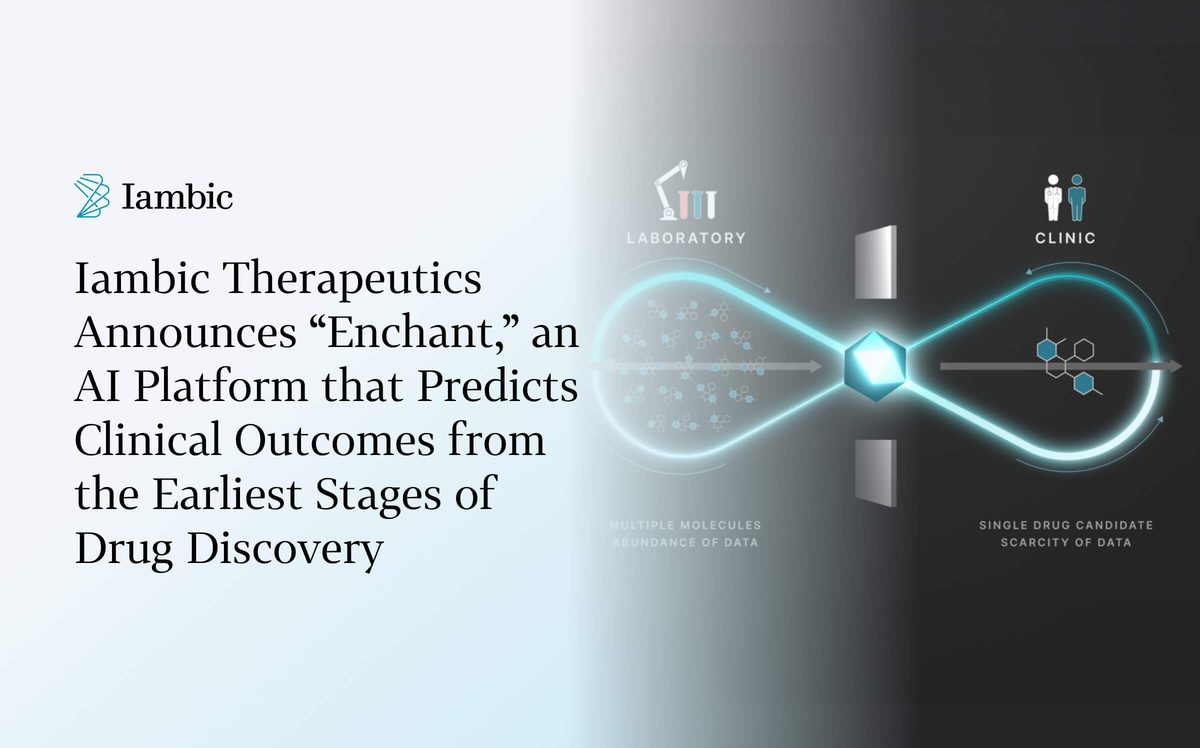
Iambic released Enchant v3 on September 21, 2026: a 41-billion-parameter AI model trained on 4.5 trillion tokens of biomedical data, spanning everything from protein structures to clinical trial records. The same day, AbbVie signed a multi-year deal to use the model across immunology, neuroscience, and oncology.

Enchant v3 is the third generation of a model its makers say follows predictable scaling laws: each larger version predicts drug properties more accurately, including in areas with sparse data. If that holds, it lets researchers test many candidate properties at once instead of one at a time. If it doesn't, it joins a long line of AI-in-medicine projects that overpromised.

Why it matters

If Enchant v3 predicts which drugs succeed in humans, it could cut years and billions from a process that fails nine times in ten.

Questions about this story

Free account needed to ask — your question is kept and asked for you right after sign-up. Answers are public.

No questions yet — be the first to ask.

Key Indicators

41B
Model parameters
Third generation of Iambic's multimodal transformer, up from v2.
4.5T
Pretraining tokens
Biomedical text, structures, images, assay, and multi-omics data.
6,000+
Molecular properties optimized
Enables multi-parameter optimization rather than one-at-a-time testing.
16
Data modalities
From 3D structures and pharmacokinetics to clinical trial data.
4
Discovery partnerships since 2024
Lundbeck, Takeda, Bayer, and AbbVie, plus a clinical deal with Jazz.

Voices

Curated perspectives — historical figures and your fellow readers.

Ever wondered what historical figures would say about today's headlines?

Sign up to generate historical perspectives on this story.

People Involved

Organizations Involved

Timeline

September 2024 September 2026

5 events Latest: Today
Tap a bar to jump to that date
  1. Enchant v3 launch and AbbVie deal

    Today Product launch / Partnership

    Iambic releases Enchant v3, a 41-billion-parameter model trained on 6,000+ molecular properties across 16 modalities; AbbVie signs a multi-year discovery collaboration the same day.

  2. Bayer deal

    Partnership

    Bayer enters a collaboration with Iambic focused on small molecule discovery against hard-to-drug targets.

  3. Takeda deal

    Partnership

    Multi-year collaboration in oncology and gastrointestinal/inflammation programs, with success-based payments reported above $1.7 billion.

  4. Jazz clinical collaboration

    Partnership

    Iambic agrees to test its HER2 inhibitor IAM1363 with Jazz's zanidatamab in HER2-positive breast cancer.

  5. Lundbeck partnership

    Partnership

    Iambic signs an agreement with H. Lundbeck to apply its platform to migraine drug discovery.

Scenarios

1

First AbbVie-Iambic candidate enters the clinic

Possible Resolves by Sep 21, 2028

Discussed by: Deal analysts cited by industry trade publications, noting typical small molecule timelines

Iambic and AbbVie will not name a candidate for months. If Enchant v3 speeds discovery as claimed, about two years of work could yield a lead compound ready for Phase I from the immunology, neuroscience, or oncology programs. Small molecule discovery typically takes two to four years from collaboration start to first-in-human trials.

2

Enchant-designed cancer drug posts positive data

Possible Resolves by End of 2027

Discussed by: Jazz Pharmaceuticals and Iambic, testing the HER2 inhibitor IAM1363 with zanidatamab

IAM1363, an Iambic inhibitor of HER2 (human epidermal growth factor receptor 2), is in a combination trial with Jazz's zanidatamab in HER2-positive breast cancer. Positive data would show Enchant's property predictions translate to real patients, which would strengthen the case for v3 across every partnership.

3

A partner leaves; scaling hits a data wall

Unlikely Resolves by Sep 21, 2028

Discussed by: Skeptics of AI drug discovery pointing to earlier failures like IBM Watson Health

Partners paid upfront but owe most money in milestones, so they can walk away before Phase II without losing much. If Enchant v3's clinical endpoint predictions prove weak where data is sparse, a major partner could exit. Watson Health's failure shows scale alone does not protect a medical AI bet.

Historical Context

3 moments from history that rhyme with this story — and how they unfolded.

2011-2021

IBM Watson Health (2011-2021)

IBM pitched Watson as a medical decision-maker after its Jeopardy! win, launching Watson Health and Watson for Oncology. Hospitals and cancer centers reported recommendations that were sometimes unsafe, and IBM sold the unit in 2021 for parts, reportedly at a loss.

Then

Watson for Oncology lost hospital partners and was discontinued.

Now

The failure became a cautionary tale for AI in medicine: brand confidence and compute scale do not guarantee clinical utility.

Why this matters now

It is the counterweight to Enchant's promises. Validation must come from real trial data, which none of Enchant's partner programs have produced yet.

December 2020

AlphaFold2 (2020)

DeepMind's AlphaFold2 won the CASP14 protein structure prediction competition, solving a problem biologists had worked on for 50 years. DeepMind later scaled it to predict structures for hundreds of millions of proteins.

Then

AlphaFold became a standard freely available tool in structural biology within months.

Now

It showed deep learning could conquer core problems in biology, feeding a wave of AI-first drug discovery startups.

Why this matters now

Enchant is built on the same premise that scaling compute and data yields biological insight, but extends prediction from structure to clinical outcomes, a far harder problem.

January 2024

Isomorphic Labs pharma deals (2024)

Isomorphic Labs, DeepMind's drug discovery spinout, signed separate partnerships with Eli Lilly and Novartis within weeks of its launch, with combined potential milestone payments reported in the billions.

Then

Isomorphic landed two top-tier pharma partners at once, proving demand for foundation-model drug discovery.

Now

It set the deal template: upfront payment plus success-based milestones and royalties, the same structure AbbVie and Iambic use.

Why this matters now

The AbbVie-Iambic arrangement follows this template directly. Iambic now has four discovery deals under it.

Sources

(10)