


Pull to refresh
Logo
Court stay blocks Army's plan to detonate lead azide in Iowa

Court stay blocks Army's plan to detonate lead azide in Iowa

Rule Changes

Sixty-eight drums of unstable explosive sit in bunkers near Middletown, three days before the Army's rescheduled blast

Overview

Updated 19 minutes ago

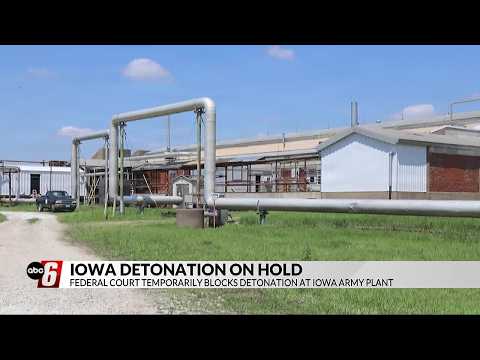
Sixty-eight drums of lead azide, a compound used to trigger larger explosives, have sat in bunkers at the Iowa Army Ammunition Plant since the Army found them degrading in March. The Army planned to blow them up on Monday, behind sand-filled barriers about two stories high and a curtain of water mist. Late Thursday, a federal appeals court put the Environmental Protection Agency permit for the blast on hold.

The Army says the material has recrystallized and grown sensitive enough that moving the drums or prying off their lids could set them off, which makes a controlled detonation the least risky option left. The Iowa Environmental Council and the Sierra Club's Iowa chapter, represented by the nonprofit law firm Earthjustice, argue the permit's cleanup terms are too thin and that lead dust could travel much farther than the Army's maps show. There is no known safe level of lead exposure, and lead is especially harmful to children and pregnant women.

Why it matters

The fight tests how much say courts and neighbors get when the Army says the fastest way to destroy unstable explosives is also the safest.

Questions about this story

Free account needed to ask — your question is kept and asked for you right after sign-up. Answers are public.

No questions yet — be the first to ask.

Key Indicators

68
Drums of lead azide in storage
The Army intends to destroy all of them where they sit.
5
Short tons of lead azide
The Army describes the cache as nearly five tons of deteriorating explosive.
25 mi
How far north lead could deposit
An Army map released Nov. 18 showed possible deposition nearly to Iowa City.
Feb. 11, 2027
Expiration of the EPA emergency permit
The permit took effect Nov. 13, 2026, and covers the detonation window.

Voices

Curated perspectives — historical figures and your fellow readers.

Sign up to generate historical perspectives on this story.

People Involved

Organizations Involved

Timeline

March 2026 November 2026

11 events Latest: Today Showing 8 of 11
Tap a bar to jump to that date
  1. EPA explains why it rejected chemical treatment

    Statement

    Region 7 Administrator Jim Macy told Governor Reynolds that removing the drums' lids could trigger an explosion.

  2. Army moves the blast from Friday to Monday

    Delay

    Governor Kim Reynolds and Iowa and Illinois lawmakers had called for more time.

  3. Army releases maps of possible lead dispersion

    Disclosure

    One forecast showed lead dust drifting north of Iowa City depending on the weather.

  4. EPA grants emergency permit for a controlled detonation

    Permit

    The permit runs through Feb. 11, 2027, and covers the blast at the storage site.

  5. Army cancels the neutralization contract

    Contract

    The deal ended two months after it was signed; the Army later said the choice was unrelated to the company's technical proposal.

  6. Army finds lead azide degrading in bunkers

    Discovery

    The EPA learns of the problem and sends a team to the plant four days later.

  7. Army hires a contractor to neutralize the chemical

    Contract

    MuniRem Environmental proposed treating the drums on site with a chemical reagent instead of blowing them up.

Scenarios

1

Army invokes the emergency exception and detonates without a permit

Possible Resolves by Nov 30, 2026

Discussed by: The Justice Department raised the exception in its Friday court filing; the Army has not said whether it will use it

Federal rules let the Army treat hazardous waste without a permit when it decides there is an immediate threat to health, safety, property or the environment. Acting Secretary Adam Telle has said the material grows more unstable as temperatures fall, which would make Monday a hard deadline. If the court does not act in time, the Army could proceed on its own authority and argue the exception afterward.

2

Court lifts the stay and the blast proceeds under the EPA permit

Uncertain Resolves by Feb 11, 2027

Discussed by: The Justice Department, which told the court it will oppose the emergency motion

The Eighth Circuit stayed the permit only while it considers the groups' motion. If the judges side with the government, the detonation can proceed under the existing permit with sand barriers, water mist and the cleanup terms the EPA wrote. The permit stays valid through Feb. 11, 2027, giving the Army a window to pick a day once the legal cloud clears.

3

Court keeps the permit blocked and the Army turns to chemical treatment

Unlikely Resolves by Feb 11, 2027

Discussed by: Toxicologists quoted by the Des Moines Register and the environmental groups challenging the permit

Some toxicologists argue neutralizing the drums on site with a chemical reagent would avoid the lead plume a blast would create. The Army tried that route in March and walked away from it, saying the drums are too sensitive to disturb. A court ruling that forces a fuller review could push the service back toward treatment, though it would have to solve the same handling problem it cited as disqualifying.

Historical Context

3 moments from history that rhyme with this story — and how they unfolded.

2012

Camp Minden propellant disposal (2012)

Louisiana authorities found millions of pounds of M6 propellant stored improperly at a National Guard site in Webster Parish. The Army and the EPA first proposed open burning, and residents fought the plan at public meetings over air quality concerns.

Then

The plan shifted to a contained burn chamber, and disposal ran for years under community monitoring.

Now

The case became a reference point for communities demanding alternatives to open burning of propellants and explosives.

Why this matters now

The Iowa groups make a similar argument: that the disposal method chosen is the easiest for the government, not the safest for the people downwind.

1982-1983

Times Beach, Missouri (1982-1983)

Dioxin-laced oil had been sprayed on the town's dirt roads to control dust. After a flood spread contaminated soil, testing found dioxin across the site and federal officials concluded the town could not be made safe for residents.

Then

The government bought out the town and relocated its residents; Times Beach was disincorporated.

Now

Cleanup of the soil took years, and the site became a state park.

Why this matters now

It shows how far contaminated dust can spread and how permanent the consequences become once it settles across homes, farms and streets.

2015-2023

U.S. chemical weapons destruction (2015-2023)

The Army destroyed its declared chemical weapons stockpile at depots in Colorado and Kentucky, using chemical neutralization rather than incineration after years of opposition from surrounding communities to burning agents in the open.

Then

The neutralization plants took years to build and operate, and the last munitions were destroyed in 2023.

Now

The program set a precedent that the Army will pay for slower, contained disposal when communities reject faster methods.

Why this matters now

It is the closest precedent for the choice facing Iowa: a fast, contained blast versus a slower treatment process the Army has already tried once.

Sources

(9)