
Pull to refresh
Logo
Korea opens first 400 Gbps research data circuit to the United States

Korea opens first 400 Gbps research data circuit to the United States

New Capabilities

KT and KISTI quadruple Korea-U.S. research bandwidth from 100 Gbps

Today: KT and KISTI open Korea's first 400 Gbps U.S. circuit

Overview

Updated 2 hours ago

Until this week, moving 100 terabytes of research data from South Korea to the United States took about two hours and 13 minutes. Starting September 16, the same transfer takes about 33 minutes.

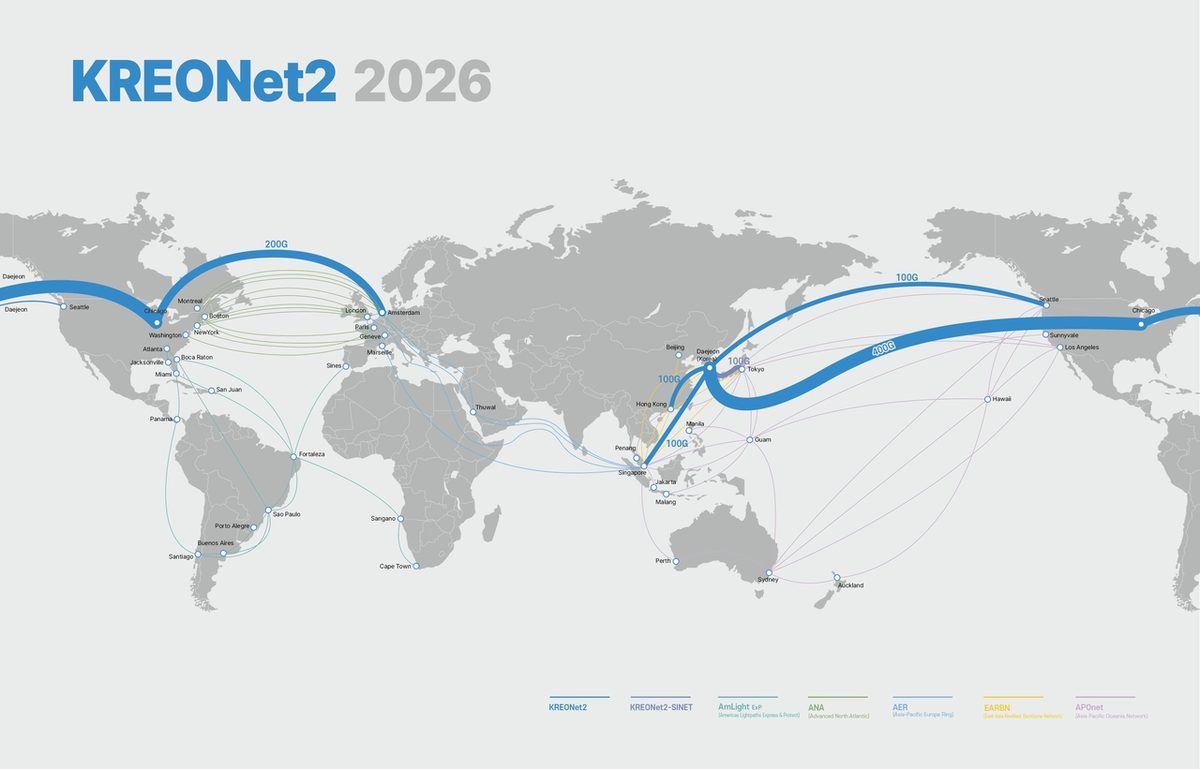
KT and the Korea Institute of Science and Technology Information (KISTI) switched on the country's first 400-gigabit-per-second international dedicated circuit, and the first single-wavelength 400 Gbps circuit built across both private carriers and the public sector. It quadruples the Korea-U.S. bandwidth of KREONET, the national research network, on a route carried by the NCP undersea cable that reaches the U.S. without passing through a third country.

The faster link matters for researchers handling petabyte-scale datasets in AI training, astronomy, space science, high-energy physics, and biotech. They can now reach U.S. supercomputers and large-scale facilities more quickly, and KISTI plans to extend the same capacity to Europe before data floods from CERN's High-Luminosity Large Hadron Collider, the ITER fusion reactor, and the Square Kilometre Array radio telescope.

Why it matters

Korean researchers can move 100 terabytes to U.S. labs in 33 minutes, opening AI, astronomy, and physics collaborations at petabyte scale.

Questions about this story

Free account needed to ask — your question is kept and asked for you right after sign-up. Answers are public.

No questions yet — be the first to ask.

Key Indicators

400 Gbps
New circuit bandwidth
Single-wavelength circuit quadruples the previous 100 Gbps Korea-U.S. research link.
33 min
Time to transfer 100 TB to U.S.
Down from 2 hours 13 minutes on the old 100 Gbps link, at theoretical maximum speeds.
10,000+ km
Trans-Pacific route length
Length of the submarine segment between Korea and Chicago.
5
Undersea cable systems KT operates
APG, APCN-2, NCP, TPE, and KJCN, with dual landing stations in Busan and Geoje.

Voices

Curated perspectives — historical figures and your fellow readers.

Ever wondered what historical figures would say about today's headlines?

Sign up to generate historical perspectives on this story.

People Involved

Organizations Involved

Timeline

2 events Latest: Today
  1. KT and KISTI open Korea's first 400 Gbps U.S. circuit

    Today Launch

    Circuit linking Daejeon and Chicago quadruples Korea-U.S. research bandwidth from 100 Gbps.

  2. KISTI and iCAIR build backbone at StarLight hub

    Infrastructure

    KISTI visited Northwestern University's StarLight hub in Chicago to establish the 400 Gbps international backbone circuit.

Scenarios

1

KISTI extends 400 Gbps capacity to the Europe route

Likely Resolves by End of 2028

Discussed by: KISTI officials, who publicly committed to the upgrade at the launch

KISTI says it will upgrade the Korea-Europe international backbone to single 400 Gbps circuits to handle data from CERN's High-Luminosity Large Hadron Collider, the ITER fusion reactor, and the Square Kilometre Array radio telescope. Executing that plan would lock in Korea's regional position in research networking.

2

SC26 demo shows the 400 Gbps backbone under live traffic

Likely Resolves by Nov 30, 2026

Discussed by: KISTI and iCAIR, whose launch announcement included the joint plan

At the SC26 supercomputing conference in Chicago in November 2026, KISTI and iCAIR plan to demonstrate the 400 Gbps backbone through SCinet, the conference's high-speed network. Completing the demo would validate the circuit under real, conference-scale traffic and give outside researchers hands-on access.

3

A rival research network reaches 800 Gbps first

Possible Resolves by End of 2028

Discussed by: Herald Business reporting that global research networks are rapidly advancing to higher tiers

The regional capacity race could accelerate. If a peer network such as Japan's NII, the U.S.'s ESnet, or Internet2 announces single-wavelength 800 Gbps international research circuits before Korea finishes its Europe extension, Korea's benchmark status on the Pacific route erodes quickly.

Historical Context

3 moments from history that rhyme with this story — and how they unfolded.

2008–2015

LHC-era data drives research network scaling (2008–2015)

When the Large Hadron Collider began generating petabytes of collision data, physicists had to move that data between institutions across three continents. Research networks scaled per-channel capacity from 10 Gbps toward 100 Gbps to keep up.

Then

International research networks became dedicated, high-capacity infrastructure for big science.

Now

The same pattern repeated with genomics and astronomy; AI training data is now the newest driver of network demand.

Why this matters now

The 400 Gbps Korea-U.S. link is the latest turn of that cycle: new science produces more data, and network builders scale capacity to move it.

circa 2020

NCP undersea cable links Korea and U.S. directly (c. 2020)

KT brought the New Cross Pacific (NCP) submarine cable system into service, connecting Korea and the U.S. without transit through a third country.

Then

Korea-U.S. traffic gained a lower-latency route with fewer points of failure.

Now

The cable became the physical foundation for the research network's growth, including the new 400 Gbps circuit.

Why this matters now

The 400 Gbps circuit runs on the NCP cable, whose direct bilateral routing is what makes the high-bandwidth, low-latency link possible.

circa 2025

Japan's NII builds single 400 Gbps research circuit (c. 2025)

Japan's National Institute of Informatics upgraded its Asia-Pacific to North America research connection to a single 400 Gbps system, the first on that route in the region.

Then

Japan set the regional benchmark for trans-Pacific research bandwidth.

Now

Korea has now matched Japan on the same route, making the two countries the Asia-Pacific leaders in single-wavelength research links.

Why this matters now

KISTI's upgrade is the second single 400 Gbps deployment on the Asia-Pacific-North America route, directly following Japan's lead.

Sources

(9)