Libya signs first unified state budget in 13 years as US brokers fiscal reunification
Rule Changes
Rival eastern and western legislatures agree on 190 billion dinar spending plan under American mediation, the first consensus on public finances since the country split in 2013
Rival eastern and western legislatures agree on 190 billion dinar spending plan under American mediation, the first consensus on public finances since the country split in 2013
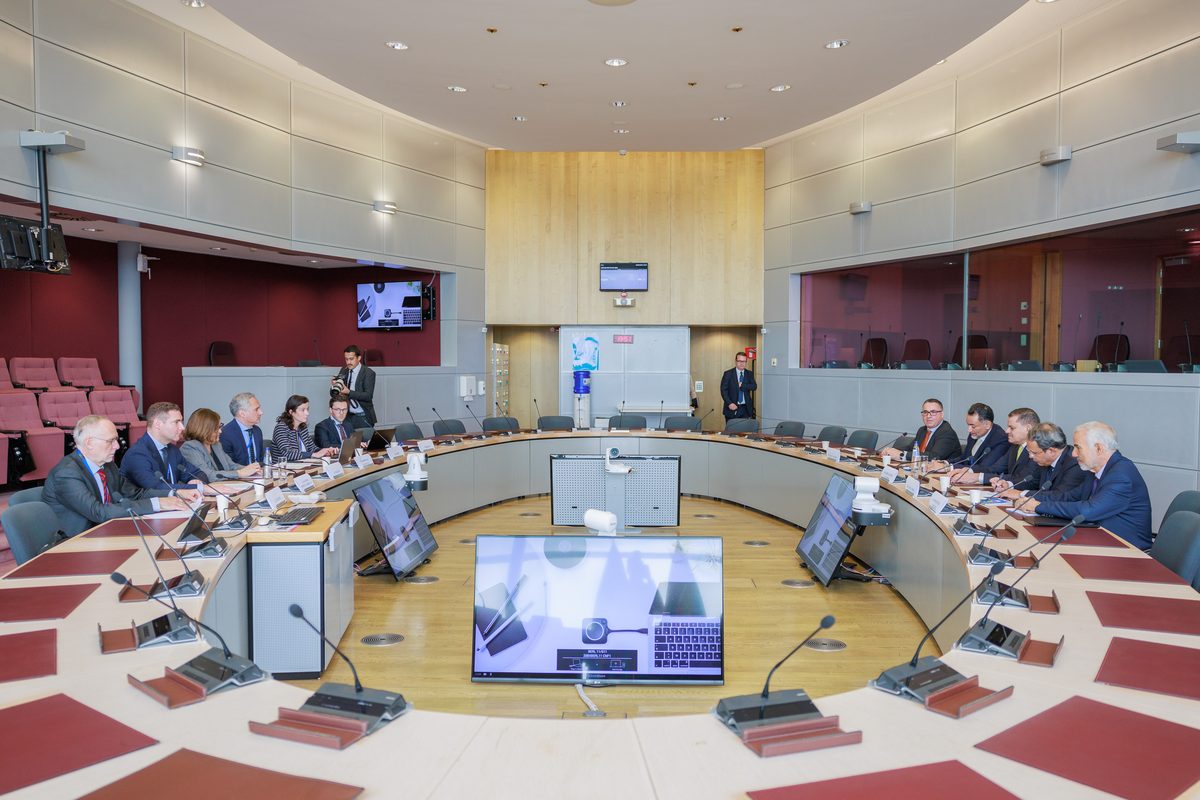
Libya has not had a single national budget since 2013, with two rival governments—one in Tripoli, one in the east—spending the country's oil wealth through separate, competing channels with no shared oversight. On April 11, 2026, representatives of both legislatures signed a US-mediated agreement on a unified 190 billion Libyan dinar (roughly $30 billion) budget covering four categories of state spending: salaries, development, subsidies, and operations.
The deal is the most concrete institutional step toward Libyan reunification since the country fractured after its 2014 civil war. But it's part of a broader US-led strategy criticized for prioritizing power-sharing among existing strongmen over elections. The real test: will fiscal unity lead to democratic governance or simply formalize the division of spoils between armed factions?
Why it matters
Africa's largest oil reserve holder just took its first real step toward ending a 13-year institutional split that has fueled migration crises, armed conflict, and Russian military expansion across the Sahel.
Questions about this story
Free account needed to ask — your question is kept and asked for you right after sign-up. Answers are public.
No questions yet — be the first to ask.
Key Indicators
190B
Libyan dinars in unified budget (~$30B)
First consensus on national spending since 2013, covering salaries, development, subsidies, and operations.
13
Years without a unified budget
Libya last operated under a single national budget in 2013, before the 2014 civil war split the country.
1.4M
Barrels per day of oil production
Libya hit a 10-year production high in 2025, generating $22 billion in oil revenue—roughly 90% of all government income.
73B
Dinars allocated to salaries
The largest single budget category, reflecting the massive public payrolls that both rival governments have used to maintain loyalty.
40B
Dinars for development projects
Aimed at reconstruction and balanced regional development across a country where infrastructure was devastated by years of war.
15 events
Latest: April 11th, 2026 · 5 months ago
Showing 8 of 15
JK to step
Tap a bar to jump to that date
Jump to
April 2026
First unified state budget signed in 13 years
LatestFiscal
The House of Representatives and High Council of State sign a US-mediated agreement on a 190 billion Libyan dinar budget—the first consensus on national spending since 2013. Central Bank governor Naji Issa confirms the deal covers all four budget categories.
February 2026
Boulos briefs UN Security Council on Libya integration plan
Diplomatic
Boulos tells the Security Council the US is pursuing concrete steps toward economic and military integration, including joint training exercises in Sirte planned for April.
January 2026
Paris talks at the Élysée Palace
Diplomatic
Ibrahim Dbeibah and Saddam Haftar meet under joint French-American sponsorship at the Élysée Palace, with Boulos and French envoy Paul Soler coordinating.
November 2025
Rival chambers agree on unified spending mechanism
Fiscal
The House of Representatives and High Council of State sign a preliminary agreement to unify spending channels, coordinated by the Central Bank—a precursor to the full budget deal.
September 2025
Secret Rome meeting between Haftar and Dbeibah representatives
Diplomatic
Saddam Haftar and Ibrahim Dbeibah meet in Rome under US and Italian mediation, with Massad Boulos present. The talks focus on institutional unification.
October 2024
Naji Issa appointed as compromise Central Bank governor
Political
The House of Representatives unanimously approves Naji Mohammed Issa Belqasem as the new governor, ending the Central Bank crisis and allowing oil production to resume.
August 2024
Central Bank governor forcibly removed; oil shutdown follows
Crisis
Armed forces remove long-serving Central Bank governor Sadiq al-Kabir from his Tripoli office. Eastern factions retaliate by shutting down oil production, cutting output dramatically.
December 2021
Planned elections collapse
Political
Presidential and parliamentary elections fall apart over disputes about candidacy rules. Dbeibah refuses to step down. The eastern parliament appoints a rival prime minister.
March 2021
Government of National Unity inaugurated
Political
Abdul Hamid Dbeibah becomes prime minister and Mohamed al-Menfi heads a presidential council, both chosen through a UN-facilitated dialogue. Their mandate: lead Libya to elections by December 2021.
June 2020
Tripoli offensive collapses after Turkish intervention
Conflict
Turkish military support—including drones and Syrian mercenaries—turns the tide against Haftar. A ceasefire follows in October 2020.
April 2019
Haftar launches offensive on Tripoli
Conflict
The Libyan National Army under Khalifa Haftar begins a 14-month siege of the capital, the most intense phase of fighting since 2011.
December 2015
Libyan Political Agreement signed in Skhirat, Morocco
Diplomatic
A UN-brokered deal creates the Government of National Accord under Fayez al-Sarraj, but it never wins full acceptance from eastern factions.
August 2014
Country splits as rival governments form
Political
After the Libya Dawn coalition seizes Tripoli, the newly elected House of Representatives relocates to Tobruk. Two rival governments begin competing for legitimacy and oil revenue.
January 2013
Last unified national budget passed
Fiscal
Libya's General National Congress approves the last budget covering the entire country. No unified spending plan would follow for 13 years.
October 2011
Muammar Gaddafi killed; Libyan civil war ends
Conflict
NATO-backed rebels capture and kill Gaddafi after an 8-month uprising, ending 42 years of authoritarian rule and plunging the country into a power vacuum.
Scenarios
1
Budget holds, military integration follows, elections delayed indefinitely
Likely
Discussed by: Middle East Monitor, The Arab Weekly, Libya Security Brief analysts who describe the 'Boulos Framework' as prioritizing stability over elections
The unified budget sticks and becomes the foundation for further institutional mergers—joint military exercises in Sirte, unified development spending, eventually a merged security apparatus. But elections keep slipping. The existing power-holders (Dbeibah in the west, Haftar in the east) formalize a power-sharing arrangement that amounts to partition-with-a-shared-checkbook. International actors accept this as 'good enough.' Libya stabilizes economically but remains a managed quasi-state without democratic legitimacy.
2
Budget deal triggers genuine political process toward elections
Possible
Discussed by: UNSMIL's Political Roadmap framework, which envisions institutional unification as a stepping stone to elections within 18 months
Fiscal unification builds enough trust and institutional capacity that political talks advance. The two legislatures agree on electoral laws, a unified government forms to oversee the process, and Libya holds its first national elections since 2014. This path requires Haftar, Dbeibah, and their networks to accept the risk of losing power through a ballot box—something neither has shown willingness to do.
3
Budget agreement collapses over implementation disputes
Possible
Discussed by: Analysts at The Geopolitical Desk and Manara Magazine who note that previous Libyan agreements have repeatedly failed at the implementation stage
The budget is signed but never meaningfully implemented. Disputes erupt over actual disbursements—who controls procurement, which regions get development funds, how salary rosters are verified. Eastern factions accuse the Central Bank of favoring Tripoli; western factions accuse eastern military commanders of diverting funds. Another oil shutdown becomes the leverage tool of choice. The deal joins the long list of signed-but-dead Libyan agreements.
4
Spoilers derail the process through violence or institutional sabotage
Unlikely
Discussed by: UN Security Council briefings where officials warned in February 2026 that Libya would 'explode again' without progress; Human Rights Watch concerns about armed actors
Actors excluded from the current framework—armed groups in western Libya, Saif al-Islam Gaddafi's supporters in the south, or Russian-aligned Africa Corps elements—decide the deal threatens their interests. Targeted violence, militia blockades of oil infrastructure, or institutional sabotage (a rival Central Bank board, legislative no-confidence votes) destabilizes the process. Regional powers with competing interests (Russia, Turkey, Egypt) may tacitly support spoilers.
Historical Context
3 moments from history that rhyme with this story — and how they unfolded.
1 of 3
May 1990 - July 1994
Yemen's 1990 Unification and 1994 Civil War
North and South Yemen unified in May 1990, merging their governments, budgets, and military forces on paper. But the two armies were never truly integrated, and disputes over power-sharing and oil revenue in the south led southern leader Ali Salem al-Beidh to declare secession in 1994. A brief civil war followed.
Then
Northern forces won the 1994 war in two months, reasserting central control. Southern leaders fled into exile.
Now
Southern grievances festered for decades, contributing to the Houthi insurgency and the civil war that began in 2014 and continues today.
Why this matters now
Yemen shows that budget and institutional unification without genuine military integration is fragile. Libya faces the same challenge: the Libyan National Army and western militias remain separate armed forces. The planned joint training exercises in Sirte are explicitly designed to address this gap.
2 of 3
November-December 1995
Bosnia-Herzegovina's Dayton Agreement (1995)
After three and a half years of war that killed roughly 100,000 people, the US brokered the Dayton Agreement to end the Bosnian conflict. The deal created a unified state containing two semi-autonomous entities—the Bosniak-Croat Federation and Republika Srpska—with a shared central government, unified currency, and joint fiscal mechanisms including a central indirect taxation authority.
Then
The war ended and a fragile peace held. International peacekeepers enforced the agreement. A unified Central Bank of Bosnia and Herzegovina was established.
Now
Thirty years later, Bosnia remains a functional but deeply divided state. The two entities maintain separate budgets and patronage networks. EU accession has stalled. The arrangement prevented further war but created institutional paralysis that critics call 'frozen conflict.'
Why this matters now
Libya's budget deal follows a similar logic to Dayton: use fiscal unification as institutional glue between armed factions that cannot be militarily defeated. Bosnia shows both the promise (war avoidance) and the risk (permanent institutional paralysis) of this approach.
3 of 3
January 2005
Sudan's Comprehensive Peace Agreement (2005)
After two decades of civil war between northern and southern Sudan, the Comprehensive Peace Agreement established oil revenue-sharing between Khartoum and the southern government. Oil wealth—split roughly 50-50—was the central mechanism holding the agreement together, much as Libya's oil revenue is the core incentive for budget unification.
Then
The agreement ended Africa's longest-running civil war and created the semi-autonomous Government of Southern Sudan. Oil revenues flowed to both sides as agreed.
Now
South Sudan voted for independence in 2011 and seceded. Without shared oil revenue binding them together, the two Sudans had little reason to stay united. South Sudan then collapsed into its own civil war in 2013.
Why this matters now
Sudan demonstrates that revenue-sharing can buy time but cannot substitute for genuine political integration. If Libya's budget deal remains a transactional arrangement between armed elites rather than a step toward shared governance, it risks a similar trajectory.