
Pull to refresh
Logo
Wolbachia mosquitoes cut dengue infections by 68.5% in Brazilian trial

Wolbachia mosquitoes cut dengue infections by 68.5% in Brazilian trial

New Capabilities

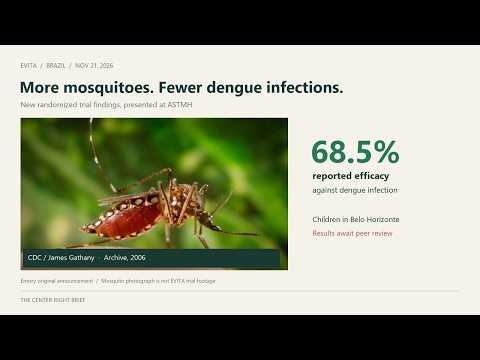
The four-year EVITA trial in Belo Horizonte also cut chikungunya by 73.3%, giving the World Health Organization its clearest evidence yet on a method Brazil is already scaling

Overview

Updated 1 hour ago

In 2024, roughly one in 10 people in Belo Horizonte caught dengue. Brazil's third-largest city was at the center of the country's largest recorded outbreak. In 29 neighborhoods where researchers had released mosquitoes carrying a common insect bacterium, children got dengue 68.5% less often than children in 29 comparable neighborhoods.

The four-year EVITA trial is the first large randomized test of the Wolbachia method in Brazil, and the first anywhere to show a clear drop in chikungunya as well. The bacterium spreads through local mosquito populations on its own, so a finite release can keep working for years. That is what makes the result a policy question now rather than a laboratory one.

Why it matters

If the method holds, city-scale mosquito releases could cut dengue across the tropics without a vaccine for each strain.

Questions about this story

Free account needed to ask — your question is kept and asked for you right after sign-up. Answers are public.

No questions yet — be the first to ask.

Key Indicators

68.5%
Drop in dengue infections
Reduction among children in the 29 neighborhoods that received Wolbachia mosquitoes versus control areas.
73.3%
Drop in chikungunya infections
The first randomized trial evidence that the method protects against a second virus.
5,757
Children enrolled
Students aged six to 11 whose blood was tested for antibodies to dengue, Zika and chikungunya.
58
School catchment areas in the trial
Half were randomized to mosquito releases plus standard control, half to standard control alone.
77%
Dengue reduction in the earlier Yogyakarta trial
The 2021 Indonesian trial that first gave randomized evidence for the method.
150 million
Wolbachia mosquito eggs produced weekly in Brazil
Output of a facility in southern Brazil, according to Fiocruz entomologist Luciano Moreira.

Voices

Curated perspectives — historical figures and your fellow readers.

Sign up to generate historical perspectives on this story.

People Involved

Organizations Involved

Timeline

2011 November 2026

7 events Latest: Yesterday
Tap a bar to jump to that date
  1. Results reach public coverage; WHO review and peer review pending

    Latest Publication

    Reports cite the 68.5% dengue and 73.3% chikungunya reductions and note the findings are not yet peer reviewed.

  2. EVITA results presented: dengue down 68.5%, chikungunya down 73.3%

    Research

    Data presented at the American Society of Tropical Medicine and Hygiene annual meeting; Zika cases were too few to assess.

  3. Brazil records its largest dengue outbreak on record

    Outbreak

    Roughly one in 10 Belo Horizonte residents falls ill, testing the method under intense transmission.

  4. Mosquito releases begin across 29 Belo Horizonte neighborhoods

    Intervention

    Infected mosquitoes reared in a refurbished health clinic are released from moving cars until May 2022.

  5. Yogyakarta trial reports 77% dengue reduction

    Research

    The Indonesian randomized trial gives the first strong human evidence for the method.

  6. EVITA enrolls its first children, then moves enrollment home

    Research

    COVID-19 school closures make the planned school-based recruitment impossible; the team enrolls families at home instead.

  7. Wolbachia establishes itself in wild Australian mosquitoes

    Research

    Releases in Cairns show the bacterium can spread through a wild Aedes aegypti population and stay there.

Scenarios

1

WHO issues global guidance endorsing Wolbachia mosquito releases

Possible Resolves by End of 2027

Discussed by: Diana Rojas Alvarez of the WHO Global Arbovirus Initiative, who said a Guideline Development Group will consider the data

The WHO's guideline process reviews trial evidence and issues recommendations countries can adopt. Alvarez said the group would act if the evidence is sufficiently strong. A formal recommendation would push the method into national disease-control plans outside Brazil, especially in Southeast Asia and Latin America.

2

Brazil expands Wolbachia releases to dozens of cities

Likely Resolves by End of 2027

Discussed by: Fiocruz entomologist Luciano Moreira, who said a multi-city expansion is planned for next year

Releases already cover Belo Horizonte, and the country has production capacity for up to 150 million infected eggs a week. Expansion depends on municipal health departments accepting releases and on the federal health ministry funding them. If it happens, Brazil becomes the largest test of whether the method works at national scale.

3

Peer review confirms the efficacy estimates

Likely Resolves by Q3 2027

Discussed by: The trial authors and Fiocruz, which described the results as preliminary and awaiting journal publication

The numbers presented in November 2026 have not been through journal peer review. Publication would let health agencies and other researchers check the statistical methods, the antibody testing and how the team handled the 2024 vaccine rollout. A published paper is the version that guideline bodies cite.

Historical Context

3 moments from history that rhyme with this story — and how they unfolded.

2011

Cairns Wolbachia release (2011)

Scott O'Neill's team released Aedes aegypti mosquitoes carrying the wMel strain of Wolbachia in Cairns, Australia. The bacterium passed from females to their offspring and spread through the local mosquito population without further releases.

Then

The bacterium established itself in wild mosquitoes, proving the invasion mechanism worked outside a lab.

Now

It turned Wolbachia from a lab curiosity into a deployable public health tool and set up the trials that followed.

Why this matters now

EVITA depends on the same self-spreading property: a limited release that keeps working for years without repeat spraying.

2017-2020

Rio de Janeiro Wolbachia release (2017-2020)

A Brazilian release program in Rio de Janeiro measured only a modest reduction in dengue and chikungunya cases, well below what earlier trials had suggested.

Then

The weaker result left health agencies uncertain about how well the method travels between cities and climates.

Now

It made a second, larger randomized trial in Brazil necessary before national scale-up could be justified.

Why this matters now

EVITA exists partly to answer the doubt Rio created, and its much larger effect is why researchers now describe two independent trials pointing the same way.

2021

Yogyakarta Wolbachia trial (2021)

In 12 randomly selected areas of Yogyakarta, Indonesia, researchers released Wolbachia-infected mosquitoes and compared dengue rates with surrounding areas. Residents in treated areas were 77% less likely to get dengue.

Then

It was the first randomized human evidence that the method reduces disease, not just mosquito infection.

Now

It became the benchmark against which later trials, including EVITA, are measured.

Why this matters now

EVITA's 68.5% result is the second independent randomized confirmation, which is what makes the case for global guidance stronger.

Sources

(9)