


Pull to refresh
Logo
Marlowe raises $277M to build AI factories around non-Nvidia chips

Marlowe raises $277M to build AI factories around non-Nvidia chips

Money Moves

A six-month-old startup with no open site and three unnamed customers is valued at $1.15 billion on the bet that inference, not training, decides who sells AI compute.

Overview

Updated 9 minutes ago

Dan Lewis and Kutta Srinivasan left Microsoft in May 2026 to build data centers for AI inference, the work of running models inside products rather than training them. Six months later, with no site open and no customer named publicly, investors put a $1.15 billion valuation on the company.

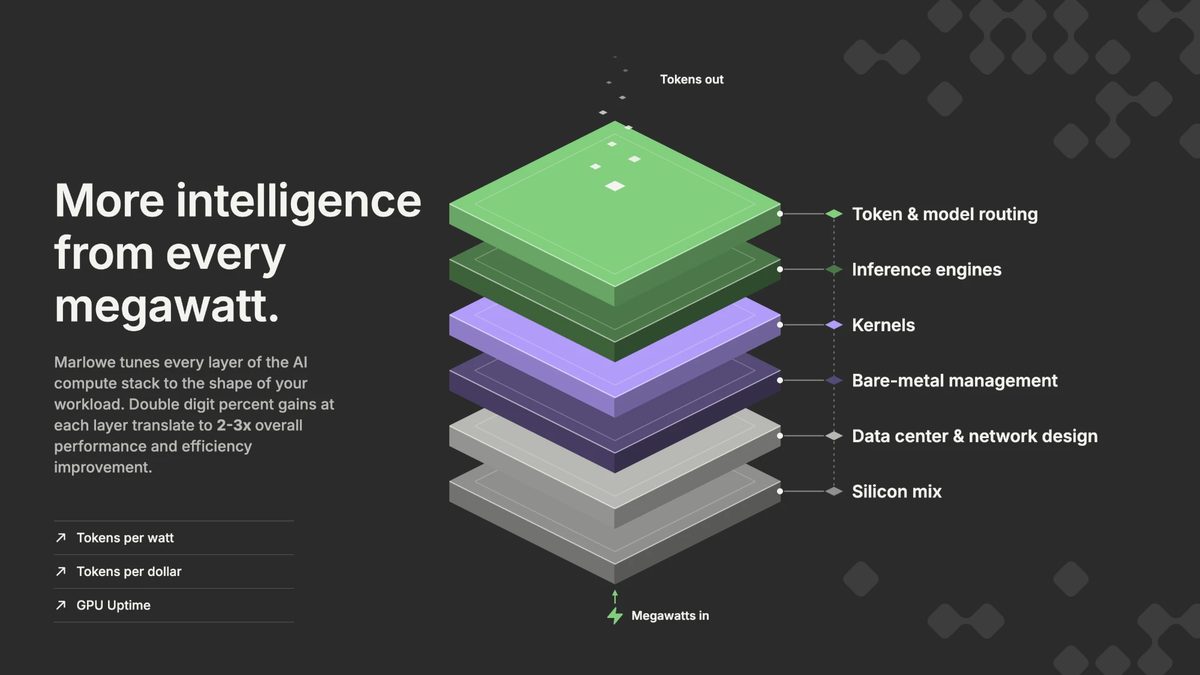
Marlowe designs and operates AI data centers on chips from AMD and Etched instead of Nvidia, which supplies most of the market. It tunes networking, power management and software to each customer's workload, and says the result is two to three times more output per watt and per dollar than standard GPU clouds. The $277 million seed round, led by Accel, is the money to test that claim.

Why it matters

Most AI you use runs on inference. If non-Nvidia chips can be made to work at scale, that inference gets cheaper for everyone.

Questions about this story

Free account needed to ask — your question is kept and asked for you right after sign-up. Answers are public.

No questions yet — be the first to ask.

Key Indicators

$277M
Seed round
Led by Accel, with a smaller earlier tranche led by Eclipse included in the total.
$1.15B
Valuation at seed
Marlowe reached unicorn status within about six months of being founded.
30
Employees
The company is approaching 30 people, split between Bellevue and Redwood City, California.
40%
Rise in data center construction costs since 2020
Marlowe cites the figure to argue every watt of power must now work harder.
2-3x
Claimed tokens per watt versus standard GPU clouds
A company projection, not an independently audited benchmark.
3
Sites under contract or letter of intent
The first, on Etched chips, is due in December 2026; a second, on AMD Helios, in the second quarter of 2027.

Voices

Curated perspectives — historical figures and your fellow readers.

Sign up to generate historical perspectives on this story.

People Involved

Organizations Involved

Timeline

May 2026 November 2026

5 events Latest: Today
Tap a bar to jump to that date
  1. Marlowe raises $277 million seed at $1.15 billion valuation

    Today Funding

    Accel leads the round, joined by Bessemer, Altimeter, Atreides, Journey and Valor, plus individual investors Henry Kravis and Dara Khosrowshahi. The company says it has three signed customer agreements.

  2. Nvidia's board reinstates Jensen Huang as chief executive

    Today Leadership

    The board reverses Huang's resignation less than two weeks after he stepped down, a leadership shake-up at the company Marlowe is built to compete with.

  3. General Compute raises $100M for mixed-chip clouds

    Funding

    A third startup joins the same thesis: rent capacity built on whichever chip is cheapest for a given workload.

  4. Gimlet Labs raises $300M at $3B for mixed-chip inference

    Funding

    A competing inference cloud built on a mix of chips shows investors will fund Nvidia alternatives at scale.

  5. Marlowe founded by two Microsoft AI executives

    Founding

    Dan Lewis and Kutta Srinivasan start the company in Bellevue and Redwood City, targeting inference rather than training.

Scenarios

1

Marlowe's first site opens and a customer puts its name on it

Possible Resolves by Q1 2027

Discussed by: Marlowe's founders, in interviews with GeekWire and Bloomberg

The company says its first site, built on Etched chips, goes live in December 2026 and primarily serves a large AI coding company it has not identified. A live site with a named customer would be the first public evidence that tuning around non-Nvidia silicon works outside a pitch deck. Both facts are currently self-reported.

2

Marlowe adds a fourth site or raises another round

Possible Resolves by Q3 2027

Discussed by: GeekWire, citing Marlowe's site-by-site financing plan

Lewis says Marlowe will prove the model at sites of tens of megawatts and finance more capacity one site at a time, rather than chasing one giant facility. A fourth site or a new equity round would show the first two sites convinced either customers or investors to keep funding that pace.

3

Marlowe ends up deploying Nvidia chips anyway

Unlikely Resolves by Q2 2028

Discussed by: Dan Lewis, who said the company has not ruled Nvidia out

The whole thesis rests on non-Nvidia silicon beating Nvidia on cost per token for real customer workloads. If tuning cannot close the gap, the hedge Lewis left open becomes the business, and Marlowe looks more like the Nvidia-based clouds it was founded to undercut.

Historical Context

2 moments from history that rhyme with this story — and how they unfolded.

2015-2023

Convoy shuts down (2023)

Dan Lewis co-founded Convoy, a digital freight marketplace that matched truckers with shippers. It reached a $3.8 billion valuation on venture funding, then closed in 2023 as freight rates fell and venture capital tightened.

Then

The company shut down and investors lost their stakes.

Now

Lewis moved to Microsoft's enterprise AI group, where he concluded that demand for inference was outrunning data center supply.

Why this matters now

Marlowe is Lewis's second capital-intensive business with thin control over the market it sells into. He argues a mix of long- and short-term contracts across several customers will keep it from depending on one buyer the way Convoy depended on freight cycles.

2026

CoreWeave's Nvidia-only cloud (2026)

CoreWeave built one of the largest AI clouds almost entirely on Nvidia chips and became the reference model for renting AI compute. As of September 30, 2026, Nvidia held about 47 million CoreWeave shares, and CoreWeave had taken on roughly $47 billion in debt to build its data centers.

Then

It set the market price for AI compute and became the standard example of single-supplier dependence.

Now

Its scale is the benchmark any multi-silicon cloud has to beat on cost per token.

Why this matters now

Marlowe is selling the opposite trade: spread across chip vendors to lower cost per token, and avoid the debt that comes with buying one vendor's systems at scale.

Sources

(7)