
Pull to refresh
Logo
Moth-inspired robot grows its own UV sensor

Moth-inspired robot grows its own UV sensor

New Capabilities

A proof-of-concept from Tartu and IIT uses artificial blood vessels and UV light to polymerize a sensor inside a robotic wing.

Overview

Updated 1 hour ago

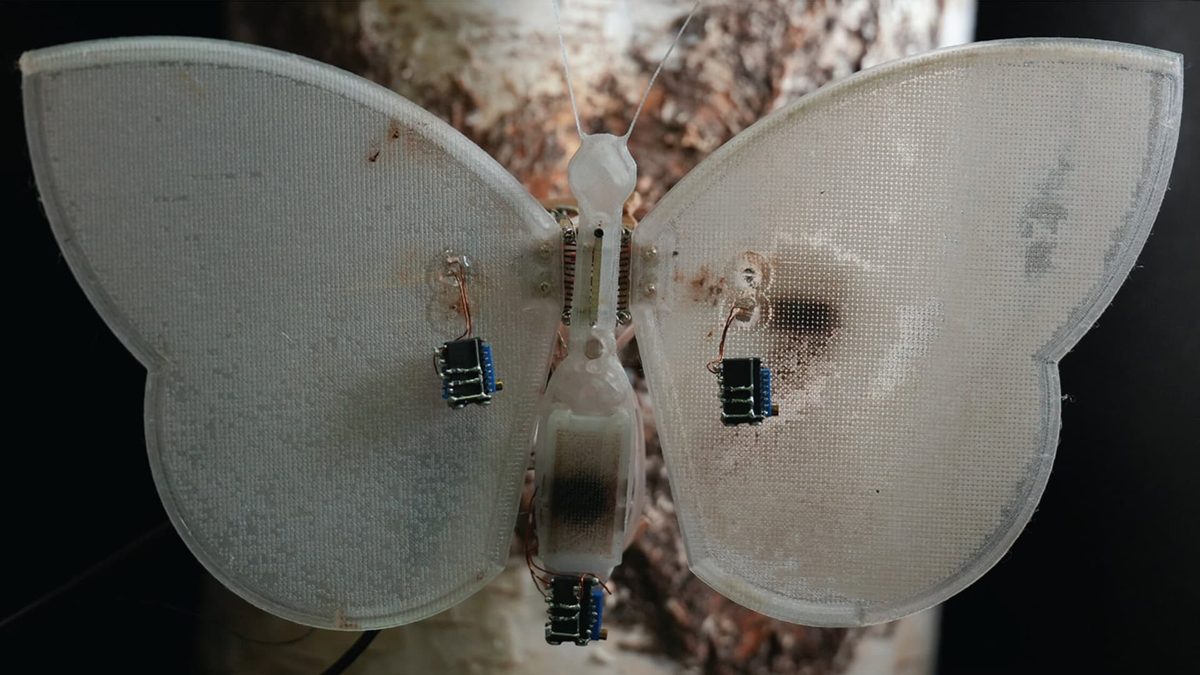
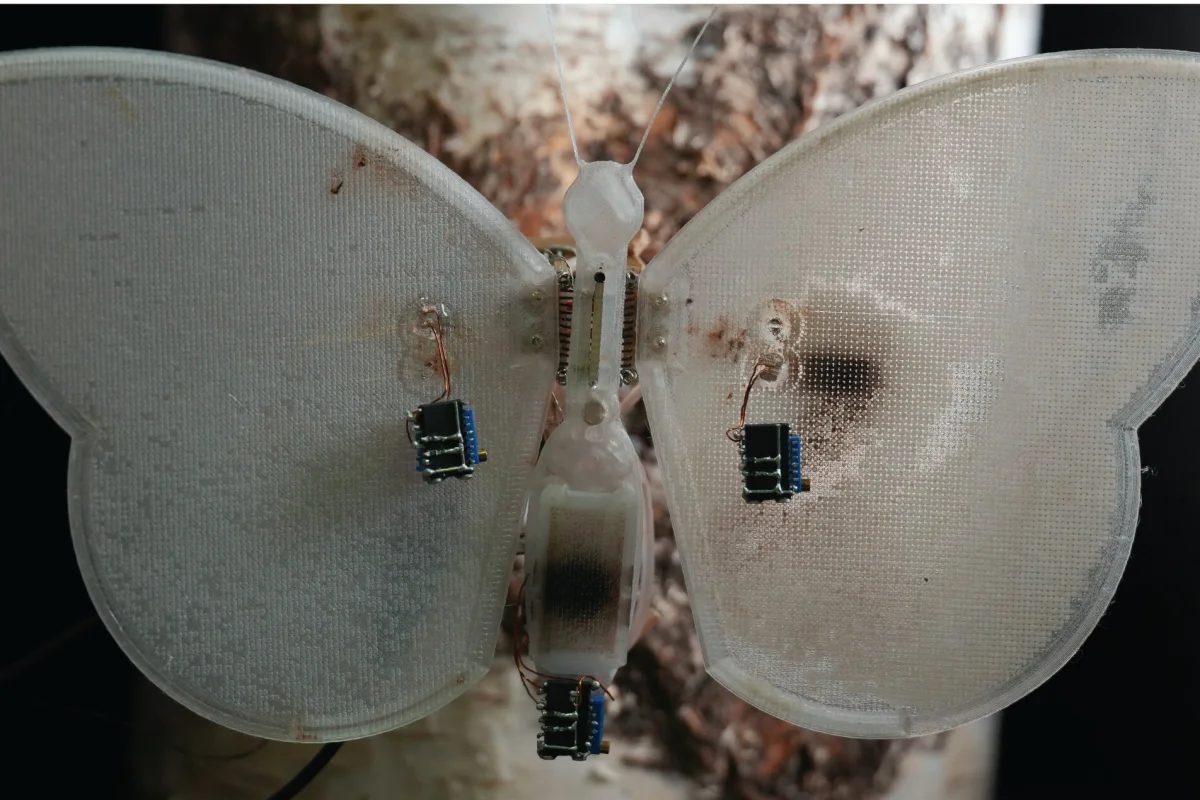
A moth-shaped robot can grow an ultraviolet (UV) sensor inside its wing after a strong dose of UV light. The machine flushes a liquid precursor through artificial blood vessels, then uses UV exposure to polymerize a conductive plastic where the light lands.

The demonstration is a proof of concept. It uses one pre-designed chemical recipe, the sensor cannot be erased, and humans prime the vascular system. The researchers present it as a step toward robots that add hardware after deployment.

Why it matters

If robots can fabricate sensors after deployment, they could adapt to local conditions instead of carrying every sensing capability from the factory.

Questions about this story

Free account needed to ask — your question is kept and asked for you right after sign-up. Answers are public.

No questions yet — be the first to ask.

Key Indicators

60 s
UV exposure to form the sensor
A 365 nm UV LED dose polymerizes pyrrole inside the wing.
0.3 mm
Spatial resolution
A contact mask localizes sensor formation to exposed areas.
3 mL
Internal vascular volume
The moth-shaped body holds about 3 milliliters of circulatory fluid.
4+ months
Storage stability
The synthesized receptor retained function after more than four months of storage.

Voices

Curated perspectives — historical figures and your fellow readers.

Sign up to generate historical perspectives on this story.

Organizations Involved

Timeline

August 2026 November 2026

2 events Latest: Yesterday
  1. Tartu and IIT researchers report the self-growing UV sensor

    Latest Report

    The reported demonstration uses a pre-designed chemical pathway; sensor formation is irreversible and requires human priming of the vascular system.

  2. Advanced Science publishes the proof of concept

    Publication

    The paper describes UV-triggered polymerization of polypyrrole inside a PETG vascular system and a moth-inspired robot that flaps its wings after sensing UV.

Scenarios

1

Independent lab replicates in-body sensor growth

Possible Resolves by Nov 7, 2027

Discussed by: The Tartu and IIT authors present the work as a proof of concept; outside robotics researchers have not yet reported a replication.

A separate research group builds a vascularized robot and grows a working sensor inside its body using a published chemical route. Replication would move the result from a single-lab demonstration toward a general technique.

2

Robot chooses its own sensor recipe

Unlikely Resolves by Nov 7, 2028

Discussed by: Coverage in New Atlas and Interesting Engineering notes that the current system cannot decide which hardware it needs; autonomy is an open research step.

A future robot selects a precursor chemistry or release location without human input and grows a sensor suited to a detected task. This would require combining chemical supply, sensing, and decision-making in one platform.

3

Untethered robot uses a grown sensor in the field

Unlikely Resolves by Nov 7, 2029

Discussed by: The published demonstration uses external UV light, external power for wing actuation, and human priming; field autonomy is not claimed.

A robot with on-board power and precursor supply grows and uses a sensor outside a controlled laboratory. This would test whether the approach survives variable light, temperature, and fluid handling.

Historical Context

2 moments from history that rhyme with this story — and how they unfolded.

2005

RepRap self-replicating 3D printer project (2005)

Adrian Bowyer launched RepRap, an open-source project to build 3D printers that could print many of their own plastic parts. The machines could fabricate components, but electronics, motors, and assembly still came from outside the printer.

Then

Hobbyists built and modified RepRap machines, helping spread low-cost desktop 3D printing.

Now

Self-replication stayed partial. The project showed both the promise and the limits of machines making their own hardware.

Why this matters now

The moth robot goes further by growing a functional sensor inside its body, but it still depends on human-supplied precursors and external UV light.

2014

First 3D printer on the International Space Station (2014)

NASA and Made In Space sent a 3D printer to the International Space Station. Astronauts used it to print tools and parts on orbit instead of waiting for resupply missions.

Then

The station demonstrated that additive manufacturing could work in microgravity.

Now

On-demand manufacturing became part of space logistics planning, though most station hardware still arrives prebuilt.

Why this matters now

Both projects aim to manufacture after deployment. The difference is that the ISS printer makes replacement objects, while the moth robot aims to make a sensing organ inside its own body.

Sources

(5)