British Columbia becomes first major jurisdiction to adopt permanent daylight saving time, testing a reform 19 U.S. states have approved but cannot implement
British Columbia becomes first major jurisdiction to adopt permanent daylight saving time, testing a reform 19 U.S. states have approved but cannot implement
British Columbia sprung its clocks forward on March 8, 2026, but will not fall back in November—it adopted permanent daylight saving time at UTC-7. The five-million-person province is the first major North American jurisdiction to lock its clocks since Arizona and Hawaii opted out in the late 1960s.
The move exposes a widening gap between public demand and legislative gridlock. Nineteen U.S. states have passed laws to adopt permanent daylight saving time, but federal law prevents them from acting without Congressional approval. The U.S. Senate passed the Sunshine Protection Act by unanimous consent in 2022, only for it to die in the House.
The bill was reintroduced in January 2025 and remains stalled. BC decided to stop waiting. Starting November 2026, Vancouver will be one hour ahead of Seattle during winter months—a live experiment in whether cross-border misalignment or biannual clock chaos is the bigger disruption.
Questions about this story
Free account needed to ask — your question is kept and asked for you right after sign-up. Answers are public.
No questions yet — be the first to ask.
Key Indicators
93%
BC public support
Share of 223,273 respondents in BC's 2019 provincial survey who supported ending clock changes
19
U.S. states waiting
States that have passed permanent DST legislation but cannot implement it without federal authorization
1 hour
Winter offset with Seattle
Starting November 2026, BC will be one hour ahead of Washington state and the rest of the U.S. Pacific coast during winter
~9:08 AM
Vancouver winter sunrise
Approximate sunrise time on the December solstice under permanent DST, about one hour later than under standard time
17 events
Latest: March 8th, 2026 · 7 months ago
Showing 8 of 17
JK to step
Tap a bar to jump to that date
Jump to
March 2026
BC springs forward for the final time
LatestImplementation
British Columbia's clocks moved forward one hour at 2:00 AM, beginning the province's permanent adoption of UTC-7. Communities in eastern BC on Mountain Time were not affected. The change will be fully in effect after November 1, when clocks do not fall back.
Eby calls on U.S. West Coast governors to follow
Statement
Premier Eby urged governors in Washington, Oregon, and California — all of which have passed conditional permanent DST laws — to join British Columbia in ending clock changes.
BC announces permanent DST adoption
Policy
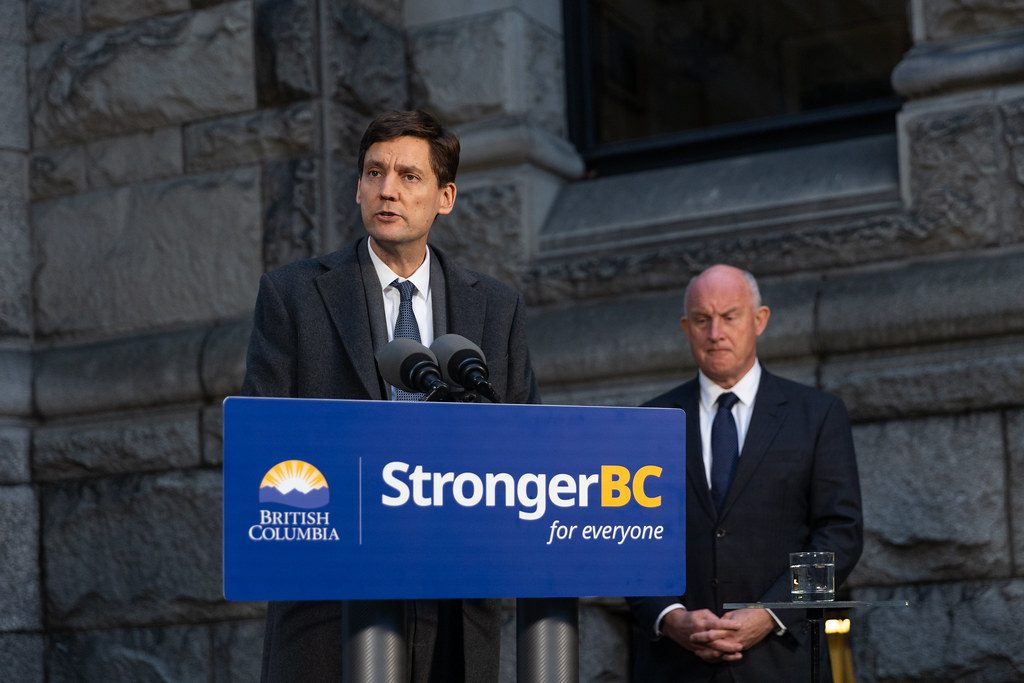
Premier David Eby and Attorney General Niki Sharma announced that British Columbia would activate Bill 40 by regulation, citing "recent actions from the United States" and nearly seven years of waiting. Clocks would spring forward one final time on March 8.
February 2026
Novel U.S. bill proposes splitting the difference at 30 minutes
Legislative
Representative Steube introduced the Daylight Act, which would permanently shift clocks forward 30 minutes from standard time — a compromise between standard time and DST — and eliminate all future changes.
January 2025
Sunshine Protection Act reintroduced in 119th Congress
Legislative
Senator Rick Scott introduced S.29 with 18 bipartisan cosponsors. A companion bill, H.R. 139, was introduced in the House. Neither has advanced out of committee.
October 2023
Sleep medicine group endorses permanent standard time
Scientific
The American Academy of Sleep Medicine, backed by 20 medical organizations including the American Medical Association, published a position statement calling permanent standard time — not permanent DST — the optimal choice for health.
October 2022
Mexico abolishes DST for most of the country
Legislative
Mexico ended clock changes for most of the country under President Andres Manuel Lopez Obrador. Border municipalities that coordinate economically with U.S. states continued observing DST on the American schedule.
March 2022
U.S. Senate passes Sunshine Protection Act unanimously
Legislative
The Senate approved the bill by unanimous consent, though some senators later said they were unaware it was being called for a vote. The bill never received a vote in the House and expired at the end of the 117th Congress.
November 2020
Yukon adopts permanent DST
Policy
Yukon became the first Canadian jurisdiction to adopt permanent daylight saving time, moving to year-round UTC-7. The change later drew complaints about dark winter mornings and caused electronic calendar glitches.
November 2019
BC passes Bill 40 enabling permanent DST
Legislative
The Interpretation Amendment Act received Royal Assent under Premier John Horgan but was not brought into force. The government chose to wait for Washington, Oregon, and California to act first.
June 2019
BC launches public consultation on clock changes
Consultation
British Columbia opened a province-wide survey that drew 223,273 responses — a record for BC government consultations. Ninety-three percent of respondents supported ending biannual clock changes.
March 2018
Rubio introduces the Sunshine Protection Act
Legislative
Senator Marco Rubio introduced the first federal bill to make daylight saving time permanent nationwide, modeled on a Florida state law passed the same year.
January 1974
U.S. begins year-round DST experiment
Policy
President Nixon signed the Emergency Daylight Saving Time Energy Conservation Act during the OPEC oil embargo. Public approval collapsed from 79% to 42% within two months as children went to school in pitch darkness. The experiment was cut short after eight months.
1968
Arizona opts out of DST permanently
Legislative
After a single summer of observing DST in 1967, Arizona abandoned the practice permanently, finding that extra afternoon sunlight increased air conditioning costs in the desert climate.
April 1966
Uniform Time Act standardizes DST across the U.S.
Legislative
Congress established uniform DST dates and allowed states to opt out entirely but prohibited them from adopting permanent DST without federal authorization.
January 1966
Saskatchewan adopts permanent standard time
Legislative
Saskatchewan stopped changing clocks, observing Central Standard Time year-round. The province effectively operates on permanent mountain daylight time relative to its geographic position.
March 1918
U.S. adopts daylight saving time for World War I
Legislative
The United States passed its first DST law to conserve fuel for the war effort. The measure was repealed the following year after the war ended.
Scenarios
1
U.S. Congress passes Sunshine Protection Act, West Coast aligns with BC
Possible
Discussed by: Senator Rick Scott and 18 bipartisan cosponsors; editorial boards at The Seattle Times and The Oregonian; sleep policy analysts note BC's move increases political pressure
BC's unilateral action creates a live demonstration of permanent DST on the U.S. border, increasing pressure on Congress to authorize what 19 states have already approved. If the Sunshine Protection Act passes, Washington, Oregon, and California would likely activate their existing laws quickly, eliminating the winter time gap with BC. This scenario becomes more likely if the 2026-2027 winter experiment in BC proceeds without major complaints and if Trump throws executive weight behind legislation.
2
Winter backlash forces BC to reconsider as dark mornings draw complaints
Possible
Discussed by: Sleep researchers at Simon Fraser University and the American Academy of Sleep Medicine; the Greater Vancouver Board of Trade; analysts citing the failed 1974 U.S. experiment
When November 2026 arrives and clocks don't fall back, Vancouver faces 9:08 AM sunrises at the December solstice. Parents, school districts, and sleep researchers amplify complaints about children commuting in darkness. The 1974 U.S. precedent looms: public approval of year-round DST dropped from 79% to 42% after one winter. Yukon's experience with calendar glitches and dark-morning frustration offers a smaller-scale preview. Cross-border businesses along the Vancouver-Seattle corridor document scheduling disruptions. Pressure mounts on the Eby government to revisit the decision or switch to permanent standard time instead.
3
Other Canadian provinces follow BC, creating a patchwork that forces federal coordination
Possible
Discussed by: Alberta Premier Danielle Smith (announced consultations); Ontario government (has conditional legislation); Canadian time policy analysts
Alberta Premier Danielle Smith has already signaled interest in ending clock changes following BC's announcement. Ontario has legislation ready, contingent on New York and Quebec acting. If Alberta moves to permanent DST, it would align with BC year-round since both would observe UTC-7. A westward cascade of provinces could pressure the federal government to establish a national framework, potentially resolving the DST-versus-standard-time question through federal coordination rather than province-by-province action.
4
Stalemate persists: BC remains an island for years as Congress and other provinces stall
Likely
Discussed by: GovTrack (estimates 4% chance of Sunshine Protection Act passage); legislative analysts tracking Congressional gridlock on non-priority issues
Congress remains gridlocked on DST legislation, treating it as a low-priority issue. Alberta's consultation produces mixed results similar to its 2021 referendum (which failed 50.2% to 49.8%). Ontario remains blocked by New York's inaction. BC operates in a unique time zone for years — aligned with Alberta in winter but one hour ahead of the U.S. Pacific coast. Businesses adapt gradually, and the disruption proves manageable but annoying, neither dramatic enough to reverse nor compelling enough to spur neighbors into action.
Historical Context
3 moments from history that rhyme with this story — and how they unfolded.
1 of 3
January-October 1974
U.S. year-round DST experiment (1974)
During the OPEC oil embargo, President Nixon signed legislation making daylight saving time year-round, claiming it would save 150,000 barrels of oil daily. Public approval started at 79%. By February — after one month of dark winter mornings — it had dropped to 42%. Eight children in Florida were hit by cars while walking to school before sunrise, and a television commentator coined the term "Daylight Disaster Time."
Then
Congress repealed the experiment after eight months, restoring standard time in October 1974. The Department of Transportation found the change saved little energy and may have increased gasoline consumption.
Now
The 1974 experience became the primary cautionary tale against permanent DST. It demonstrated that public enthusiasm for evening light evaporates when winter morning darkness becomes a daily reality — a pattern BC's critics warn will repeat.
Why this matters now
BC faces the same fundamental trade-off: 93% public support was measured in a summer survey. The real test comes in November 2026, when Vancouver's sun won't rise until after 9 AM. The 1974 precedent suggests public opinion can shift dramatically once the consequences become tangible.
2 of 3
November 2020-present
Yukon's permanent DST adoption (2020)
Yukon became the first jurisdiction in western Canada to lock its clocks at UTC-7, stopping the November 2020 fallback. The territory of roughly 43,000 people served as a small-scale test case for the exact policy BC has now adopted. Electronic calendars following Pacific Standard Time displayed appointments an hour off, causing scheduling confusion. Dark winter mornings — sunrise past 10 AM in Whitehorse at the solstice — drew criticism from residents and sleep researchers.
Then
Technology companies updated timezone databases, but some scheduling software remained glitchy for months. Residents adjusted but complaints about winter darkness persisted.
Now
Yukon has not reversed the decision. However, its small population and limited cross-border commercial activity meant the stakes were far lower than for BC, which has 100 times more residents and shares one of North America's busiest border corridors.
Why this matters now
Yukon provided both a proof of concept and a warning. The decision stuck in a small, remote territory — but BC's experiment involves five million people and the economically critical Vancouver-Seattle corridor, amplifying both the benefits and the risks.
3 of 3
1966-present
Saskatchewan's permanent standard time (1966)
After decades of chaotic timekeeping — with different cities observing different time rules — Saskatchewan held a 1956 plebiscite and ultimately passed The Time Act in 1966, locking the province on Central Standard Time year-round. Because Saskatchewan sits geographically in the Mountain Time Zone, it effectively operates on permanent mountain daylight time without calling it that.
Then
The province resolved a generation of scheduling confusion. Urban areas that had favored Central time and rural areas that had favored Mountain time both accepted the unified system.
Now
Sixty years later, Saskatchewan's system is unremarkable. Residents rarely think about it. The province demonstrates that eliminating clock changes is entirely workable — the question is which offset to choose, not whether to stop switching.
Why this matters now
Saskatchewan proves the endpoint is stable: once a jurisdiction stops changing clocks and people adjust, the issue fades from public consciousness. The debate is about the transition period and the specific offset chosen, not whether permanent time can work.