
Pull to refresh
Logo
Norway's new car market is now almost entirely electric

Norway's new car market is now almost entirely electric

New Capabilities

Electric cars hit 98.7% of August registrations as the country nears its goal of ending combustion-engine sales

September 8th, 2026: August data shows record 98.7% EV share

Overview

Updated 1 hour ago

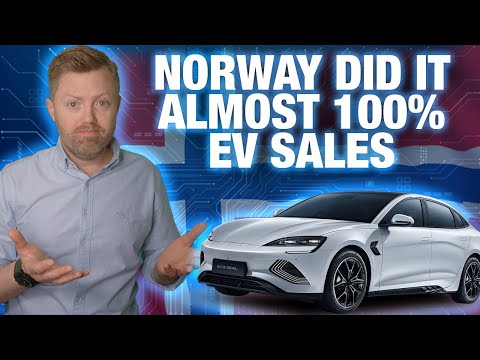
Norway registered 13,451 new passenger cars in August. All but 177 were battery-electric, a record 98.7% share, up from 96.9% a year earlier. No other country comes close.

The milestone caps a 35-year policy push that exempted electric cars from purchase taxes and VAT, let them use bus lanes, and waived tolls. Now that nearly every new buyer chooses electric anyway, the government is phasing out those incentives. The next bottleneck is the existing fleet, where only about a third of registered cars are electric.

Why it matters

Norway's success shows a full electric-vehicle transition is possible. Its next challenge is replacing the millions of combustion cars still on its roads.

Questions about this story

Free account needed to ask — your question is kept and asked for you right after sign-up. Answers are public.

No questions yet — be the first to ask.

Key Indicators

98.7%
August 2026 EV share of new passenger cars
Record monthly share, up from 96.9% a year earlier.
97.8%
2026 year-to-date EV share
Up from 94.5% in the same period of 2025.
32.2%
EV share of total passenger car fleet
About 945,000 electric cars registered at end of 2025.
13,451
New passenger cars registered in August 2026
Down 3.4% from August 2025 as the market shrinks.

Voices

Curated perspectives — historical figures and your fellow readers.

Ever wondered what historical figures would say about today's headlines?

Sign up to generate historical perspectives on this story.

People Involved

Organizations Involved

Timeline

January 1990 September 2026

8 events Latest: September 8th, 2026 · 2 weeks ago
Tap a bar to jump to that date
  1. August data shows record 98.7% EV share

    Latest Data Release

    August data shows record 98.7% electric share of new passenger cars.

  2. VAT exemption begins phasing out

    Policy

    VAT exemption begins phasing out on cars above a price threshold.

  3. Zero-emission target met

    Milestone

    Electric cars hit 95.9% of new car sales; zero-emission target met. Fleet share reaches 32.2%.

  4. Electric cars reach 88.9% of annual sales

    Market

    Electric cars reach 88.9% of new car sales for the year.

  5. Tesla cuts prices

    Market

    Tesla cuts prices sharply, offsetting new taxes and keeping electric sales strong.

  6. Battery-electric cars reach 79% of sales

    Market

    Battery-electric cars reach 79% of new car sales as model availability expands.

  7. Zero-emission target set

    Policy

    Government sets target: all new cars zero-emission by 2025.

  8. Norway introduces first EV incentives

    Policy

    Norway exempts electric cars from purchase tax, beginning a 35-year policy push.

Scenarios

1

Norway posts first 100% electric month for new car sales

Likely Resolves by End of 2027

Discussed by: OFV and industry analysts tracking monthly registration data

With EV share at 98.7% in August and combustion sales shrinking to a few dozen cars per month, Norway could post a calendar month with 100% electric new passenger car registrations. The remaining 1.3 percentage points include a handful of petrol, diesel, and hybrid sales each month. A 100% month would be symbolic, confirming the market has fully turned.

2

Norway's fleet turnover stalls as old petrol cars linger

Likely Resolves by Q1 2027

Discussed by: OFV director Geir Inge Stokke and Statistics Norway

New car sales are nearly all electric, but only 32.2% of Norway's registered passenger cars are electric. The remaining two-thirds are petrol and diesel vehicles that will take years to leave the fleet. If fleet turnover slows, Norway's transport emissions will plateau even as new car sales stay electric.

3

Incentive phase-out slows Norway's EV adoption

Unlikely Resolves by End of 2028

Discussed by: Norwegian finance ministry and EV industry observers

Norway is phasing out the VAT exemption on electric cars, with the full exemption ending by 2028. Toll discounts are also shrinking. If these changes make electric cars more expensive relative to combustion models, EV sales could dip. The 2023 Tesla price cuts showed how sensitive the market is to price changes.

Historical Context

3 moments from history that rhyme with this story — and how they unfolded.

1990-present

California ZEV mandate (1990-present)

California mandated in 1990 that a percentage of new cars sold be zero-emission. The mandate was weakened in the 1990s but revived in the 2000s and now drives EV adoption across multiple US states.

Then

Early attempts stalled as automakers fought the mandate.

Now

California's rules now shape EV production for a market of 40 million people.

Why this matters now

California used the same policy lever as Norway, but Norway's smaller market and stronger incentives produced faster results.

2015-2024

UK coal phase-out (2015-2024)

The UK announced in 2015 it would close all coal power plants by 2025. The last one closed in 2024, making the UK the first G7 country to end coal-fired electricity.

Then

Coal's share of UK electricity fell from 23% in 2015 to zero by 2024.

Now

The UK showed a complete energy transition is possible within a decade when policy is consistent.

Why this matters now

Like the UK's coal phase-out, Norway's EV transition shows a complete technology shift is achievable with sustained policy.

1970s-2021

Leaded gasoline phase-out (1970s-2021)

Countries began banning leaded gasoline in the 1970s after studies linked it to health problems. The phase-out took decades, with the last countries banning it in 2021.

Then

Refiners switched to unleaded fuel as regulations tightened.

Now

Global leaded gasoline use fell from near-universal to zero, showing policy can drive a complete fuel transition.

Why this matters now

Like leaded gasoline, combustion-engine cars are being pushed out by policy. Norway shows the transition can happen faster than most predicted.

Sources

(11)