

Pull to refresh
Logo
Daily Brief
Following
Why Ranks Sign Up
World Bank reclassifies the Philippines as upper-middle-income

World Bank reclassifies the Philippines as upper-middle-income

Money Moves

Rising average incomes push the country past a global income threshold it had sat below since 1987, changing its borrowing terms and investment profile.

Yesterday: Philippines graduates to upper-middle-income

Overview

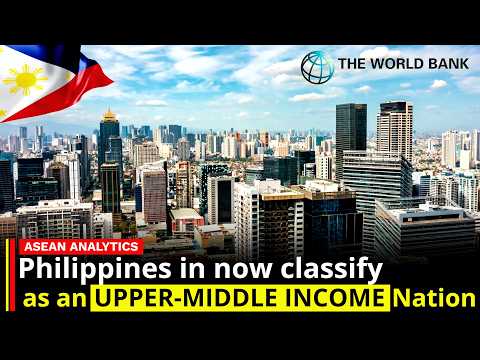
For the first time since 1987, the average Filipino counts as a citizen of an upper-middle-income country. On July 1, 2026, the World Bank moved the Philippines up a rung, after income per person crossed a line the country had chased for a generation.

The measure is gross national income per capita: the total income earned by a country's people and companies, divided by population. The Philippines hit $4,850, above the $4,636 cutoff. The upgrade can lower borrowing costs and draw investors. It also starts closing the door on the cheap development loans reserved for poorer nations.

Why it matters

Upper-middle-income status can boost the Philippines' credit profile and draw investors, while phasing out the cheap development loans it long relied on.

Questions about this story

No questions yet — be the first to ask.

Key Indicators

$4,850
GNI per capita (2025)
Average income per person, the figure that crossed the threshold.
$4,636
Upper-middle-income cutoff
The lower bound of the World Bank's upper-middle band for fiscal 2027.
5.8%
Average annual GDP growth
Pace of expansion from 2021 to 2025, spread across industries.
39 years
Years in the lower tier
The Philippines had been lower-middle-income since 1987.
$26
Prior-year shortfall
In the 2025 classification, income per person fell $26 short.

Voices

Curated perspectives — historical figures and your fellow readers.

Ever wondered what historical figures would say about today's headlines?

Sign up to generate historical perspectives on this story.

Play

Exploring all sides of a story is often best achieved with Play.

Log in to play. Track your picks, climb the leaderboards. Log in Sign Up
Predict 4 ways this could play out. Contrarian picks score more — points lock when the scenario resolves. Log in to play
Higher or Lower Two numbers from this story. Guess which is bigger. 5 rounds to set a streak. Log in to play
Connections Sixteen names from the news. Find the four hidden groups of four. Log in to play

People Involved

Organizations Involved

Timeline

January 1987 July 2026

5 events Latest: Yesterday
Tap a bar to jump to that date
  1. Philippines graduates to upper-middle-income

    Latest Milestone

    Income per person hits $4,850, above the $4,636 cutoff. The World Bank moves the country up a tier alongside four others.

  2. World Bank signals the country is closing in

    Statement

    A World Bank update notes the Philippines has moved nearer the upper-middle-income threshold.

  3. A $26 miss

    Milestone

    Income per person reaches $4,470, falling $26 short of that year's threshold.

  4. Planners brace for the trade-offs

    Policy

    The planning agency warns that moving up will cost the country concessional loans and some tariff perks.

  5. Philippines enters the lower-middle band

    Milestone

    The country is classified lower-middle-income and stays there for decades.

Historical Context

3 moments from history that rhyme with this story — and how they unfolded.

2010

China graduates to upper-middle-income (2010)

China crossed into the upper-middle-income band around 2010 after two decades of fast growth. Its income per person kept climbing, and the country later became a lender rather than a borrower of development aid.

Then

Access to the softest World Bank lending narrowed as China's income rose.

Now

China stayed in the upper-middle band and turned into a major creditor to other developing nations.

Why this matters now

It shows the upside path: a big economy can clear the threshold on broad growth and keep rising, while cheap official loans fade.

July 2020

Sri Lanka's demotion (2020)

Sri Lanka reached upper-middle-income in 2019, then a contracting economy pushed income per person back down. The World Bank demoted it to lower-middle-income the next year, before a later crisis deepened the damage.

Then

The reversal restored some aid eligibility but signaled economic weakness.

Now

Sri Lanka needed years and an IMF program to recover; it re-graduated to upper-middle-income in the same 2026 cohort as the Philippines.

Why this matters now

It is the cautionary case: crossing the line is not permanent, and a shock can undo it within a year.

2011

Thailand and the middle-income trap

Thailand reached upper-middle-income around 2011 and has stayed there ever since. Slower productivity growth and an aging population have kept it short of the high-income tier for over a decade.

Then

Thailand gained the status but lost some concessional financing.

Now

It became a standard example of the middle-income trap, where growth stalls before high-income status.

Why this matters now

It frames the harder next phase: the jump the Philippines just made is often easier than the climb that follows it.

Sources

(6)