


Pull to refresh
Logo
Diamond membranes generate voltage when bent, overturning a century-old assumption

Diamond membranes generate voltage when bent, overturning a century-old assumption

New Capabilities

University of Hong Kong team shows grain boundaries in polycrystalline diamond produce a piezoelectric response

3 days ago: Discovery circulates widely in technical and mainstream media

Overview

Updated 23 minutes ago

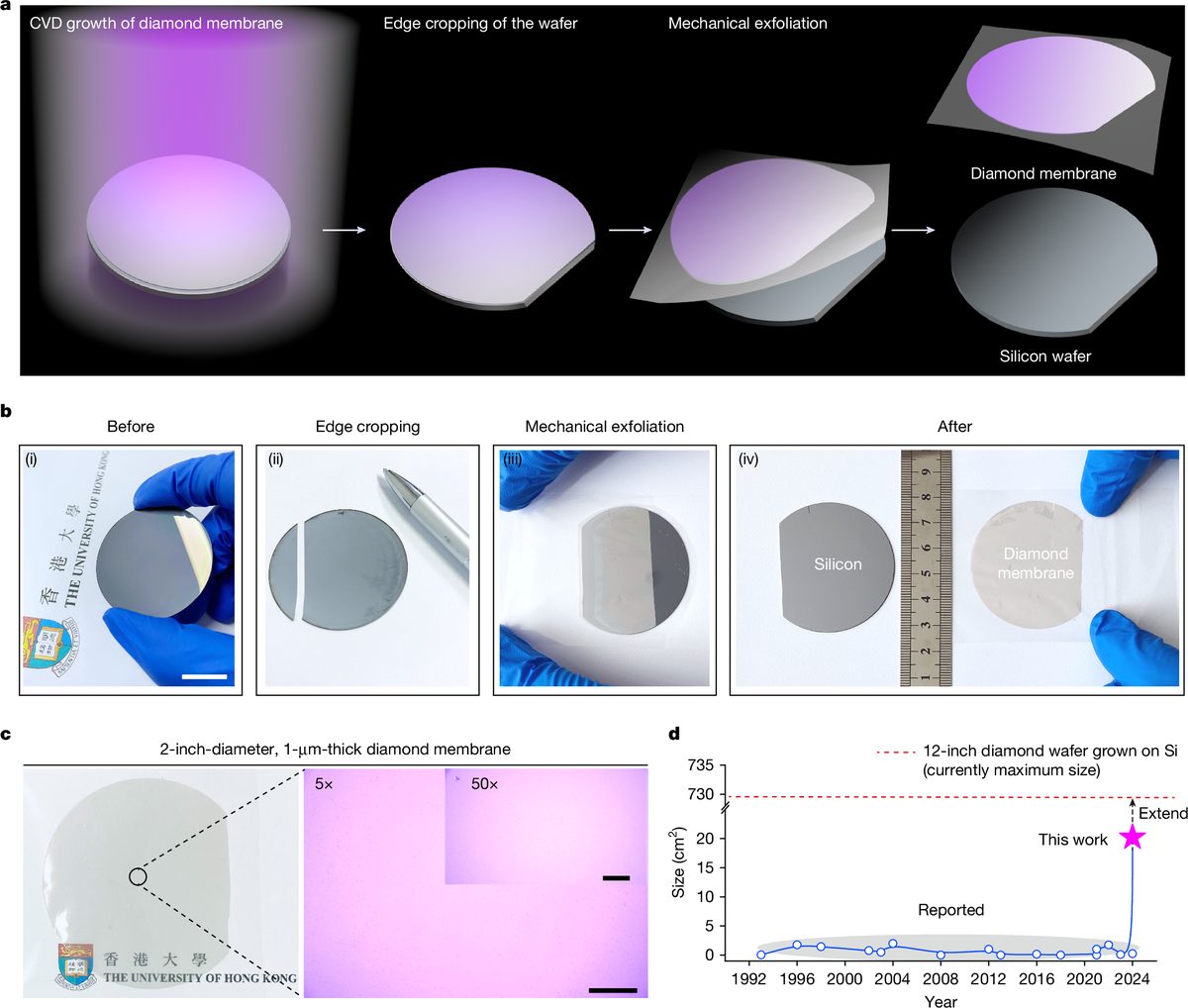
For more than a century, diamond was classified as nonpiezoelectric — its perfect cubic lattice symmetry meant that squeezing it produced no electrical charge. A team led by the University of Hong Kong just showed that polycrystalline diamond membranes only a few micrometers thick generate a measurable voltage when bent, with a piezoelectric voltage coefficient of 82.2 millivolt-meters per newton, higher than many conventional piezoelectric materials.

The effect comes from grain boundaries — the interfaces where tiny diamond crystals meet during chemical vapor deposition growth. These boundaries break the lattice's local symmetry, letting stress displace charges unevenly. The work was published in Science Advances and challenges a textbook assumption that has stood since the 19th century.

Why it matters

Diamond's hardness, thermal stability, and biocompatibility could make it a piezoelectric material for sensors and energy harvesters in harsh environments — from engine compartments to medical implants.

Questions about this story

Free account needed to ask — your question is kept and asked for you right after sign-up. Answers are public.

No questions yet — be the first to ask.

Key Indicators

82.2 mV·m/N
Piezoelectric voltage coefficient (g33)
Surpasses PZT, BaTiO3, AlN, GaN, and MoS2 for voltage output per unit strain.
4 pC/N
Peak piezoelectric charge coefficient (d33)
Measured in 5-micrometer-thick membranes; single-crystal bulk diamond shows zero.
5 μm
Optimal membrane thickness
Peak response; d33 rises from 2 pC/N at 1 μm and falls for membranes over 7 μm.
600 K
Maximum tested operating temperature
Piezoelectric coefficient remained stable at high temperature, suitable for harsh environments.
70 mV
Peak output voltage at 1.4% strain
5-micrometer membrane maintained output for over 7,000 bending cycles.

Voices

Curated perspectives — historical figures and your fellow readers.

Ever wondered what historical figures would say about today's headlines?

Sign up to generate historical perspectives on this story.

People Involved

Organizations Involved

Timeline

May 2026 September 2026

4 events Latest: 3 days ago
Tap a bar to jump to that date
  1. Discovery circulates widely in technical and mainstream media

    Latest Coverage

    Popular Mechanics, Times of India, and science blogs report the finding, noting the grain-boundary mechanism.

  2. HKU issues press release on the discovery

    Announcement

    University highlights that the finding challenges the century-old scientific dogma that diamond is nonpiezoelectric.

  3. Science Advances publishes diamond piezoelectricity paper

    Publication

    HKU-led team reports piezoelectric voltage coefficient of 82.2 mV·m/N in 5-micrometer-thick polycrystalline diamond membranes.

  4. Paper accepted for publication in Science Advances

    Publication

    Peer-reviewed manuscript reporting piezoelectric effect in polycrystalline diamond membranes.

Scenarios

1

Diamond piezoelectric sensors reach commercial prototypes

Possible Resolves by End of 2030

Discussed by: Mining Metal News, ScienceBlog.com

Research groups and MEMS manufacturers pursue diamond-based pressure sensors, accelerometers, and energy harvesters. The 600 K stability and biocompatibility make diamond attractive for engine monitoring and medical implants. Commercialization faces real hurdles: reproducible wafer-scale properties, durable electrodes, packaging, and manufacturing costs.

2

Research stays at lab scale pending engineering breakthroughs

Likely Resolves by End of 2028

Discussed by: ScienceBlog.com, Mining Metal News

The paper demonstrates a material response, not a useful power source. Energy output (~70 mV at 1.4% strain) is too small for most applications. Engineers need to solve electrode integration, long-term mechanical fatigue, and batch-to-batch reproducibility before devices are viable. If those problems prove intractable, the discovery remains a materials-science curiosity.

3

Grain-boundary piezoelectricity found in other hard materials

Possible Resolves by Q2 2028

Discussed by: Materials research community

The first-principles finding — that grain boundaries break local symmetry and generate piezoelectric response — could apply to other centrosymmetric hard materials (carbides, nitrides, borides). Replication studies may expand the family of piezoelectric materials beyond diamond, with implications for sensing and energy harvesting.

Historical Context

3 moments from history that rhyme with this story — and how they unfolded.

1944-1949

Barium titanate piezoelectric ceramics (mid-1940s)

During World War II, US and Soviet researchers independently discovered that barium titanate ceramics, unlike quartz, could be sintered into arbitrary shapes and poled to exhibit strong piezoelectricity. It became the first non-quartz practical piezoelectric material.

Then

Barium titanate replaced quartz in sonar transducers and phonograph pickups within a decade.

Now

It spawned the broader perovskite piezoelectric family, including PZT, now used in actuators, sensors, and ultrasonic devices worldwide.

Why this matters now

A new piezoelectric material class created an entire device ecosystem — the same path diamond could follow if engineering hurdles are solved.

1997

Diamond nitrogen-vacancy centers (1997)

Researchers demonstrated that nitrogen-vacancy (NV) defects in diamond could be optically detected and coherently manipulated at room temperature, giving diamond an unexpected quantum sensing capability. Diamond was known as an electrical insulator and optical host, but the NV center's quantum properties were unanticipated.

Then

NV-center physics became a major research field within a decade.

Now

Diamond NV centers are now used in commercial quantum magnetometers and being developed for quantum computing.

Why this matters now

A second surprising property found in diamond after decades of assumed inertness — showing that diamond's 'boring' classification rewards re-examination.

2011

Hafnium oxide ferroelectricity discovery (2011)

Researchers at Germany's NaMLab found that thin films of hafnium dioxide — long assumed non-ferroelectric due to its centrosymmetric crystal structure — exhibit ferroelectricity when deposited as ~10-nanometer-thick films. The effect arises from a non-centrosymmetric orthorhombic phase stabilized by grain boundaries and dopants.

Then

The discovery initially met skepticism; several groups replicated it within a few years.

Now

Ferroelectric hafnia is now central to ferroelectric memory (FeRAM) and negative-capacitance transistors, with major foundries developing production processes.

Why this matters now

A centrosymmetric material showing a surprising thin-film effect driven by grain-boundary physics — the same structural story as the diamond finding.

Sources

(10)