


Pull to refresh
Logo
Scientists watch a lithium battery's cathode turn brittle in real time

Scientists watch a lithium battery's cathode turn brittle in real time

New Capabilities

Real-time measurements reveal nickel-rich cathodes lose plasticity above 4.2 volts, a hidden aging mechanism

2 days ago: Operando nanoindentation study published

Overview

Updated 3 hours ago

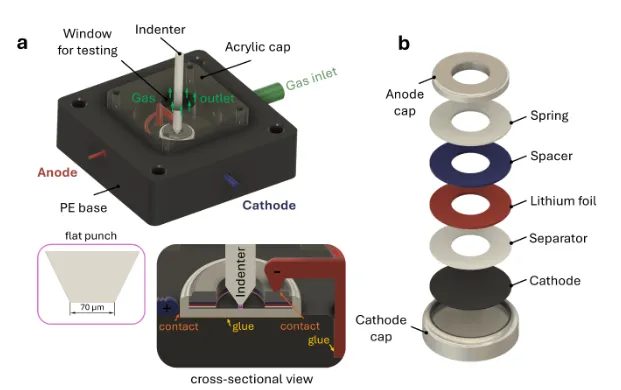
Battery researchers have long had to guess how a cathode's mechanical properties change during charging, because measuring them meant taking the battery apart. A team at Skoltech in Moscow has now watched it happen live for the first time, using a modified coin cell with a diamond probe pressed against the cathode while the battery ran.

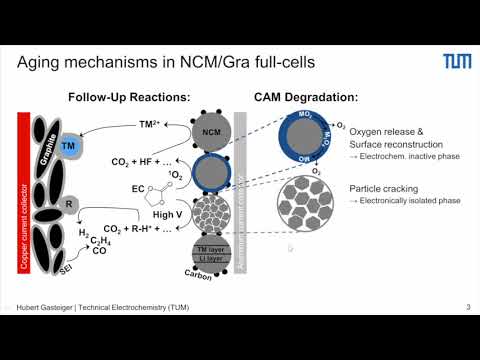
The measurement revealed something unexpected. The cathode doesn't get softer as it degrades; it loses its ability to deform plastically. Above 4.2 volts, the work of plastic deformation drops by nearly a third, making particles brittle and prone to cracking.

That's a hidden aging mechanism that could explain why nickel-rich batteries fail faster than expected. The data gives engineers reference parameters for calibrating models that predict internal stress and crack propagation in high-energy-density batteries.

Why it matters

If cathode embrittlement above 4.2 volts is a universal failure mode, battery makers may need to redesign high-voltage cathodes for electric vehicles and phones.

Questions about this story

Free account needed to ask — your question is kept and asked for you right after sign-up. Answers are public.

No questions yet — be the first to ask.

Key Indicators

~30%
Drop in plastic deformation work
Work of plastic deformation dropped by almost a third during transition to the high-voltage H3 phase.
4.2 V
Voltage threshold for embrittlement
Above 4.2 volts, the cathode loses its ability to deform plastically, increasing crack risk.
NMC811
Cathode material studied
Nickel-rich cathode material (LiNi0.8Mn0.1Co0.1O2) used in high-energy-density batteries.

Voices

Curated perspectives — historical figures and your fellow readers.

Ever wondered what historical figures would say about today's headlines?

Sign up to generate historical perspectives on this story.

People Involved

Organizations Involved

Timeline

1 event Latest: 2 days ago
  1. Operando nanoindentation study published

    Latest Research

    Skoltech team publishes first real-time mechanical measurements of a working battery cathode in the journal Measurement.

Scenarios

1

Operando nanoindentation spreads to other battery labs

Possible Resolves by End of 2028

Discussed by: The Skoltech team, which frames the technique as an extension of the operando research paradigm

Other research groups adopt the modified coin cell and nanoindentation approach to study mechanical degradation in different cathode materials, from lithium iron phosphate to solid-state electrolytes. The technique's value depends on whether labs can reproduce the modified cell design.

2

Embrittlement data reshapes high-voltage cathode design

Possible Resolves by End of 2028

Discussed by: The researchers, who note the data's value for calibrating multiscale computational models

Battery manufacturers use the plasticity-loss data to design cathodes that maintain mechanical robustness above 4.2 volts, through coatings, doping, or microstructure engineering. The finding gives engineers a concrete target: preserve plastic deformation capacity at high voltage.

3

Technique remains a niche research tool

Uncertain Resolves by End of 2028

Discussed by: Null scenario; the default if adoption stalls

The method stays in Skoltech's lab, used for occasional studies but not widely adopted, because the modified coin cell is difficult to reproduce or because other techniques prove more practical for routine battery testing.

Historical Context

2 moments from history that rhyme with this story — and how they unfolded.

October 2013

Ebner et al. x-ray tomography of tin oxide batteries (2013)

Martin Ebner and colleagues at ETH Zurich used synchrotron x-ray tomography to watch a tin oxide battery electrode degrade in real time, tracking crack initiation and growth along preexisting defects as the battery cycled.

Then

The study showed that mechanical fracture and structural disintegration of electrodes cause capacity loss in conversion and alloying materials.

Now

It established x-ray tomography as a tool for studying mechanical degradation in operating batteries, but it could not measure mechanical properties directly.

Why this matters now

Ebner's work visualized mechanical damage in real time but couldn't quantify the mechanical properties that cause it. The Skoltech technique adds direct mechanical measurement to the operando toolkit.

2023

Chemomechanical stress-induced phase transformation in high-Ni cathodes (2023)

Researchers used deep-learning-aided super-resolution imaging to show that mechanical deformation during battery operation directly triggers phase transformation in commercial layered cathodes, distinct from the conventional delithiation-driven transformation.

Then

The finding revealed a new degradation pathway in nickel-rich cathodes.

Now

It suggested that stress-induced phase degradation is universal in layered cathode materials.

Why this matters now

This work connected mechanical stress to chemical change in cathodes. The Skoltech study provides the mechanical property data needed to model and predict such stress-driven degradation.

Sources

(4)