


Pull to refresh
Logo
New boron allotrope conducts electricity and bends like a metal

New boron allotrope conducts electricity and bends like a metal

New Capabilities

Imma-B60 breaks boron's hard-brittle pattern with conductivity 10 million times standard boron

2 days ago: Imma-B60 synthesized and published

Overview

Updated 1 hour ago

For more than half a century, every boron crystal chemists could make was diamond-hard, brittle, and nearly insulating. A team at Yanshan University in China has now reported a phase that breaks all three patterns: pure boron that conducts electricity about ten million times better than standard boron and deforms plastically by roughly 23% instead of shattering.

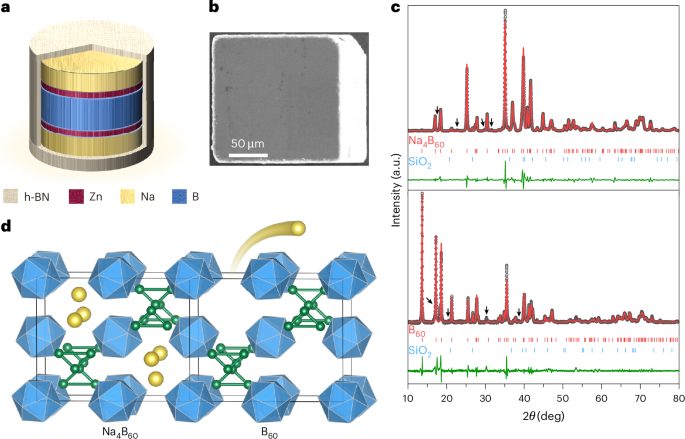
The team built it in two steps: grow a sodium boride crystal (Na₄B₆₀), then bake out the sodium at 900°C under vacuum, leaving the boron framework intact. The open structure slides along internal planes under stress, so it bends instead of breaking, and its narrow bandgap makes charge transport easy. That combination, never seen in pure boron, sets up potential applications in thermoelectric devices, flexible electronics, and lightweight electrodes.

Why it matters

A pure element that both conducts electricity and flexes could bring thermoelectric devices, bendable electronics, and lightweight electrodes within reach.

Questions about this story

Free account needed to ask — your question is kept and asked for you right after sign-up. Answers are public.

No questions yet — be the first to ask.

Key Indicators

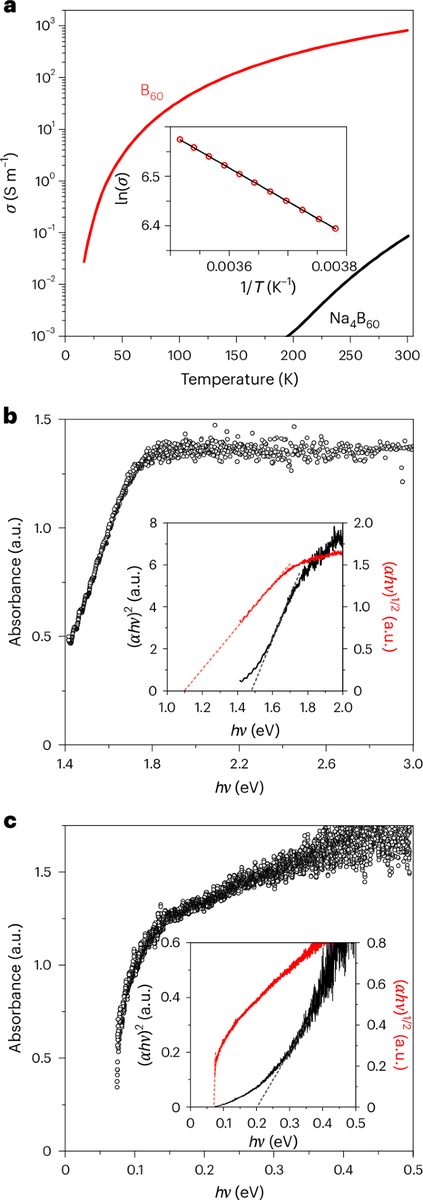
900 S/m
Electrical conductivity of Imma-B60
Seven orders of magnitude above standard β-boron, measured at room temperature.
10 million×
Conductivity vs. standard β-boron
The paper reports a ~10⁷ improvement over conventional rhombohedral boron.
<0.2 eV
Bandgap
Narrow enough that the material behaves like a conducting semiconductor.
23%
Plastic strain before fracture
Reached up to 32% in nanopillar compression tests via dislocation-mediated slip.

Voices

Curated perspectives — historical figures and your fellow readers.

Ever wondered what historical figures would say about today's headlines?

Sign up to generate historical perspectives on this story.

People Involved

Organizations Involved

Timeline

January 2015 September 2026

2 events Latest: 2 days ago
  1. Imma-B60 synthesized and published

    Latest Publication

    Yanshan University team reports the sodium-scaffold route to Imma-B60, a conductive, plastic boron phase, in Nature Chemistry.

  2. Theory predicts conductive, ductile boron

    Research

    First-principles calculations suggested boron allotropes that are both conductive and plastic, but a decade of direct synthesis attempts failed.

Scenarios

1

Imma-B60 powers a working device prototype

Possible Resolves by End of 2027

Discussed by: The Nature Chemistry paper and coverage in Nature News and phys.org cite thermoelectric and flexible-electronics applications as the obvious next step.

The Yanshan team or a follow-on group dopes Imma-B60 or integrates it into a thermoelectric module or flexible electrode, demonstrating function in a working device. The narrow bandgap and porous structure are the properties that make this plausible.

2

Independent groups reproduce the synthesis

Likely Resolves by End of 2027

Discussed by: Standard validation bar for a new allotrope claim; the paper supports it with multi-technique structural confirmation and benchmarking against every reported boron phase.

Another laboratory reproduces Imma-B60 via the Na₄B₆₀ precursor route, confirming the structure and the measured conductivity and plasticity. Replication is the test that separates a real phase from a one-off artifact.

3

Scaffold strategy yields other open-framework phases

Possible Resolves by End of 2028

Discussed by: The authors describe the sodium-scaffold method as a general route to metastable materials that direct synthesis cannot reach.

The two-step scaffold-and-degas approach is applied to other elements or to new boron frameworks, producing additional open-framework allotropes with unusual properties. Success would widen the method's value beyond a single phase.

Historical Context

3 moments from history that rhyme with this story — and how they unfolded.

September 1985

Buckminsterfullerene C₆₀ (1985)

Kroto, Curl, Smalley, and colleagues discovered C₆₀, a 60-carbon cage, while vaporizing graphite — a form of an element long thought fully mapped. The finding upended the assumption that carbon only formed diamond and graphite.

Then

Ignited a surge of carbon allotrope research.

Now

Led to fullerenes, nanotubes, graphene, and the modern carbon materials field.

Why this matters now

Shows how a single unexpected allotrope of a common element can open a new materials landscape — the position Imma-B60 now claims for boron.

December 2015

Borophene synthesis (2015)

Mannix and colleagues synthesized borophene, a two-dimensional boron sheet grown on a silver substrate — boron's first 2D form, with metallic and anisotropic properties.

Then

Expanded boron from rigid 3D icosahedral phases into 2D sheets.

Now

Enabled boron-based nanoelectronics research and variants like double-layer borophene.

Why this matters now

A prior case of breaking boron's structural mold, showing boron can be metallic; Imma-B60 does the same for bulk 3D material.

1990s–2000s

Silicon clathrates (1990s–2000s)

Chemists made open-framework silicon clathrates such as Na₄Si₁₃₆ by synthesizing a sodium silicide, then heating it to remove the sodium and leave a porous silicon cage. These were among the first open-framework elemental phases ever produced.

Then

Demonstrated that a scaffold-and-remove approach can yield phases unreachable by direct crystallization.

Now

Became the template for making open-framework elemental materials with tunable electronic properties.

Why this matters now

Imma-B60 was made by exactly the same logic — sodium scaffold, then vacuum degassing — extended from silicon to boron.

Sources

(5)