





Pull to refresh
Logo
Daily Brief
Following
Why Sign Up
FDA panel weighs blood-test-guided early drug switch for breast cancer

FDA panel weighs blood-test-guided early drug switch for breast cancer

New Capabilities
By Newzino Staff |

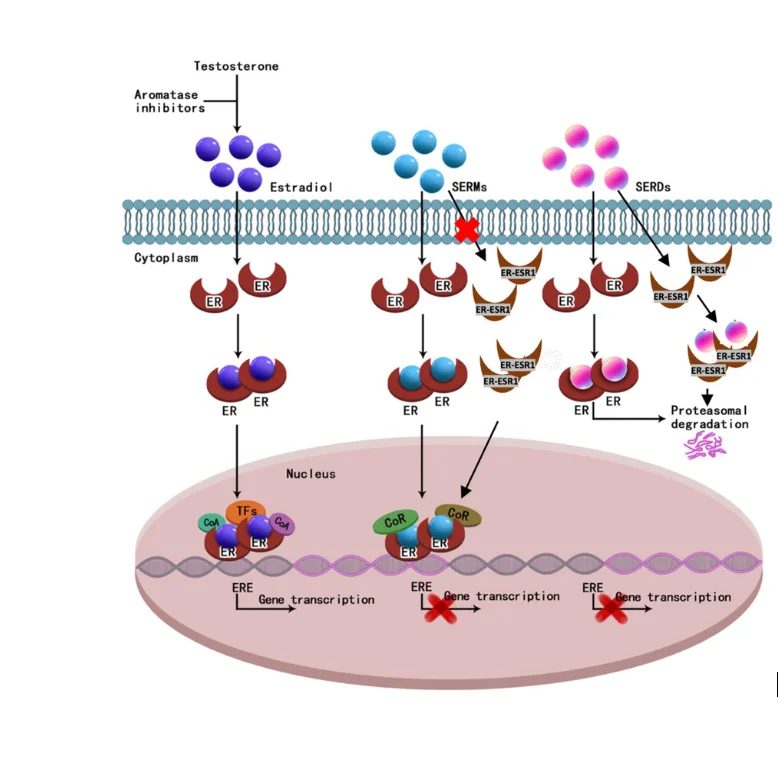
AstraZeneca's camizestrant tests whether oncologists should treat a mutation in the bloodstream — before the tumor grows back

Today: ODAC reviews camizestrant and Truqap applications

Overview

For decades, oncologists changed breast cancer drugs only after a scan showed the tumor growing back. On April 30, 2026, an FDA advisory panel weighed a different approach: switch the drug the moment a blood test detects the resistance mutation — weeks or months before the cancer becomes visible on imaging.

Why it matters

If approved, this would be the first cancer regimen prescribed based on a blood test finding a mutation rather than a tumor growing — reshaping how millions are treated.

Key Indicators

56%
Reduction in progression risk
SERENA-6 hazard ratio for disease progression or death versus standard endocrine therapy.
16.0 vs 9.2
Median months progression-free
Camizestrant arm versus continued aromatase inhibitor plus CDK4/6 inhibitor.
3,256
Patients screened by liquid biopsy
Total enrolled to find 315 with an emergent ESR1 mutation before radiographic progression.
34%
Visual disturbances on camizestrant
Versus 16% on the aromatase-inhibitor control arm — a key FDA safety concern.
~30%
Overall survival data maturity
Reviewers flagged this as too early to confirm a long-term survival benefit; final analysis expected around 2028.
9 months
Time since prior cancer ODAC
This was the FDA's first oncology advisory committee meeting since July 2025.

Interactive

Exploring all sides of a story is often best achieved with Play.

Ever wondered what historical figures would say about today's headlines?

Sign up to generate historical perspectives on this story.

Sign Up

Debate Arena

Two rounds, two personas, one winner. You set the crossfire.

People Involved

Organizations Involved

Timeline

  1. ODAC reviews camizestrant and Truqap applications

    Advisory Committee

    First FDA oncology advisory meeting in nine months. Morning session on camizestrant; afternoon session on capivasertib plus abiraterone for PTEN-deficient prostate cancer.

  2. FDA briefing documents flag safety concerns

    Regulatory

    Reviewers raise immature overall survival, visual disturbances in 34% of patients, bradycardia, and QT prolongation — especially with ribociclib.

  3. FDA announces ODAC meeting in Federal Register

    Regulatory

    Public docket opened for both the camizestrant NDA and the supplemental Truqap-plus-abiraterone application.

  4. AstraZeneca files New Drug Application 220359

    Regulatory

    Camizestrant submitted to FDA for ESR1-mutated HR+/HER2- advanced breast cancer alongside Guardant360 CDx companion diagnostic.

  5. SERENA-6 primary results presented at ASCO plenary

    Trial Readout

    Camizestrant cuts progression risk by 56%; results published simultaneously in NEJM. Quality-of-life deterioration delayed from 6.4 to 21.0 months.

  6. SERENA-6 begins enrolling patients

    Clinical Trial

    Phase 3 trial screens 3,256 patients with serial blood tests, looking for ESR1 mutations that emerge during first-line endocrine therapy.

  7. Camizestrant enters clinical development

    Drug Development

    AstraZeneca's next-generation oral selective estrogen receptor degrader begins phase 1 testing in advanced breast cancer.

Scenarios

1

FDA approves camizestrant with safety labeling

Discussed by: Wells Fargo, Leerink, and most sell-side biotech analysts covering AstraZeneca

A 56% reduction in progression risk is unusually large for a hormone-receptor-positive breast cancer trial, and the patient-reported outcome data showing quality-of-life deterioration delayed by 14 months strengthens the case. FDA approves with a boxed or prominent warning on QT prolongation, restrictions on ribociclib co-administration, and a post-marketing commitment to deliver mature overall survival data by 2028. Guardant360 CDx is approved as companion diagnostic.

2

FDA delays decision pending more mature survival data

Discussed by: FDA briefing reviewers, BioSpace, FierceBiotech

ODAC votes that progression-free survival benefit is not yet sufficient to outweigh the safety signals without overall survival confirmation. FDA issues a Complete Response Letter requiring updated data — pushing approval into 2027 or 2028. AstraZeneca's first-mover advantage over Lilly's imlunestrant and Pfizer's vepdegestrant narrows.

3

Approval carves a narrow indication, not a paradigm shift

Discussed by: Oncology key opinion leaders cited in OncLive coverage

FDA approves camizestrant only for patients who already have radiographic progression with an ESR1 mutation, declining to endorse the ctDNA-guided early-switching strategy that SERENA-6 was designed to test. The drug enters the market as one of several oral SERDs rather than as the launch vehicle for a new precision-medicine standard.

4

ctDNA-guided switching becomes new standard across cancer types

Discussed by: ASCO leadership, AJMC, precision-medicine researchers

If approved on the SERENA-6 indication as written, oncology shifts from radiographic-progression-triggered switches to molecular-progression-triggered switches. Other tumor types — colorectal, lung, prostate — accelerate trials of the same design. Liquid biopsy moves from diagnostic to surveillance tool, expanding companion-diagnostic markets significantly.

Historical Context

Trastuzumab and the birth of HER2-targeted therapy (1998)

September 1998

What Happened

FDA approved Genentech's Herceptin for the 25-30% of breast cancer patients whose tumors overexpress the HER2 protein, paired with a companion diagnostic test. It was the first time a cancer drug was approved alongside a biomarker test that selected which patients should get it.

Outcome

Short Term

Established HER2 status as a routine pathology test and gave HER2-positive patients — previously the worst-prognosis group — the best long-term outcomes in breast cancer.

Long Term

Became the template for every targeted-therapy-plus-companion-diagnostic approval that followed: EGFR in lung cancer, BRAF in melanoma, BRCA in ovarian cancer.

Why It's Relevant Today

Camizestrant could extend that template by adding a temporal dimension — not just selecting patients at diagnosis based on tumor tissue, but switching therapy mid-course based on what blood reveals about evolving resistance.

Olaparib and the rise of liquid biopsy companion diagnostics (2020)

May 2020

What Happened

FDA approved AstraZeneca's olaparib (Lynparza) for metastatic prostate cancer with BRCA mutations, alongside Guardant Health's Guardant360 CDx — the first liquid-biopsy companion diagnostic approved for solid tumors. It established that a blood test could legally substitute for tissue biopsy in selecting cancer therapy.

Outcome

Short Term

Validated liquid biopsy as a regulatory-grade tool and accelerated investment in ctDNA platforms.

Long Term

By 2026, liquid biopsy was used at diagnosis across multiple tumor types, but always to select an initial therapy, not to switch mid-treatment.

Why It's Relevant Today

SERENA-6 attempts the next step that olaparib's approval set up: using liquid biopsy not just once, but repeatedly during treatment — to detect resistance before it shows on imaging.

Accelerated approvals withdrawn for oncology drugs without OS benefit (2021-2024)

2021-2024

What Happened

FDA's ODAC voted to withdraw or modify several accelerated approvals — including indications for Tecentriq, Keytruda, and Imfinzi — after confirmatory trials failed to show overall survival benefit despite progression-free survival gains. Pazdur's office signaled new skepticism toward PFS-only endpoints.

Outcome

Short Term

FDA tightened expectations that PFS gains translate to OS, particularly for non-curative settings.

Long Term

Set a higher bar for any new indication that relies on PFS without mature OS data — the exact situation camizestrant faces.

Why It's Relevant Today

FDA reviewers' explicit concern about immature OS data in SERENA-6 is part of this broader trend, not a one-off concern about camizestrant specifically.

Sources

(11)