
Pull to refresh
Logo
Quantum-Si detects all 20 amino acids at the single-molecule level

Quantum-Si detects all 20 amino acids at the single-molecule level

New Capabilities

Proteus hits its year-end goal early, but the instrument is not expected to ship until mid-2027

Overview

Updated 7 hours ago

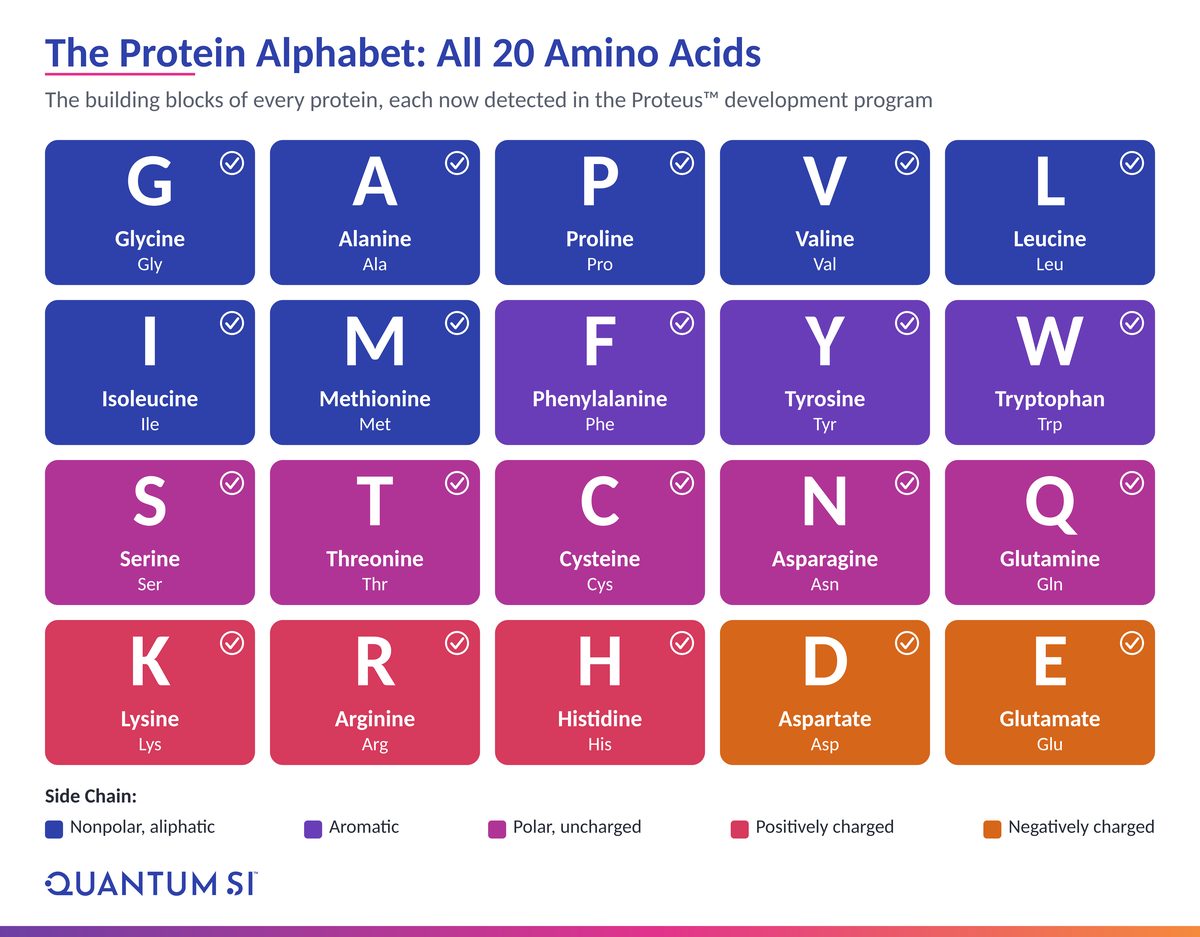
Proteins are strings of 20 amino acids. Reading one directly means telling all 20 apart, one molecule at a time. On November 18, Quantum-Si said its Proteus development program had done that, three weeks after reporting 19.

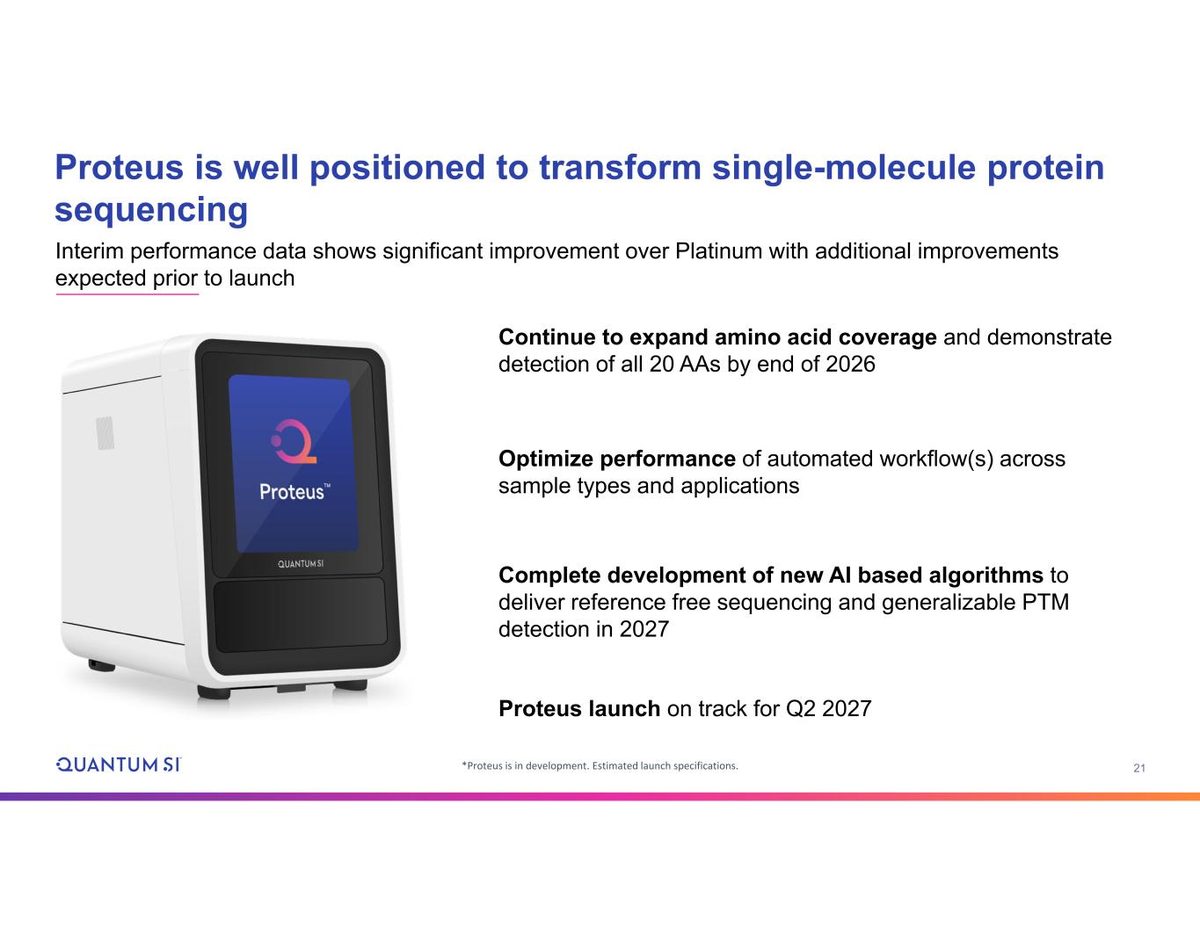
The payoff is naming a protein without a reference library, including variants and chemical modifications that fragment-based methods blur. A demonstration is not an instrument, though. Proteus is now targeted for a second-quarter 2027 launch, and Quantum-Si booked $212,000 in revenue in the third quarter of 2026.

Why it matters

If protein sequencing follows DNA sequencing's path, drugmakers could read modified proteins directly instead of inferring them from fragments.

Questions about this story

Free account needed to ask — your question is kept and asked for you right after sign-up. Answers are public.

No questions yet — be the first to ask.

Key Indicators

20
Amino acids detected
All 20 naturally occurring amino acids distinguished in the Proteus development program.
19
Amino acids detected six weeks earlier
The October 8, 2026 milestone that preceded the full set.
$212K
Third-quarter 2026 revenue
Sales during the transition from the Platinum platform to Proteus.
30x
Sequencing output per chamber vs. Platinum Pro
Interim result from a controlled peptide study presented at World HUPO.
Q2 2027
Targeted commercial launch
Moved back from an earlier end-of-2026 target.

Voices

Curated perspectives — historical figures and your fellow readers.

Sign up to generate historical perspectives on this story.

People Involved

Organizations Involved

Timeline

November 2025 November 2026

4 events Latest: Today
Tap a bar to jump to that date
  1. All 20 amino acids detected at the single-molecule level

    Today Milestone

    Quantum-Si says Proteus detected the complete amino acid alphabet, ahead of its year-end goal, and will now build the capability into a developmental sequencing kit.

  2. Launch date moves to second quarter of 2027

    Earnings

    Third-quarter revenue is $212,000. Management reaffirms a Q2 2027 launch, later than the prior year's end-2026 target, and opens a pre-order program.

  3. Nineteen amino acids detected

    Milestone

    Quantum-Si reports 19 amino acids and says it is folding the capability into a developmental kit, with all 20 expected by year-end.

  4. Company sets end-of-2026 launch for Proteus

    Guidance

    At an investor day, Quantum-Si says Proteus will launch with 18 amino acids in late 2026 and reach all 20 in 2027.

Scenarios

1

Proteus ships in the second quarter of 2027 with 20-amino-acid detection

Possible Resolves by Q2 2027

Discussed by: Quantum-Si management in its November 5 and November 18, 2026 releases

Management says instrument variability issues identified earlier in development have been substantially addressed and that design work on an additional instrument cycle is complete. A pre-order program opened in the third quarter of 2026 to hold customer places. Hitting the date would put a machine on the market that is sold on reading the full amino acid alphabet.

2

Launch slips again, past mid-2027

Possible Resolves by Q3 2027

Discussed by: The company's own revised guidance and reporting on the causes of the first delay

The target already moved once, from the end of 2026 to the second quarter of 2027. Management attributed the shift to instrument reproducibility, manufacturing yields and component supply. Folding 20-amino-acid detection into a kit adds another step between a lab result and a shippable product. A second slip would leave the milestone as a demonstration for at least another year.

3

An outside lab publishes protein sequences read on Proteus

Possible Resolves by Q2 2028

Discussed by: Proteomics researchers and early-access customers; Quantum-Si's own statements about reference-free identification

The claim that matters scientifically is whether researchers outside the company can read proteins on the instrument and name them without a reference database. Early-access and pre-order customers are the first test. A peer-reviewed paper or conference talk from an unaffiliated lab using Proteus data would mark the shift from company demonstration to usable tool.

Historical Context

3 moments from history that rhyme with this story — and how they unfolded.

1949–1955

Frederick Sanger sequences insulin (1949–1955)

Sanger spent years working out the order of the 51 amino acids in bovine insulin, breaking the protein into overlapping fragments and piecing the sequence back together. Before this work, no one knew that a protein had a defined, reproducible order of residues.

Then

The result showed proteins are chemically specified strings, not shapeless colloids, and earned Sanger the 1958 Nobel Prize in Chemistry.

Now

The method read one purified protein at a time, from grams of material, and could not handle mixtures or modified forms.

Why this matters now

It established that a protein's 20-letter alphabet can be read, and that doing so by chemistry alone is painfully slow. Quantum-Si is claiming that read at the scale of a single molecule.

1950–1967

Edman degradation becomes the standard (1950s–1980s)

Pehr Edman's method clipped amino acids off the end of a protein one at a time and identified each one. Automated sequencers built on the technique in the 1960s became standard equipment in protein laboratories for decades.

Then

Reading a protein's first few dozen residues became routine for labs with purified samples.

Now

The method typically stalled after a few dozen residues and needed a clean, single protein, so large or modified proteins stayed out of reach.

Why this matters now

That ceiling, one residue at a time from a purified sample, is the constraint single-molecule sequencing is designed to remove.

2005–2015

Next-generation DNA sequencing (2005–2015)

454 Life Sciences, founded by Quantum-Si's founder Jonathan Rothberg, began selling a machine in 2005 that read millions of DNA fragments in parallel. Illumina and Ion Torrent followed. The cost of sequencing a human genome fell by roughly four orders of magnitude between 2007 and 2015.

Then

Sequencing moved out of a handful of large centers and onto benchtop machines in ordinary labs.

Now

Instrument reliability, accuracy and cost per sample decided which companies survived, not who demonstrated the chemistry first.

Why this matters now

It is the closest precedent for what Quantum-Si is attempting, and a warning that the first demonstration rarely determines the winner. Distinguishing 20 building blocks is also much harder than distinguishing four.

Sources

(8)