



Pull to refresh
Logo
Scientists crack 25-year quantum entanglement measurement challenge

Scientists crack 25-year quantum entanglement measurement challenge

New Capabilities

Kyoto and Hiroshima researchers demonstrate a one-shot method to identify W states, a key form of multi-photon entanglement

3 days ago: W-state measurement demonstrated

Overview

Updated 1 hour ago

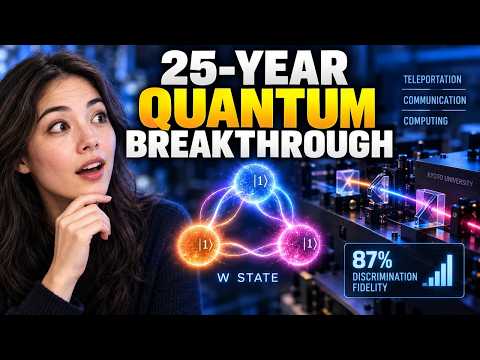
For 25 years, physicists could efficiently identify one major type of multi-photon quantum entanglement but not the other. Researchers at Kyoto University and Hiroshima University have now closed that gap, demonstrating a one-shot method to identify W states.

The technique matters because measuring multi-photon entanglement is a bottleneck for quantum teleportation, communication, and computing. Standard tomography needs exponentially more data as photons are added. The new approach identifies the state in a single measurement, and the team says it applies in principle to any number of photons.

Why it matters

Measuring multi-photon entanglement is a bottleneck for quantum teleportation and communication; this one-shot method removes it for W states.

Questions about this story

Free account needed to ask — your question is kept and asked for you right after sign-up. Answers are public.

No questions yet — be the first to ask.

Key Indicators

25 years
Time since GHZ entangled measurement was proposed
The new W-state method closes a gap that has stood for more than 25 years.
3
Photons in the demonstrated W state
The team experimentally demonstrated the method with three-photon W states.
1
Measurements needed to identify the state
The one-shot approach replaces tomography, which needs exponentially more data as photons are added.

Voices

Curated perspectives — historical figures and your fellow readers.

Ever wondered what historical figures would say about today's headlines?

Sign up to generate historical perspectives on this story.

People Involved

Organizations Involved

Timeline

March 1993 c. 2001

5 events Latest: 3 days ago
Tap a bar to jump to that date
  1. GHZ entangled measurement proposed

    Upcoming Milestone

    Physicists propose a one-shot measurement for GHZ states, the best-known multi-photon entanglement type, more than 25 years before the 2026 W-state work.

  2. W-state measurement demonstrated

    Latest Breakthrough

    Kyoto and Hiroshima researchers demonstrate a one-shot entangled measurement for three-photon W states, closing a 25-year gap.

  3. Teleportation to low Earth orbit

    Milestone

    Chinese scientists use the Micius satellite to teleport quantum states from Earth to orbit and back.

  4. First teleportation experiments

    Milestone

    Researchers demonstrate quantum teleportation across short distances in the late 1990s, confirming the 1993 proposal.

  5. Quantum teleportation protocol proposed

    Milestone

    Bennett and colleagues publish the theoretical protocol for transferring quantum states without moving matter.

Scenarios

1

W-state measurement scales beyond three photons

Likely Resolves by End of 2027

Discussed by: The Kyoto University research team, which states the method applies in principle to any number of photons

The team plans to extend the approach beyond the three-photon demonstration. Success would make the method useful for larger quantum systems, where tomography becomes impractical. The theoretical framework is already in place; the question is whether the optical circuits can be built at scale.

2

On-chip circuits make entangled measurement compact

Possible Resolves by End of 2028

Discussed by: The research team's stated longer-term goal

The team intends to develop on-chip photonic quantum circuits capable of performing entangled measurements. This would make the technology more compact and easier to integrate into future quantum systems, moving it from laboratory setups toward practical devices.

3

W-state measurement enables new quantum communication protocols

Possible Resolves by End of 2028

Discussed by: The researchers, who note implications for quantum teleportation and communication

The measurement approach could contribute to new quantum communication protocols, methods for transferring multi-photon entangled states, and measurement-based quantum computing. This would require integrating the method into a working protocol or experiment beyond the initial demonstration.

Historical Context

3 moments from history that rhyme with this story — and how they unfolded.

c. 2001

GHZ entangled measurement proposal (c. 2001)

Physicists proposed a one-shot entangled measurement for Greenberger-Horne-Zeilinger (GHZ) states, the best-known form of multi-photon entanglement. It was a major advance in measuring entangled systems.

Then

The GHZ measurement was experimentally demonstrated, giving researchers a tool for one major entanglement type.

Now

For 25 years, no comparable method existed for W states, the other major type.

Why this matters now

This is the exact gap the new Kyoto-Hiroshima work closes.

Late 1990s

First quantum teleportation experiments (late 1990s)

Following the 1993 theoretical proposal, researchers demonstrated quantum teleportation across short distances, showing quantum states could be transferred without moving matter.

Then

Proved the concept experimentally.

Now

Led to teleportation across cities and to low Earth orbit by 2017.

Why this matters now

Shows the trajectory from measurement capability to practical teleportation.

2017

Micius satellite teleportation (2017)

Chinese scientists used the Micius satellite to teleport quantum states from Earth to low Earth orbit and back, demonstrating long-distance quantum communication.

Then

Extended teleportation to space distances.

Now

A step toward a quantum internet.

Why this matters now

The new measurement capability could accelerate such applications.

Sources

(4)