
Pull to refresh
Logo
Daily Brief
Following
Why Sign Up
Saudi Arabia doubles its industrial coast at Jubail

Saudi Arabia doubles its industrial coast at Jubail

Built World
By Newzino Staff |

An $80 billion expansion turns a planned Gulf city into one of the world's largest petrochemical hubs

June 17th, 2020: Aramco completes acquisition of SABIC

Overview

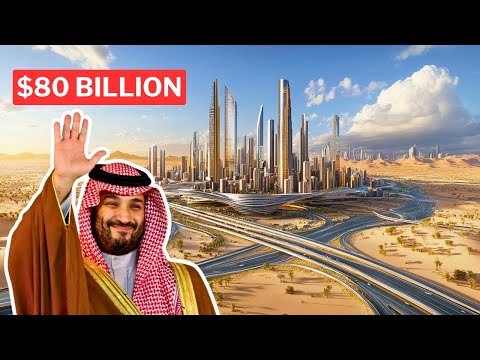
On Christmas Day 2004, Crown Prince Abdullah bin Abdulaziz pressed a foundation stone into sand on Saudi Arabia's eastern coast. The stone marked the start of Jubail II—a roughly $80 billion expansion that would add 6,200 hectares of plants, pipelines, and housing, effectively doubling what was already among the largest civil-engineering projects ever attempted.

Why it matters

If Jubail II succeeds, Saudi Arabia stops selling barrels and starts selling plastics, capturing margin that today flows to Houston, Rotterdam, and Singapore.

Key Indicators

$80B
Expansion cost
Estimated total spend on Jubail II infrastructure, plants, and supporting urban development.
6,200 ha
New land developed
Industrial and urban area added by Jubail II, roughly doubling the original city footprint.
1975
Original groundbreaking
Year the Royal Commission for Jubail and Yanbu was established by royal decree to plan the original city.
~7%
Share of global ethylene
Approximate Saudi share of world ethylene capacity once Jubail II expansions are factored in.

Interactive

Exploring all sides of a story is often best achieved with Play.

Ever wondered what historical figures would say about today's headlines?

Sign up to generate historical perspectives on this story.

Sign Up

Debate Arena

Two rounds, two personas, one winner. You set the crossfire.

People Involved

Organizations Involved

Timeline

  1. Aramco completes acquisition of SABIC

    Corporate

    The $69 billion deal places the country's flagship oil and chemicals firms under one owner, consolidating control of the Jubail value chain.

  2. Sadara declares full commercial operation

    Operations

    All 26 units of the Aramco-Dow complex come online, signaling that Jubail II is producing at scale.

  3. Aramco and Dow finalize Sadara joint venture

    Corporate

    The two firms commit roughly $20 billion to a 26-unit chemicals complex inside Jubail II, the largest petrochemical project ever built in a single phase.

  4. Foundation stone laid for Jubail II

    Construction

    Crown Prince Abdullah inaugurates the $80 billion expansion phase, which will add roughly 6,200 hectares of industrial and urban land to the existing city.

  5. First major SABIC plants come online at Jubail

    Operations

    Sadaf, Petrokemya, Hadeed, and other SABIC affiliates begin commercial production, shifting Saudi Arabia from pure crude exporter to chemicals producer.

  6. Bechtel begins program management of original Jubail

    Construction

    American engineering firm Bechtel starts the multi-decade contract to manage construction of roads, ports, utilities, and housing for Jubail Industrial City.

  7. SABIC founded as anchor industrial tenant

    Corporate

    The Saudi government creates SABIC to build petrochemical plants in Jubail and Yanbu using state-supplied gas and oil feedstocks.

  8. Royal Commission for Jubail and Yanbu created

    Policy

    King Khalid issues a royal decree establishing the commission with sweeping authority to plan, build, and govern two new industrial cities on opposite coasts.

Scenarios

1

Jubail becomes the world's anchor petrochemical hub

Discussed by: International Energy Agency outlooks; SABIC and Aramco investor presentations

Cheap feedstock, integrated logistics, and continued state investment let Jubail capture market share from older complexes in the U.S. Gulf and Northwest Europe. Saudi Arabia exports more chemicals than crude by value within two decades, fulfilling the original Vision 2030 logic.

2

Energy transition strands part of the buildout

Discussed by: BloombergNEF; Carbon Tracker analyses of petrochemical demand

Plastic-reduction policies in Europe and Asia, plus circular-economy mandates, slow virgin polymer demand growth from the late 2030s onward. Some Jubail II units run below capacity, and planned third-phase expansions are quietly shelved.

3

Regional security shock disrupts capacity

Discussed by: Center for Strategic and International Studies; Gulf-focused defense analysts

A direct strike or sustained drone-and-missile campaign against Eastern Province infrastructure—similar to the 2019 Abqaiq attack—knocks out segments of Jubail. Insurance costs surge and foreign joint-venture partners reassess Saudi exposure.

4

Vision 2030 redirects capital away from chemicals

Discussed by: Saudi Public Investment Fund coverage in Reuters and the Financial Times

Tourism, mining, and giga-projects like NEOM compete with Jubail for state capital. The expansion continues but at a slower pace, with later phases scaled back or handed to private operators.

Historical Context

Original Jubail Industrial City groundbreaking (1975)

September 1975

What Happened

King Khalid's government created the Royal Commission for Jubail and Yanbu and contracted Bechtel to convert a Gulf fishing village into a planned industrial city. Initial estimates put the project at roughly $70 billion in 1975 dollars, making it the largest civil-engineering undertaking on record at the time.

Outcome

Short Term

Construction proceeded for a decade before significant production began, requiring sustained oil revenue to fund the buildout.

Long Term

By the early 2000s Jubail was producing meaningful global shares of ethylene, methanol, and fertilizers, validating the state-led industrial model that Jubail II now extends.

Why It's Relevant Today

Jubail II is not a new idea—it is phase two of a fifty-year bet that planned industrial cities can move Saudi Arabia up the hydrocarbon value chain. Understanding phase one explains why phase two was inevitable.

Singapore's Jurong Island integration (1995-2009)

1995-2009

What Happened

Singapore reclaimed seven small islands into one 3,000-hectare petrochemical complex, attracting roughly $35 billion from ExxonMobil, Shell, and others. The state acted as master planner, providing shared utilities and pipelines that let tenants specialize.

Outcome

Short Term

Jurong Island became one of the world's top three refining and chemicals hubs by 2010.

Long Term

It demonstrated that a state-orchestrated cluster with shared infrastructure can outcompete privately developed complexes—a model Jubail II explicitly emulates.

Why It's Relevant Today

Jubail II uses the same shared-utility, shared-feedstock playbook as Jurong Island, scaled up roughly twentyfold and backed by the country's own crude rather than imports.

U.S. Gulf Coast petrochemical buildout (1940s-1960s)

1945-1965

What Happened

Postwar American oil and chemical firms built a continuous belt of refineries and crackers from Corpus Christi to New Orleans, anchored on cheap domestic crude and natural gas. Houston Ship Channel alone hosted dozens of plants from Exxon, Shell, Dow, and Union Carbide.

Outcome

Short Term

The Gulf Coast became the dominant global chemicals producer for four decades.

Long Term

Aging infrastructure, environmental constraints, and feedstock cost shifts have steadily eroded its lead—creating the opening Jubail II is built to fill.

Why It's Relevant Today

The U.S. Gulf shows both the upside and the lifecycle risk of a concentrated petrochemical region. Jubail's planners studied it closely; Jubail's competitors in Texas and Louisiana are watching the expansion warily.