

Pull to refresh
Logo
Deep-sea mollusk houses symbiotic bacteria in layered 'dragon ball' organelle

Deep-sea mollusk houses symbiotic bacteria in layered 'dragon ball' organelle

New Capabilities

Researchers describe dracosphera, a 10 to 15 micrometer structure with more than 20 membrane layers, in Chaetoderma shenloong from the South China Sea.

Overview

Updated 59 minutes ago

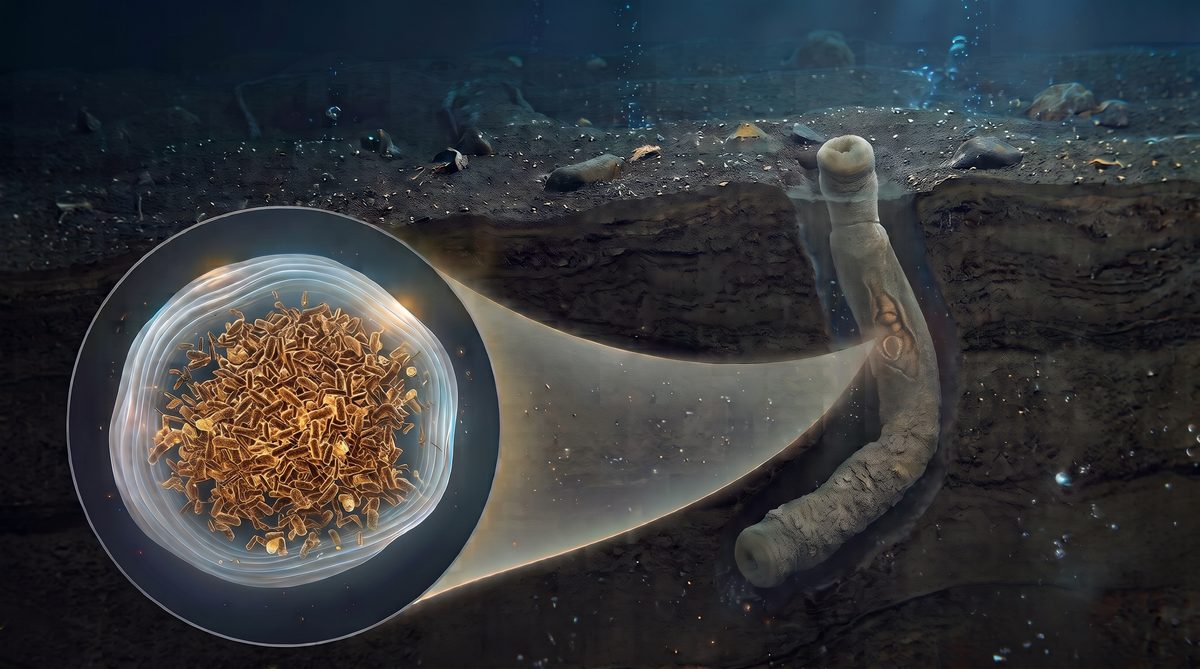
Three millimeters below the seafloor in the South China Sea, sediment contains almost no oxygen and plenty of hydrogen sulfide. A worm-like mollusk called Chaetoderma shenloong lives there, and researchers say it survives with the help of a previously unknown cellular structure.

The structure, named dracosphera, is a sphere 10 to 15 micrometers wide wrapped in more than 20 membrane layers. It holds hundreds to thousands of sulfur-oxidizing bacteria, and the team argues it is a dedicated organelle for maintaining symbionts rather than a digestive vacuole. The finding offers the first evidence that an animal can build a specialized compartment for housing symbiotic bacteria.

Why it matters

If confirmed, the finding would add a new way animals can build organs for microbial partners, expanding what biologists consider possible in symbiosis.

Questions about this story

Free account needed to ask — your question is kept and asked for you right after sign-up. Answers are public.

No questions yet — be the first to ask.

Key Indicators

10 to 15 μm
Dracosphera diameter
The spherical structure is roughly the size of a typical eukaryotic cell.
20+
Membrane layers
Each dracosphera is wrapped in more than 20 dense lipid membranes.
1,629
Symbionts per host cell
A single host cell holds an average of 1,629 sulfur-oxidizing bacteria.
506 nm
Average membrane wall thickness
The layered wall is thick enough to act as a possible diffusion barrier.
1.14 Mb
Symbiont genome size
The bacterial genome is highly reduced and retains a high-affinity oxygen enzyme.
3 mm
Anoxic sediment depth
Sediment at the sampling site becomes completely anoxic just 3 millimeters below the surface.

Voices

Curated perspectives — historical figures and your fellow readers.

Sign up to generate historical perspectives on this story.

People Involved

Organizations Involved

Timeline

2024 November 2026

3 events Latest: Today
  1. ScienceAlert reports the dracosphera finding

    Today Media

    ScienceAlert publishes an English-language report on the discovery in the South China Sea.

  2. Guangzhou lab announces dracosphera discovery

    Research

    Researchers report the multilamellar organelle and its possible role in low-oxygen adaptation.

  3. Chaetoderma shenloong named a top marine species

    Discovery

    The deep-sea mollusk is named one of the top-ten marine species of 2024.

Scenarios

1

Independent labs find dracosphera-like organelles in other mollusks

Possible Resolves by Nov 14, 2029

Discussed by: The study authors and independent marine biologists

If the structure is a general solution to chemosymbiosis, other aplacophorans or deep-sea mollusks living in low-oxygen sediment should contain similar multilamellar compartments. A peer-reviewed report would shift dracosphera from a one-species curiosity to a recognized class of symbiont-housing organelle.

2

Membrane layers shown to control oxygen diffusion

Possible Resolves by Q2 2029

Discussed by: The HKUST-led research team

The team hypothesizes that the more than 20 membrane layers slow oxygen diffusion and direct scarce oxygen to host mitochondria. A follow-up experiment could test this by measuring oxygen flux across the layers or by altering membrane composition.

3

Dracosphera remains a one-species curiosity

Unlikely Resolves by Nov 14, 2029

Discussed by: Marine biologists assessing the generality of the finding

The structure may be an idiosyncratic adaptation of Chaetoderma shenloong rather than a broader organelle type. In that case, later reviews would cite it as a striking but isolated example, and no independent group would report a similar structure.

Historical Context

2 moments from history that rhyme with this story — and how they unfolded.

February 1977

Galápagos Rift hydrothermal vents (1977)

Geologists in the submersible Alvin found warm springs and dense animal communities on the seafloor near the Galápagos Rift. The animals lived without sunlight, supported by bacteria that oxidized hydrogen sulfide.

Then

Biologists had to rethink the base of deep-sea food webs.

Now

The discovery launched the field of chemosynthesis-based ecology and led to decades of symbiosis research.

Why this matters now

Chaetoderma shenloong belongs to that lineage of animals that rely on chemical energy, but it adds a new cellular structure for housing the microbes.

1981

Riftia pachyptila symbiosis (1981)

Researchers described the giant tube worm Riftia pachyptila from hydrothermal vents and found sulfur-oxidizing bacteria inside a specialized organ called the trophosome.

Then

The worm was shown to depend on its symbionts for nutrition.

Now

The trophosome became a textbook example of animal-bacterial symbiosis, but it is a tissue-level organ, not a multilamellar organelle.

Why this matters now

Dracosphera differs by packaging symbionts in a membrane-bound structure inside a host cell.

Sources

(4)