
Pull to refresh
Logo
Senolytic drug pair improves liver fibrosis in pilot MASH trial

Senolytic drug pair improves liver fibrosis in pilot MASH trial

New Capabilities

Dasatinib plus quercetin beat placebo on fibrosis in a 21-week trial of 31 patients; a wide confidence interval tempers the result.

4 days ago: Results published in Nature Metabolism

Overview

Updated 1 hour ago

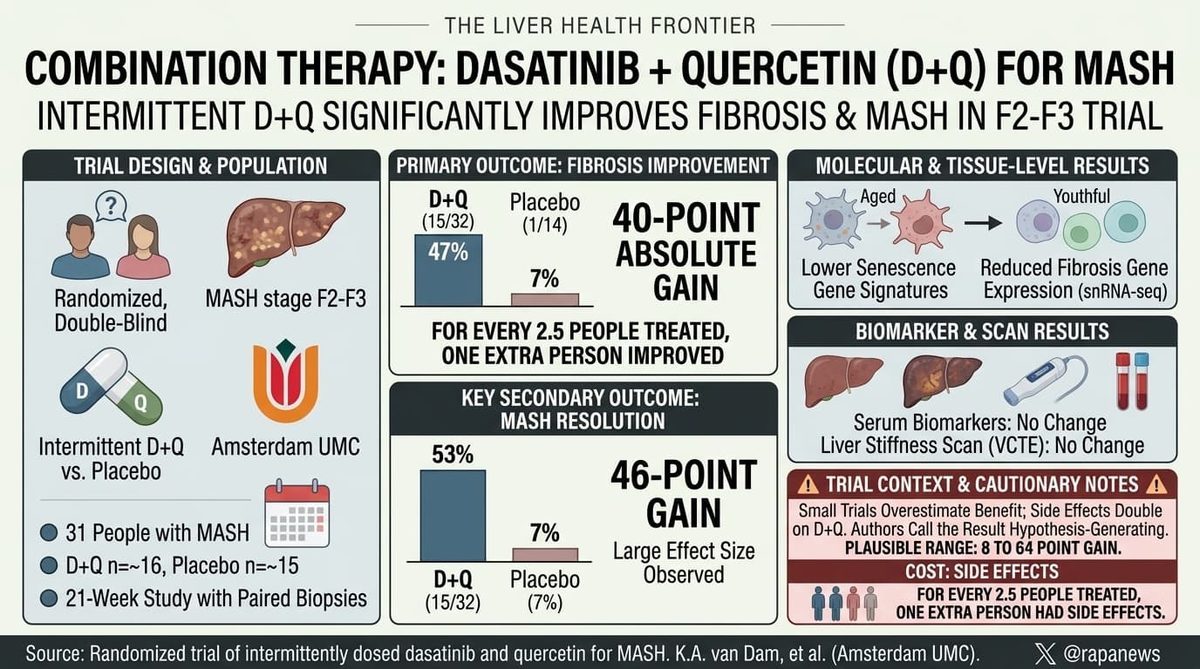
Eight of 17 patients whose fatty liver disease had progressed to scarring saw their fibrosis improve after three 3-week cycles of two drugs. One of 14 on placebo did. The randomized, placebo-controlled result, published in Nature Metabolism, is the first controlled evidence that clearing senescent cells can reverse liver fibrosis in people.

The drugs are dasatinib, a leukemia therapy, and quercetin, a plant compound. Given intermittently, the pair kills senescent cells — damaged, non-dividing cells that keep emitting inflammatory signals and accumulate in scarred livers. The catch: 31 patients is a tiny sample, and the headline effect's confidence interval nearly includes zero. The researchers call it a proof-of-principle result.

Why it matters

If confirmed in a larger trial, senolytics would be the first therapy to reverse liver fibrosis in MASH, not just slow it.

Questions about this story

Free account needed to ask — your question is kept and asked for you right after sign-up. Answers are public.

No questions yet — be the first to ask.

Key Indicators

47%
Fibrosis improvement (≥1 stage) in D+Q group
8 of 17 treated patients improved versus 1 of 14 on placebo (P = 0.02).
53%
MASH resolution rate with D+Q
9 of 17 treated patients resolved MASH versus 1 of 14 on placebo (P = 0.02).
31
Participants randomized
17 to D+Q and 14 to placebo; 27 completed the 21-week trial.
40 percentage points
Absolute difference in fibrosis response
Relative risk 6.59 with a 95% confidence interval of 0.93 to 46.53, which includes no effect.

Voices

Curated perspectives — historical figures and your fellow readers.

Ever wondered what historical figures would say about today's headlines?

Sign up to generate historical perspectives on this story.

People Involved

Organizations Involved

Timeline

2019 October 2026

5 events Latest: 4 days ago
Tap a bar to jump to that date
  1. Results published in Nature Metabolism

    Latest Publication

    The phase 2 proof-of-principle results appear online in Nature Metabolism.

  2. Trial completes

    Completion

    Final study visits and paired liver biopsies are collected.

  3. Enrollment begins at Amsterdam UMC

    Start

    First participants randomized to D+Q or placebo for the 21-week study.

  4. TRUTH trial registered

    Registration

    The trial is registered on ClinicalTrials.gov as NCT05506488, testing D+Q in fibrotic NAFLD.

  5. First human senolytic trials reported

    Research

    Mayo Clinic reports the first human tests of D+Q, in idiopathic pulmonary fibrosis and diabetic kidney disease.

Scenarios

1

Senolytics advance to a larger confirmatory trial

Possible Resolves by End of 2029

Discussed by: Trial authors and Nature Metabolism commentary

The strong effect sizes (47% versus 7% on fibrosis) justify a properly powered phase 2b or 3. The obstacle is economics: dasatinib is an off-patent generic and quercetin is an over-the-counter supplement, so no single company has a commercial incentive. Academic or public funding would be needed to launch the follow-up.

2

The finding fails to replicate in a larger trial

Possible Resolves by End of 2029

Discussed by: rapamycin.news critique of the trial's fragility

The primary result is 8 responders against 1. The relative risk confidence interval (0.93 to 46.53) includes no effect, a worst-case analysis of the four missing biopsies erases the significance, and flipping one placebo patient to responder removes the headline. A larger trial could easily find no histologic benefit.

3

No follow-up; result stands as proof-of-principle only

Likely Resolves by End of 2027

Discussed by: The off-patent economics of both drugs

Neither drug rewards a commercial sponsor: dasatinib is generic and quercetin is sold as a supplement. Without a patent or exclusivity hook, pharma has little reason to fund an expensive fibrotic-MASH registration program. The result may remain a suggestive early signal rather than a launchpad.

Historical Context

2 moments from history that rhyme with this story — and how they unfolded.

2019

First human senolytic trials (2019)

Mayo Clinic researchers gave intermittent dasatinib plus quercetin to patients with idiopathic pulmonary fibrosis and diabetic kidney disease — the first human tests of drugs that clear senescent cells. The pair had been chosen for its track record killing senescent cells in mice.

Then

Both small studies showed the regimen was tolerable and reduced senescent cell burden in tissue.

Now

They established the intermittent dosing schedule and safety profile used in nearly every senolytic trial since.

Why this matters now

The Amsterdam MASH trial uses the same drugs, dose schedule, and rationale, but tests a harder endpoint: histologic reversal of liver fibrosis.

March 2024

Resmetirom becomes first FDA-approved MASH drug (March 2024)

After years of late-stage failures, including the FDA's 2023 rejection of obeticholic acid, the FDA approved resmetirom (Rezdiffra) for MASH with moderate to advanced fibrosis. The thyroid hormone receptor agonist lowers liver fat.

Then

Resmetirom became the first approved MASH therapy, with fibrosis improvement shown as a supporting measure.

Now

It re-established MASH as a treatable disease and set the bar that histologic endpoints must clear.

Why this matters now

Senolytics attack a different mechanism — cellular senescence — and the Amsterdam trial is the first randomized evidence they can improve fibrosis histologically, an endpoint resmetirom's trials handled only as secondary.

Sources

(6)