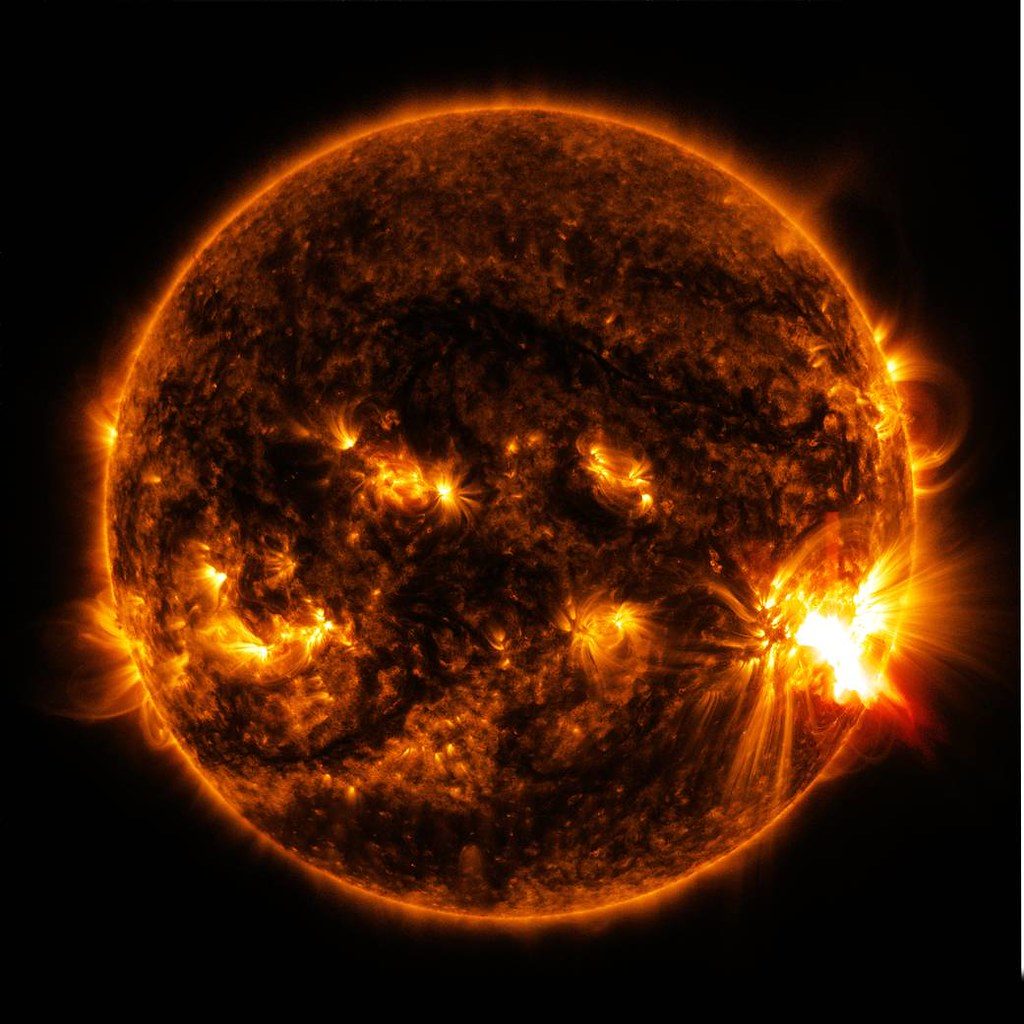
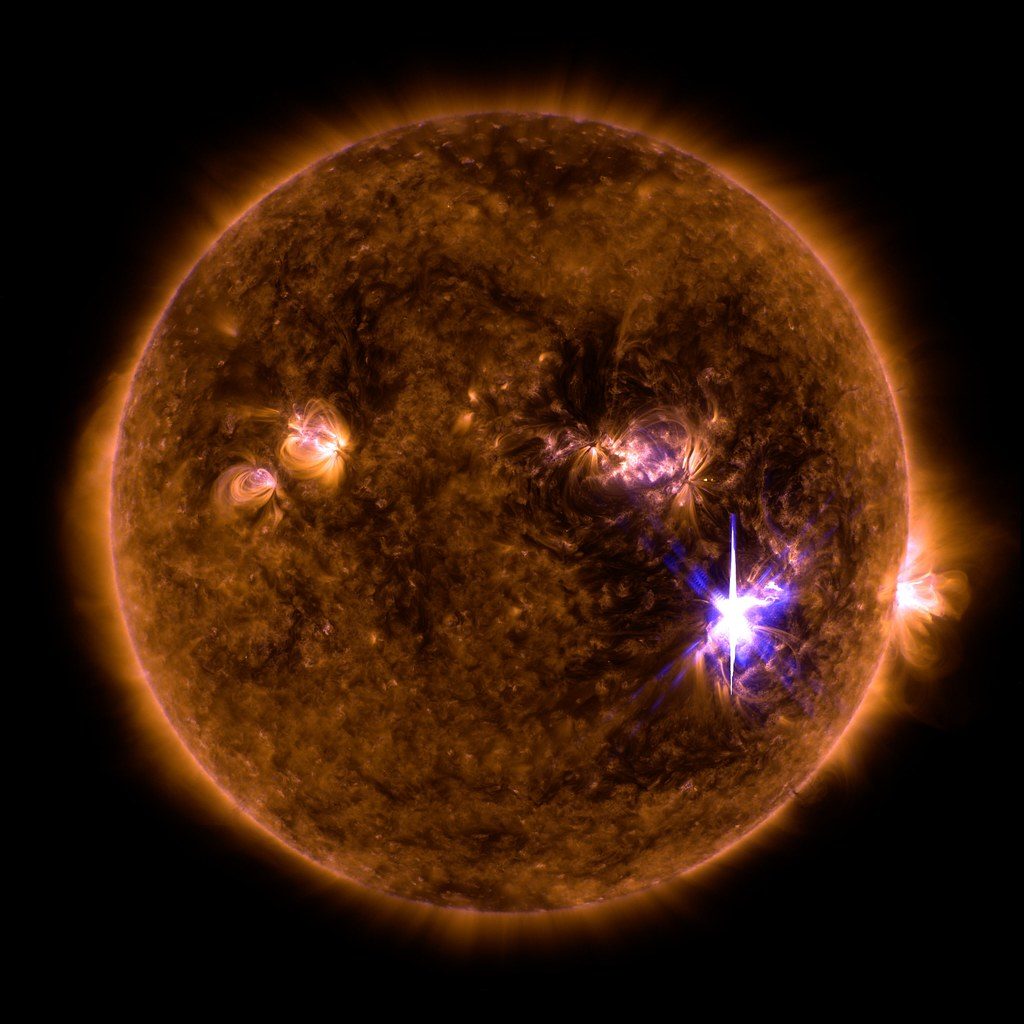
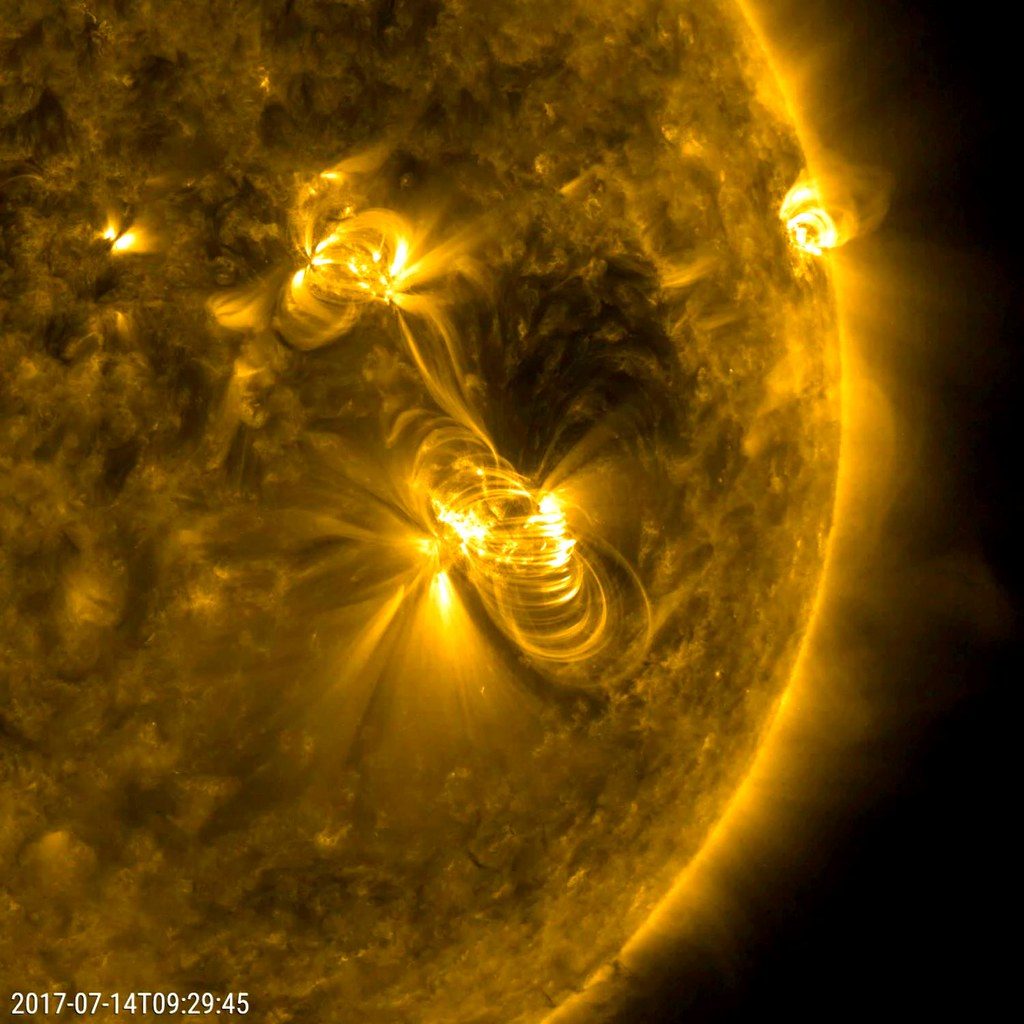
Sunspot region AR4366 rotated into view February 1, two weeks after the January 19 X1.9 flare and G4.7 geomagnetic storm. At 23:44 UTC, AR4366 unleashed an X8.1 flare—the 3rd-largest of Cycle 25—triggering an R3 strong radio blackout across Earth's sunlit hemisphere, then fired four more X-class flares (X2.9, X2.8, X1.5, X1.7) within hours. By February 5, it had produced 10 X-class flares in five days and over 100 M-class flares, growing to nearly 10 times Earth's width with a magnetically unstable delta-class configuration.
Multiple coronal mass ejections from AR4366 are forecast to reach Earth between February 5 and 8, possibly triggering G1 minor geomagnetic storms and auroras, with G1 conditions already underway February 5. The January 2026 storm demonstrated the grid's resilience, but this outbreak will test whether recent infrastructure hardening holds against sustained impacts from a single region. Forecasters estimate a 40% probability of more X-class flares and 80% probability of M-class flares continuing through February 7.
Questions about this story
Free account needed to ask — your question is kept and asked for you right after sign-up. Answers are public.
No questions yet — be the first to ask.
Key Indicators
X8.1
Largest Recent Flare
3rd-largest flare of Solar Cycle 25, erupted February 1, 2026
10
X-Class Flares in 5 Days
AR4366 produced 10 X-class flares between February 1-5, unprecedented rate
100+
M-Class Flares
Over 100 M-class flares from AR4366 in same period
10x Earth
Sunspot Region Size
AR4366 has grown to nearly 10 times Earth's diameter
G1
Current Storm Level
Minor geomagnetic storming underway as of February 5
Sunspot region AR4366 fires X4.2 flare on February 4-5. Region has now produced 10 X-class flares in 5 days. G1 minor geomagnetic storming ongoing from early-arriving CME. Aurora possible at high latitudes.
AR4366 Fires X1.5 Flare; 9th X-Class in 4 Days
Solar Flare
Sunspot region AR4366 produces X1.5 flare causing R3 strong radio blackout over south Atlantic. Region also produced 15 M-class flares same day.
AR4366 Erupts with M7.2 Flare; 14 M-Class Flares in 24 Hours
Solar Flare
Sunspot region AR4366 produces strongest M-class flare (M7.2) of the outbreak, triggering R2 moderate radio blackout. Region continues relentless flare production.
AR4366 Fires Second X-Class Flare Within Hours
Solar Flare
X2.9 flare erupts from AR4366 less than an hour after X8.1. Reinforces radio blackout conditions across Earth's sunlit hemisphere.
AR4366 Produces X2.8 Flare
Solar Flare
Third X-class flare in rapid succession from newly emerged sunspot region AR4366.
AR4366 Fires X1.5 Flare
Solar Flare
Second X-class flare from AR4366 within 15 minutes of X8.1 eruption.
X8.1 Flare—3rd Largest of Solar Cycle 25
Major Solar Flare
Sunspot region AR4366 erupts with X8.1 flare, the 3rd-largest flare of Solar Cycle 25. Triggers R3 strong radio blackout across Earth's sunlit hemisphere, disrupting HF communications for aviation, maritime, and amateur radio users, especially across Pacific east of Australia and New Zealand.
AR4366 Emerges as Giant Sunspot Region
Solar Feature
New sunspot region AR4366 rotates into Earth-facing view on solar east limb. Region rapidly grows to nearly 10 times Earth's width with magnetically unstable beta-gamma-delta configuration.
January 2026
Storm Subsides After 42-Hour Duration
Storm Resolution
Geomagnetic storm concludes after lasting approximately 42 hours. Peak reached G4.7, close to G5 extreme levels, before gradually declining. Infrastructure impacts minimal despite severity.
Aurora Visible Across Southern U.S. States
Ongoing Impact
Aurora displays continue through January 21, visible as far south as Southern California. Viewing conditions favorable due to new moon phase.
G4 Conditions Continue; Aurora Reaches Southern U.S.
Ongoing Impact
Storm persists through January 20 UTC-day. Northern lights photographed from Alabama, Kentucky, and New Mexico. Power grids report manageable impacts.
Second G4 Peak as Storm Persists
Ongoing Impact
After declining to G2 levels, storm reaches G4 severe conditions again at 08:23 UTC (03:23 EST) and 10:21 UTC (05:21 EST) as CME effects continue.
CME Arrives Early—G4 Storm Begins
Major Storm
CME traveling ~1,700 km/s reaches Earth in 25 hours instead of predicted 40+. G4 severe conditions reached within minutes.
S4 Radiation Storm Declared
Radiation Event
NOAA declares the first S4 severe solar radiation storm since the 2003 Halloween storms. ISS crew shelters in shielded areas.
S4 Radiation Storm Peaks at Highest GOES Record
Radiation Event
High-energy particle shower reaches maximum intensity, placing at top of GOES satellite radiation storm records. Enhanced risk to polar flights and satellites confirmed.
X1.9 Flare Erupts from AR4341
Solar Flare
First X-class flare of 2026 triggers R3-strong radio blackouts across the Americas, Europe, and Africa. Full-halo CME detected.
November 2025
X5.16 Flare Triggers G4 Storm
Major Storm
Region AR4274 produces an X5.16 flare with a 1,950 km/s CME, causing the third-strongest geomagnetic storm of Cycle 25.
October 2024
NASA/NOAA Declare Solar Maximum
Cycle Event
Official announcement that Solar Cycle 25 reached maximum with a smoothed sunspot number of 161—exceeding the predicted peak of 115.
X9.0 Flare—Strongest of Cycle 25
Solar Flare
Sunspot region AR3842 produces an X9.0 flare, the most powerful Earth-facing flare of the current cycle.
May 2024
First G5 Extreme Storm Since 2003
Major Storm
Multiple CMEs from sunspot region 3664 trigger the first G5 storm in 21 years. Aurora visible from Texas to Florida. 40 Starlink satellites lost.
February 2022
Starlink Loses 38 Satellites to Minor Storm
Infrastructure Impact
A G1 geomagnetic storm increases atmospheric drag, causing 38 of 49 newly launched Starlink satellites to reenter and burn up.
December 2019
Solar Cycle 25 Begins
Cycle Event
Solar minimum marks the start of Cycle 25, with a smoothed sunspot number of 1.8.
Scenarios
1
G5 Extreme Storm Strikes Before Cycle 25 Ends
Possible
Discussed by: Space.com, NOAA forecasters, and solar physics researchers
Studies predict 2±1 extremely strong flares (>X14) may occur between May 2026 and December 2027 as Cycle 25 declines. A direct-hit CME from such an event could produce G5 conditions with more severe infrastructure impacts than May 2024. NOAA's Shawn Dahl noted the January 2026 storm had potential to escalate to G5. The declining phase of solar cycles has historically produced some of the strongest individual events.
2
Major Satellite Constellation Loss During Storm
Possible
Discussed by: MIT Technology Review, space weather researchers, satellite operators
The February 2022 Starlink loss demonstrated that even minor G1 storms can destroy satellites at vulnerable orbital insertion altitudes. A G4 or G5 storm during a large satellite deployment could cause significant losses. Operators have since adjusted procedures, but the risk of thermospheric density spikes catching newly launched constellations remains a concern as megaconstellation deployments continue.
3
Forecasting Models Improve to Sub-6-Hour Accuracy
Likely
Discussed by: Nature Scientific Reports, arXiv space weather research, NOAA
Recent AI models have shown unprecedented accuracy in predicting CME arrivals, with some achieving uncertainty as small as one minute in test cases. NOAA's Space Weather Follow On-L1 satellite, launched in 2025, adds coronagraph capabilities for earlier CME detection. If operational forecasting adopts these improvements, the gap between prediction and reality could narrow substantially, giving grid operators and airlines more reliable lead time.
4
Regional Power Grid Disruption During Severe Storm
Unlikely
Discussed by: NERC, USGS, Lloyd's of London, power grid analysts
The January 2026 storm produced manageable grid impacts, but NERC standards are designed for 1-in-100-year events, not Carrington-scale storms. USGS modeling shows the U.S. Midwest and East Coast are most vulnerable due to underlying geology. A sustained, well-directed G5 storm could overwhelm protective systems. Transformer replacement backlogs of up to two years add to long-term risk.
5
Sustained Multi-Week Flare Barrage from AR4366
Likely
Discussed by: NOAA SWPC forecasters, EarthSky solar analysts
AR4366's rapid growth and complex delta-class magnetic configuration suggest it could remain highly productive for 1-2 weeks as it transits the visible disk. If the region maintains its current flare rate (10 X-class flares per 5 days), it could produce 20-40 additional X-class flares before rotating off the visible disk. This would establish a new record for X-class flare production in a single solar rotation and test grid and satellite operator response protocols repeatedly.
6
Direct-Hit CME from AR4366 Produces G3-G4 Storm
Possible
Discussed by: NOAA SWPC, space weather forecasters
AR4366 is moving toward a more geoeffective position on the solar disk. Current CME modeling suggests glancing-blow scenarios, but if a major flare occurs when the region is directly Earth-facing, a direct-hit CME could produce G3 (strong) or G4 (severe) geomagnetic conditions. Such an event would test whether January 2026's grid hardening measures hold under repeated stress from a single active region.
Historical Context
3 moments from history that rhyme with this story — and how they unfolded.
1 of 3
March 1989
Quebec Blackout (1989)
On March 13, 1989, a severe geomagnetic storm caused Hydro-Québec's power grid to collapse in under 90 seconds. Telluric currents overwhelmed seven static var compensators in sequence, causing the entire La Grande network to separate. Six million people lost power for nine hours.
Then
Quebec spent $2 billion over six years on grid hardening. U.S. utilities narrowly avoided similar cascading failures.
Now
The blackout drove development of NERC's geomagnetic disturbance standards and modern GIC monitoring. Hydro-Québec engineers believe their current grid would survive a repeat event.
Why this matters now
The 1989 storm remains the benchmark for grid vulnerability. The January 2026 storm, though severe, did not match its intensity—but demonstrated that forecasting gaps still leave operators with limited warning time.
2 of 3
October-November 2003
Halloween Storms (2003)
Three massive sunspot groups produced 17 major flares over two weeks, including an X17 and X10 in rapid succession. CMEs traveling over 2,000 km/s triggered three consecutive G5 storms. The storms knocked out the Japanese ADEOS-II satellite, caused a power outage in Sweden, and disabled 12 transformers in South Africa.
Then
Over half of Earth-orbiting satellites experienced effects. USAF satellite trackers lost position on most LEO assets for days.
Now
The Halloween storms established the modern standard for severe space weather events and drove investment in space weather forecasting infrastructure.
Why this matters now
The January 2026 S4 radiation storm was the first to exceed Halloween 2003 intensity in 23 years, marking a significant return to extreme conditions despite the solar cycle's declining phase.
3 of 3
February 2022
Starlink Satellite Loss (2022)
A minor G1 geomagnetic storm—the lowest severity category—coincided with a Starlink deployment at 210 km altitude. Atmospheric density increased up to 50%, dramatically increasing drag on the 49 newly launched satellites. Despite safe-mode maneuvers, 38 satellites failed to reach operational altitude and burned up during reentry.
Then
SpaceX lost approximately $50 million in satellites. The event demonstrated that even minor storms pose risks during specific operational phases.
Now
Satellite operators adjusted deployment procedures to account for space weather windows. The incident intensified research into thermospheric density forecasting.
Why this matters now
The 2022 loss showed that storm severity ratings alone don't capture operational risk. The January 2026 G4 storm carried similar satellite drag concerns, with operators preemptively entering safe mode.