
Pull to refresh
Logo
Manganese-doped quantum dots keep hot electrons moving across 0.15 mm at room temperature

Manganese-doped quantum dots keep hot electrons moving across 0.15 mm at room temperature

New Capabilities

Los Alamos and KITECH report a room-temperature drift mobility of about 150 square centimetres per volt-second, ten times that of the best conventional quantum-dot films, by re-exciting electrons mid-flight.

Overview

Updated 1 hour ago

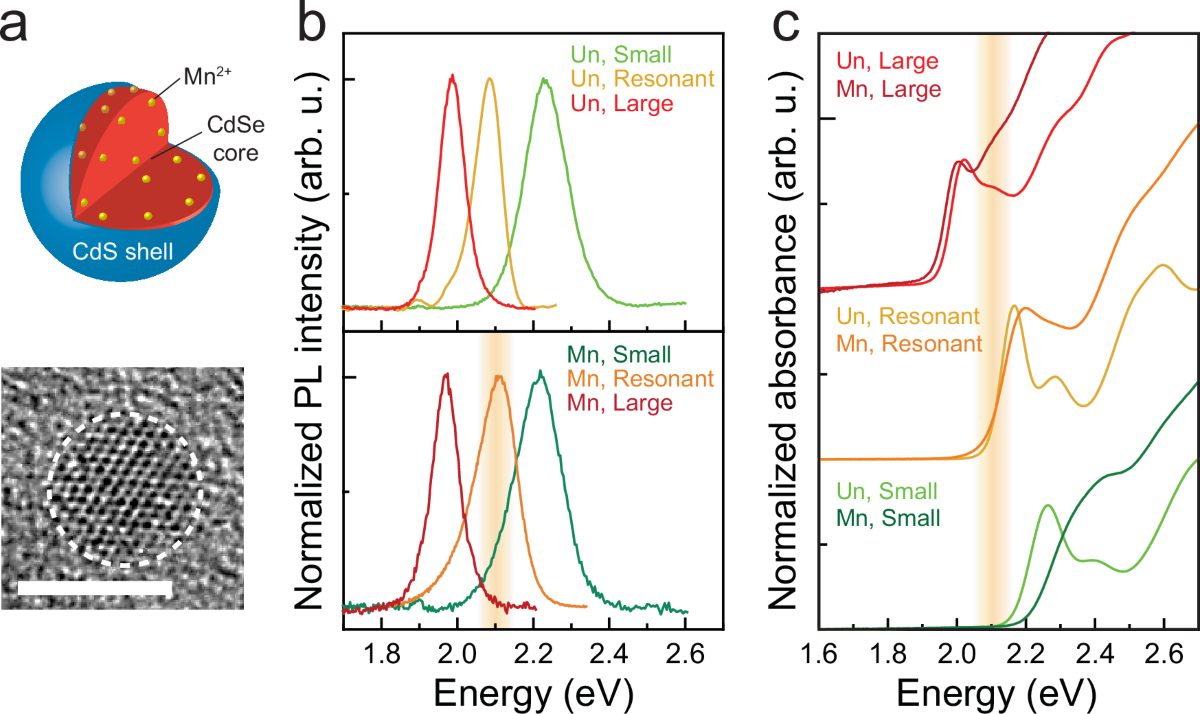
A photon that frees an electron in a semiconductor leaves it carrying excess energy, and that energy is usually gone as heat within picoseconds. A manganese-doped quantum-dot film reported in Nature on 25 November 2026 held such electrons for seven nanoseconds. Its room-temperature drift mobility was about 150 square centimetres per volt-second, roughly ten times that of the best conventional quantum-dot films.

The mechanism is spin-exchange Auger upconversion: manganese ions push energy into electrons faster than phonons can drain it, then re-excite them partway through their flight. The measured drift range reached about 0.15 millimetres, more than twice the 70-micrometre gap between the device electrodes. Solar cells and photodetectors that collect carriers this fast could exceed the efficiency ceiling set in 1961.

Why it matters

Hot carriers shed their energy in picoseconds. Devices that collect them before they cool could push solar cells past a 60-year efficiency ceiling.

Questions about this story

Free account needed to ask — your question is kept and asked for you right after sign-up. Answers are public.

No questions yet — be the first to ask.

Key Indicators

150
Room-temperature electron drift mobility
Square centimetres per volt-second; roughly ten times device-grade quantum-dot films at 10 to 20.
0.15 mm
Drift range of the hot-electron population
Computed from a 7-nanosecond effective lifetime and a 21.5 micrometres per nanosecond drift velocity at 100 volts.
230 fs
Spin-exchange Auger upconversion time
The resulting energy-gain rate of about 9 electron-volts per picosecond dwarfs phonon losses below 1.
7 ns
Effective lifetime of the regenerated hot electrons
Not a recombination lifetime. It is how long repeated manganese-driven re-excitation keeps working.

Voices

Curated perspectives — historical figures and your fellow readers.

Sign up to generate historical perspectives on this story.

Organizations Involved

Timeline

2019 November 2026

3 events Latest: 2 days ago
  1. Nature publishes submillimetre hot-electron transport in doped dot films

    Latest Research

    Time-of-flight measurements gave a room-temperature drift mobility of about 150 square centimetres per volt-second and a drift range near 0.15 millimetres.

  2. Interfacial spin exchange shown to drive photoreduction

    Research

    A companion study used manganese-doped dots to capture excitons before cooling and drive demanding photocatalytic reactions.

  3. Manganese doping shown to outrun phonon cooling in single dots

    Research

    Los Alamos reported spin-exchange Auger upconversion in manganese-doped cadmium selenide quantum dots, fast enough to eject electrons before they cooled.

Scenarios

1

A quantum-dot solar cell beats the detailed-balance limit

Unlikely Resolves by End of 2030

Discussed by: The Nature authors, who name photoconversion as the first application; no group has yet published a hot-carrier photovoltaic device built on these films

A hot-carrier cell would absorb above-bandgap photons and collect electrons before they cool, converting the surplus instead of losing it as heat. The paper supplies the transport, not the device. Contacts, doping uniformity and film thickness at device scale remain unsolved, and a working cell has to beat the limit by more than the losses its own architecture adds.

2

Gigahertz photodetectors built on manganese-doped films

Possible Resolves by End of 2028

Discussed by: The Nature authors, who list transit-time-limited photodetection as an application

Transit-time-limited detection is the nearest application. Carriers cross a micrometre-scale gap in nanoseconds, so shrinking the gap raises bandwidth. The published drift velocity of about 21.5 micrometres per nanosecond already implies a detector whose speed is set by how fast carriers cross rather than by circuit capacitance.

3

Other labs cannot reproduce the mobility in their own films

Possible Resolves by Q2 2028

Discussed by: Quantum-dot transport researchers outside Los Alamos and KITECH; the paper's own discussion notes that regeneration fails in dots without an excited manganese ion

Manganese doping level, ligand chemistry and film thickness all set the spin-exchange rate. A group that cannot reproduce the doping profile would measure ordinary hopping transport and report mobilities near the 10 to 20 square centimetres per volt-second typical of coupled dot films.

Historical Context

2 moments from history that rhyme with this story — and how they unfolded.

1961

Shockley-Queisser limit (1961)

William Shockley and Hans Queisser calculated the maximum efficiency of a single-junction solar cell by detailed balance. Photons below the bandgap are wasted, and carriers excited above it lose the surplus as heat. For silicon the answer came out near 30%.

Then

The result became the reference point for every photovoltaic technology that followed.

Now

It defined the ceiling that hot-carrier, tandem and multi-exciton designs all try to break.

Why this matters now

The manganese-doped films target exactly the heat-loss term in that calculation.

2004-2010

Carrier multiplication in quantum dots (2004-2010)

Groups at Los Alamos and the National Renewable Energy Laboratory reported that one high-energy photon could produce two or more electron-hole pairs in lead selenide and lead sulfide quantum dots, a route around the detailed-balance limit.

Then

The reports drew wide attention and sharp debate over measurement artefacts and quantum yields.

Now

Carrier multiplication is now accepted in dots, but no commercial solar cell uses it.

Why this matters now

Same lab lineage, same promise, same open question: does the single-dot effect survive in a device?

Sources

(5)