
Pull to refresh
Logo
Suriname toad hunts with hypersensitive star-shaped fingertips

Suriname toad hunts with hypersensitive star-shaped fingertips

New Capabilities

Study finds the frog's fingertip lobes form a 'somatosensory fovea' that senses prey through water pressure

2 days ago: Science magazine reports the finding

Overview

Updated 1 hour ago

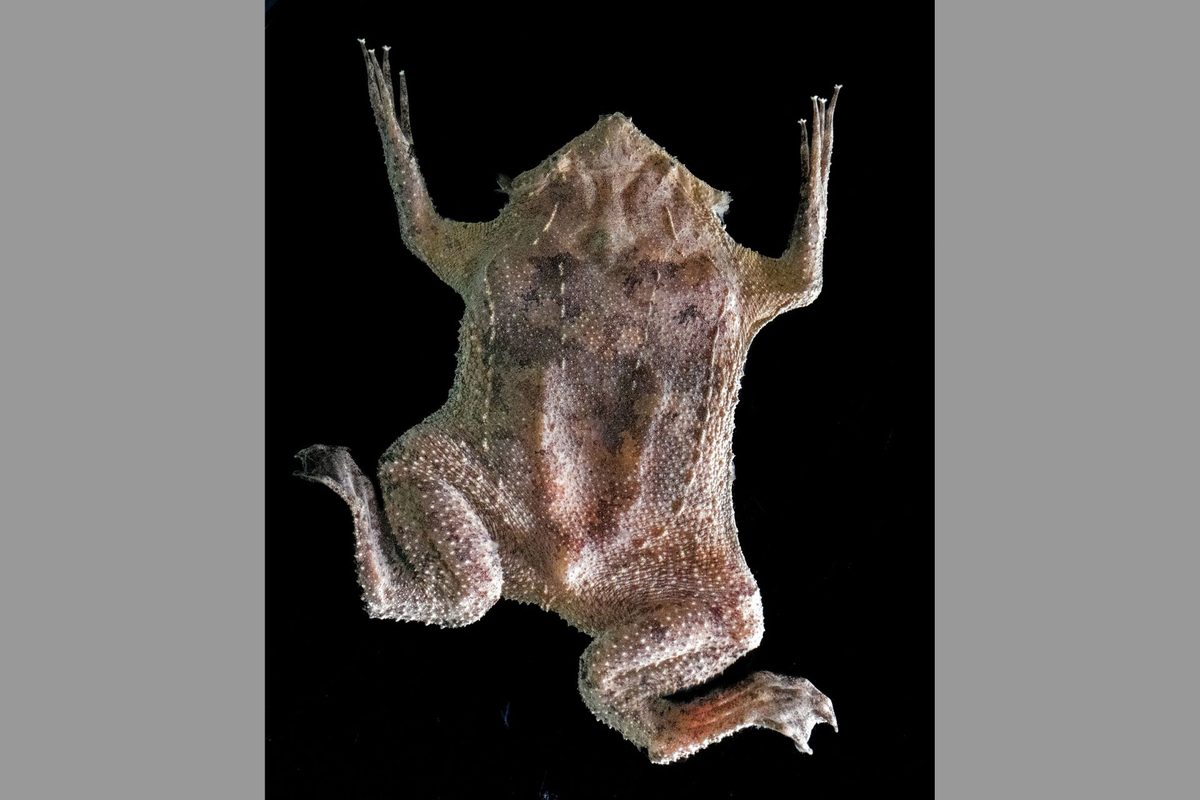
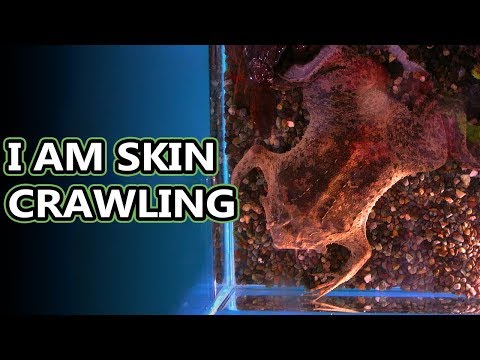
The Suriname toad is flat, tongueless, and nearly blind in murky water. Yet it captures fish with 87% accuracy even in total darkness.

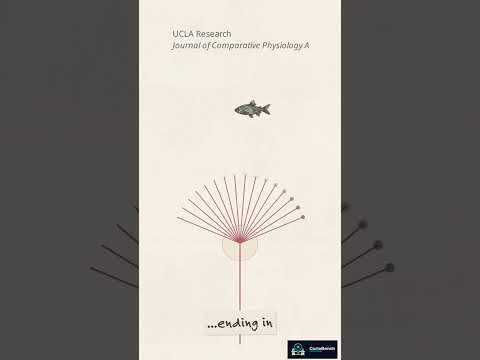
New UCLA research shows why: the star-shaped fingertips that give the species its name are hypersensitive motion detectors. Each fingertip carries dense clusters of touch receptors that sense the water pressure from approaching prey, letting the toad strike before contact. The study, published in the Journal of Comparative Physiology A, describes this as only the second known 'somatosensory fovea' — a tactile organ with disproportionate brain representation — after the star-nosed mole.

Why it matters

Only the second known tactile fovea, this finding shows touch-based 'vision' evolved independently across 350 million years of divergence.

Questions about this story

Free account needed to ask — your question is kept and asked for you right after sign-up. Answers are public.

No questions yet — be the first to ask.

Key Indicators

4.3x
Brain magnification of digit tip representation
Digit tips occupy 34% of the forelimb brain map despite being only 8% of forelimb surface area.
94.5%
Prey capture success under visible light
Success stays at 87.2% in total darkness and 78.8% with both vision and lateral line blocked.
128
Terminal lobules per toad
Each fingertip's lobes subdivide into 16 lobules, yielding 128 terminal touch-sensitive units per frog.
60%
Share of forelimb touch nerves in the lobules
The fingertip lobes cover only 8% of forelimb skin yet house the majority of its touch-sensitive nerves.

Voices

Curated perspectives — historical figures and your fellow readers.

Ever wondered what historical figures would say about today's headlines?

Sign up to generate historical perspectives on this story.

People Involved

Organizations Involved

Timeline

August 2026 September 2026

2 events Latest: 2 days ago
  1. Science magazine reports the finding

    Latest Publication

    Science covers the study, describing the toad's star-shaped toes as 'tactile eyeballs' and highlighting the discovery as the second known somatosensory fovea.

  2. Study published in Journal of Comparative Physiology A

    Research

    UCLA researchers characterize the Suriname toad's fingertip lobes as hypersensitive mechanoreceptive organs and verify touch-guided prey capture with high-speed video.

Scenarios

1

Researchers identify tactile foveae in other aquatic species

Possible Resolves by End of 2027

Discussed by: The UCLA team and commentators interviewed by CBC and The Transmitter

The finding that a frog independently evolved a somatosensory fovea suggests other aquatic species with tactile organs may have similar adaptations. Researchers will likely re-examine salamanders, fish, and other frogs for disproportionate tactile representation in the brain.

2

Engineers build water-motion sensors modeled on toad fingertip lobes

Unlikely Resolves by End of 2028

Discussed by: Biomimetic engineering community; no named group yet

The study's quantitative data — papillae density of 142 per square millimeter and mechanical thresholds of 0.07 millinewtons — provide a design blueprint for pressure-sensitive hydrophones. A prototype or patent citing Pipa pipa morphology would confirm this path.

3

UCLA team maps the neural circuits behind touch-guided suction feeding

Likely Resolves by End of 2027

Discussed by: The study's own authors; natural extension of the published work

The current study documents the peripheral receptors and the tectal representation but leaves the intervening circuits open. A follow-up tracing the pathway from fingertip afferents to the suction-feeding motor program would close the loop between sensation and behavior.

Historical Context

3 moments from history that rhyme with this story — and how they unfolded.

2000s

Star-nosed mole tactile fovea (early 2000s)

Ken Catania at Vanderbilt University showed the star-nosed mole's 22 fleshy tentacles are covered with roughly 25,000 Eimer's organs, and that the tentacles occupy a massively enlarged map in the somatosensory cortex — the first described somatosensory fovea. The mole identifies prey in about 120 milliseconds.

Then

Established the tactile fovea concept and made the star-nosed mole a model organism for sensory neuroscience.

Now

Became the reference point for any study of extreme tactile specialization; the new toad study explicitly compares its magnification factor to the mole's.

Why this matters now

The Suriname toad is the second species shown to have a somatosensory fovea. That the two evolved in lineages separated by more than 350 million years is the study's central claim about convergent evolution.

1980s

Platypus electroreception (discovered mid-1980s)

Researchers found the platypus hunts in murky water using electroreceptors in its bill, detecting the electric fields generated by prey muscle activity. It was the first mammal shown to use electroreception for foraging.

Then

Expanded the known sensory toolkit of mammals beyond the classic five senses.

Now

Demonstrated that aquatic predators in low-visibility water routinely evolve specialized non-visual prey detection — the same pattern now seen in the Suriname toad.

Why this matters now

Both findings show aquatic animals substituting a tactile or electrical sense for vision in turbid water, strengthening the case that this is a recurring evolutionary solution.

20th century

Echolocation convergence in bats and toothed whales (20th century)

Bats and toothed whales independently evolved sonar-like echolocation for navigation and hunting. The two lineages diverged roughly 80 million years ago, yet arrived at nearly identical sound-processing mechanisms.

Then

Established echolocation as a classic textbook example of convergent evolution.

Now

Provided a framework for expecting convergent solutions to the same sensory problem.

Why this matters now

The toad-mole tactile fovea follows the same pattern: identical structural logic (a sensory fovea) appearing in distantly related lineages facing similar sensory constraints.

Sources

(6)