

Pull to refresh
Logo
CFTC adviser ordered retraction of referral on suspicious Iran oil trades

CFTC adviser ordered retraction of referral on suspicious Iran oil trades

Rule Changes

Traders bet hundreds of millions minutes before Trump's Iran reversal; a senior appointee then ordered the regulator to back off

3 days ago: Bloomberg reveals retraction order

Overview

Updated 1 hour ago

On March 23, about 15 minutes before President Trump posted that he was postponing strikes on Iranian power plants, traders placed billions of dollars in futures bets that oil would fall and stocks would rise. In a two-minute window, roughly $580 million in crude contracts changed hands — 8.5 times the volume traded in the same window the prior week.

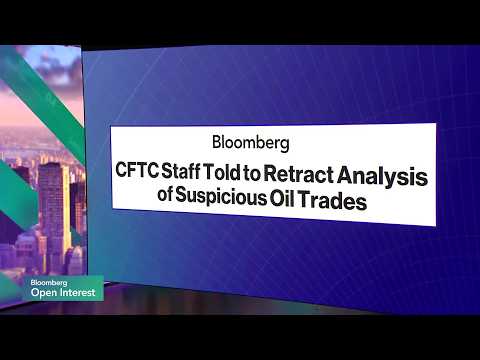
Analysts at the Commodity Futures Trading Commission flagged the trades and referred them to the enforcement division for a potential insider trading investigation. A senior adviser to the CFTC chairman then ordered the referral retracted — a move career staff said had rarely, if ever, happened before.

Why it matters

If political appointees can bury referrals on politically sensitive trades, markets lose a key deterrent against insider trading.

Questions about this story

Free account needed to ask — your question is kept and asked for you right after sign-up. Answers are public.

No questions yet — be the first to ask.

Key Indicators

$580M
Value of crude contracts traded in two minutes on March 23
6,200 Brent and West Texas Intermediate contracts changed hands between 6:49 and 6:50 a.m. ET.
8.5x
Oil volume traded in the two-minute window vs. prior week average
Analysts scrutinized the trade specifically because of this jump in volume.
15 min
Time between the trades and Trump's Truth Social post
Trump announced a five-day postponement of strikes on Iranian power plants after the trades were placed.
13
CFTC enforcement actions in fiscal year 2025
Down from 58 in 2024 and 96 in 2023, reflecting sharply reduced regulatory activity.

Voices

Curated perspectives — historical figures and your fellow readers.

Ever wondered what historical figures would say about today's headlines?

Sign up to generate historical perspectives on this story.

People Involved

Organizations Involved

Timeline

March 2026 October 2026

7 events Latest: 3 days ago
Tap a bar to jump to that date
  1. Bloomberg reveals retraction order

    Latest Revelation

    Bloomberg reports a CFTC adviser ordered staff to retract the referral and took over the analysis.

  2. CFTC chair pledges enforcement

    Statement

    Selig tells House committee fraud will face the full force of the law.

  3. Senators press CFTC to investigate

    Congressional

    Warren and Whitehouse ask Selig to investigate suspicious oil trades.

  4. Another suspicious bet before ceasefire announcement

    Market Event

    Hours before a ceasefire announcement, traders bet about $950M against oil.

  5. CFTC enforcement director acknowledges speculation

    Statement

    David Miller says the agency is watching speculation about insider trading in its markets.

  6. Traders bet on falling oil minutes before Trump's post

    Market Event

    Traders placed $580M in crude contracts in two minutes, 15 minutes before Trump's Iran reversal post.

Scenarios

1

DOJ files insider trading charges tied to the March 23 trades

Possible Resolves by Q3 2027

Discussed by: The Justice Department was reported in April 2026 to be examining the trades independently of the CFTC.

DOJ uses exchange data and its own subpoenas to trace the traders. If it finds evidence they knew the March 23 decision before Trump's post, charges follow. The retracted referral doesn't stop a criminal case, but DOJ would lack the CFTC's forensic report as a starting point.

2

Investigation closes without charges

Likely Resolves by Q3 2027

Discussed by: Public Citizen and former CFTC staff note the agency's enforcement has declined sharply; the referral is no longer active.

With the referral retracted and the original analysts gone, the case stalls. DOJ's review, without the CFTC's forensic work, doesn't produce charges. Congressional pressure fades as the news cycle moves on.

3

Congressional hearing or inspector general review into the retraction

Possible Resolves by Q2 2027

Discussed by: Senators Warren and Whitehouse wrote to Selig in April; Public Citizen called for an immediate public meeting of the CFTC's Energy & Environmental Advisory Committee.

New public pressure forces the Senate Agriculture or House Agriculture Committee to hold hearings on the retraction. An inspector general or Government Accountability Office review into the CFTC's process becomes the main vehicle for accountability.

Historical Context

3 moments from history that rhyme with this story — and how they unfolded.

January-March 2020

Senate stock trades during COVID (2020)

Senators including Richard Burr and Kelly Loeffler sold large stock positions in early 2020 after closed-door briefings on the coming pandemic, before the public realized its severity.

Then

The FBI and Justice Department opened insider trading inquiries. The DOJ closed its investigation into Burr in January 2021 without charges.

Now

No senator faced consequences, demonstrating how difficult it is to prove insider trading against officials acting on public-policy knowledge.

Why this matters now

Shows that proving insider trading in politically sensitive cases is hard even when timing looks damning. This case may follow a similar path — or, if the trades are traced to specific people, depart from it.

November 2011-April 2012

The STOCK Act (2012)

'60 Minutes' aired a segment showing members of Congress traded stocks based on non-public legislative information. Congress passed the Stop Trading on Congressional Knowledge Act within months.

Then

The law required members to disclose stock trades within 45 days.

Now

Enforcement proved weak; the disclosure requirement was the main lasting change.

Why this matters now

Illustrates the reform path that typically follows political insider-trading scandals — and how rarely such reforms change actual enforcement.

October 1973

Saturday Night Massacre (1973)

President Nixon ordered Attorney General Elliot Richardson to fire Watergate special prosecutor Archibald Cox. Richardson resigned, his deputy resigned, and Solicitor General Robert Bork finally carried out the firing.

Then

Public backlash was immediate; a new special prosecutor was appointed within days.

Now

The episode set a precedent that presidents cannot control independent investigations without political consequences.

Why this matters now

A benchmark for executive interference in investigations. The CFTC retraction is far less dramatic, but the mechanism — an appointee suppressing a staff referral — is similar.

Sources

(6)