


Pull to refresh
Logo
U.S. birth rate hits record low as motherhood shifts to women over 30

U.S. birth rate hits record low as motherhood shifts to women over 30

New Capabilities

CDC data shows the fertility rate at a record low, while women over 30 buck the trend

Today: Record low framed by older-women counter-trend

Overview

Updated 2 hours ago

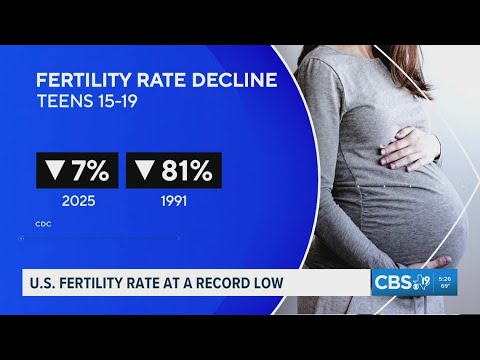
The U.S. fertility rate fell to a record low in 2025, capping two decades of decline that has cut births by nearly a quarter since 2007. The drop would have been larger if not for one counter-trend: women over 30 are having more babies than earlier generations of American women.

How much this matters depends on which number you watch. The record-low figure is a snapshot of one year's births; many children that 20-somethings are postponing may still arrive in their 30s. What is certain is that the country is aging: the median age reached 39.4 in 2025 and the population under 18 keeps shrinking.

Why it matters

With births falling for two decades, the U.S. workforce shrinks relative to retirees and the median age keeps climbing — now past 39.

Questions about this story

Free account needed to ask — your question is kept and asked for you right after sign-up. Answers are public.

No questions yet — be the first to ask.

Key Indicators

1.57
Total fertility rate (children per woman)
The record-low period total fertility rate for 2025.
-23%
Fertility decline since 2007 peak
The general fertility rate has fallen nearly a quarter since the 2007 high.
-6%
One-year birth-rate drop, women 20–24
Younger women drove the 2025 decline; teens fell 7% in the same year.
+127%
Birth-rate increase, women 40–44 (1990–2023)
Older-woman rates have climbed sharply as motherhood is delayed.

Voices

Curated perspectives — historical figures and your fellow readers.

Ever wondered what historical figures would say about today's headlines?

Sign up to generate historical perspectives on this story.

People Involved

Organizations Involved

Timeline

2007 October 2026

4 events Latest: Today
Tap a bar to jump to that date
  1. Record low framed by older-women counter-trend

    Today Report

    NPR reports the record-low birth rate, noting women over 30 are the only group having more children.

  2. CDC confirms record-low fertility

    Report

    Provisional 2025 data shows the general fertility rate fell 1% to a new record low.

  3. Older mothers outnumber teens

    Data point

    For the first time on record, more babies are born to women 40 and over than to teenage girls.

  4. Fertility peaks at 2.12

    Data point

    The U.S. fertility rate hits its modern high, the starting point of two decades of decline.

Scenarios

1

Fertility rate falls again in 2026

Possible Resolves by Jun 1, 2027

Discussed by: CDC demographers and economists such as Phillip Levine of Wellesley College

Women in their 20s keep postponing children, and rising births among 30-somethings do not fully compensate. The 2026 provisional data shows the general fertility rate slipping below the 2025 record low, extending a slide many analysts see as structural rather than temporary.

2

Older-mother births keep climbing

Possible Resolves by Jun 1, 2027

Discussed by: NCHS analysts tracking the upward age shift of mothers

Birth rates for women 35–44 continue rising as delayed motherhood becomes the norm and medical care supports older pregnancies. The total rate holds near its low, but the age profile of mothers keeps pushing upward, consistent with the two-decade pattern.

3

Policy push to lift birth rates

Unlikely Resolves by Jan 1, 2028

Discussed by: Researchers and advocates who cite affordability as the main barrier

Congress or state legislatures respond to the record lows by expanding paid leave, childcare subsidies or housing support, and early indicators point to a stabilizing fertility rate. Most analysts see no such package passing at the federal level before 2027.

Historical Context

3 moments from history that rhyme with this story — and how they unfolded.

1976

The 1970s baby-bust trough (1976)

After the post-war Baby Boom, U.S. fertility fell to about 1.7 children per woman in the mid-1970s, a then-record low driven by rising female workforce participation and delayed marriage.

Then

The low deepened public anxiety about a 'population bust' that never came as sharply as feared.

Now

Fertility rebounded modestly into the late 1980s, showing that a deep period low does not guarantee permanent collapse.

Why this matters now

The parallel matters now because the current 1.57 reflects the same mix of delayed and foregone births, and history suggests some of today's postponed births will still happen.

2007

The 2007 Great Recession inflection

The U.S. fertility rate peaked at 2.12 children per woman in 2007, then slid as the recession hit and stayed weak through the 2010s, never recovering to its former level.

Then

Recession-era job losses and housing strain pushed couples to delay or forgo children.

Now

The 2007 peak became the baseline for what demographics now call the 'demographic cliff' in births.

Why this matters now

Every record since is measured against 2007, making it the structural starting point of the current story.

1990s–present

Japan's persistent low fertility (1990s–present)

Japan's fertility rate fell below 1.5 in the 1990s and never recovered, leaving the country with a shrinking population and a quarter of residents over 65.

Then

Decades of low births produced labor shortages and pressure on pension systems.

Now

Japan is the cautionary case for whether postponement hardens into permanent childlessness.

Why this matters now

Demographers cite Japan when asking whether the U.S. delay in childbearing will become a permanent drop in family size.

Sources

(7)