

Pull to refresh
Logo
U.S. labor share falls to lowest level since 1947

U.S. labor share falls to lowest level since 1947

Money Moves

Workers took home 52.8% of national income in the second quarter of 2026 as corporate profits hit records

Overview

Updated 1 hour ago

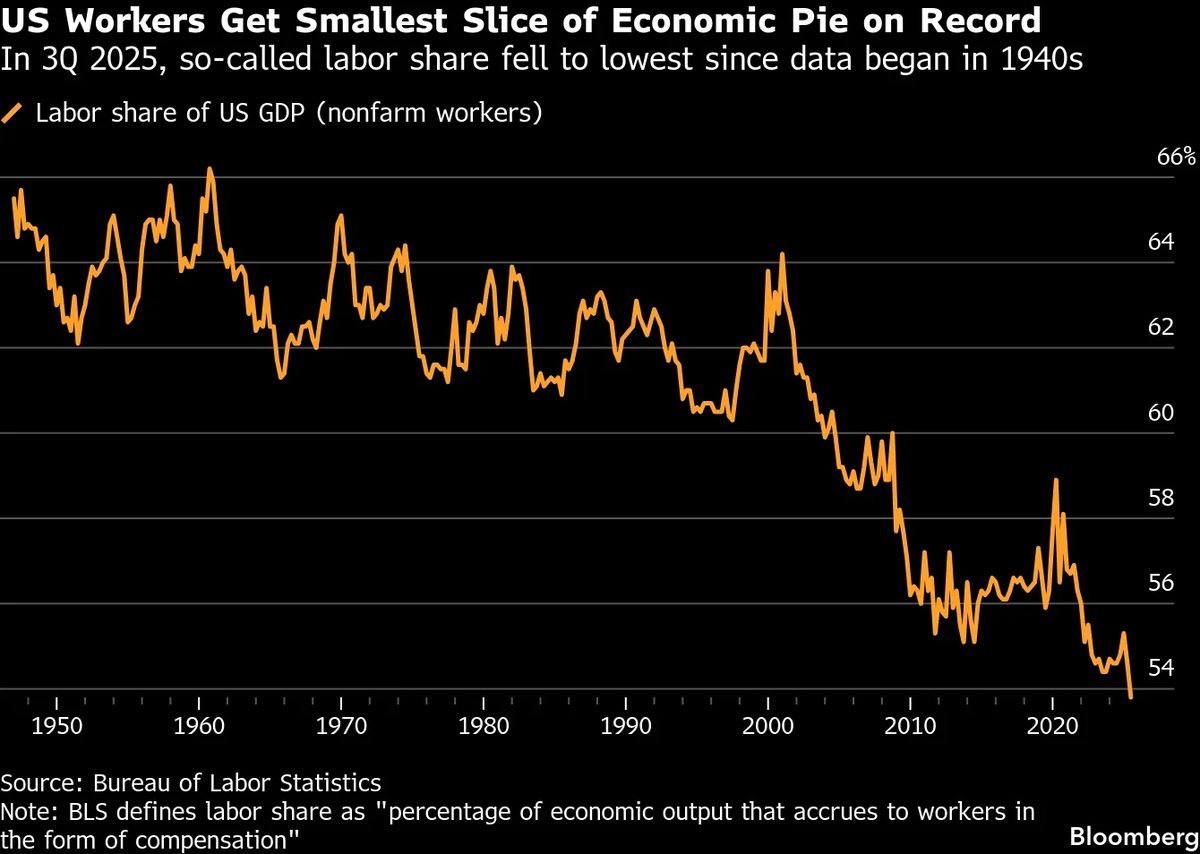
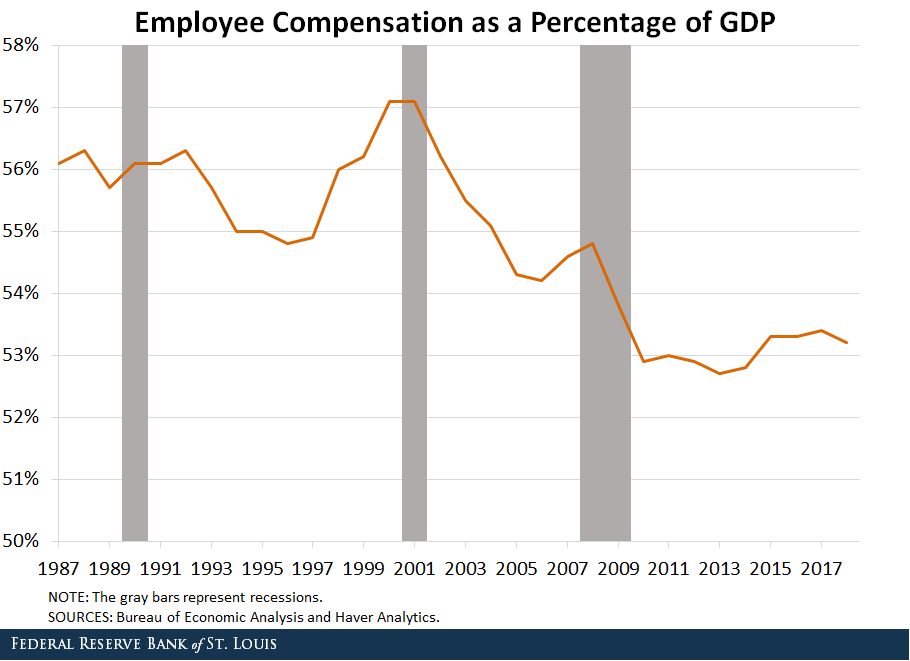
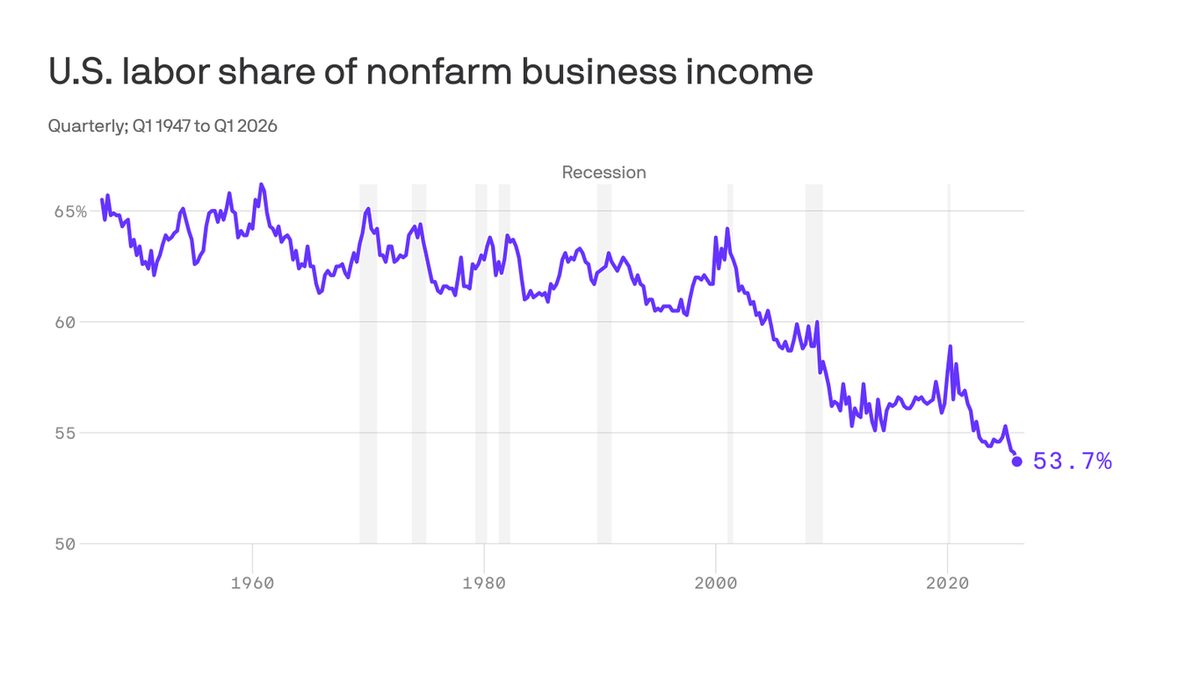
American workers took home 52.8% of the country's income in the second quarter of 2026, the smallest slice since the Bureau of Labor Statistics began tracking the figure in 1947. The previous quarter was 53.6%. This decade's average is about 55.6%.

Corporate profits hit a record $2.1 trillion for Fortune 500 companies in 2025, and GDP grew 3.4% in the third quarter of that year. The gap between those numbers and workers' pay is the mechanism: output is rising, but a larger share of it is going to capital rather than wages.

Why it matters

If the trend holds, a growing economy stops translating into rising paychecks for most workers.

Questions about this story

Free account needed to ask — your question is kept and asked for you right after sign-up. Answers are public.

No questions yet — be the first to ask.

Key Indicators

52.8%
Labor share of U.S. income, Q2 2026
The portion of economic output paid to workers as wages and salaries, the lowest since records began in 1947.
$2.1T
Fortune 500 profits, 2025
Record corporate earnings reported for 2025.
4.2%
Unemployment rate, September 2026
Up from earlier in the year as hiring slowed.
584,000
Jobs added in 2025
Down from about 2 million added in 2024.
55.6%
Decade average labor share
The 2020s average, roughly three points above the current reading.

Voices

Curated perspectives — historical figures and your fellow readers.

Sign up to generate historical perspectives on this story.

People Involved

Organizations Involved

Timeline

January 2026 October 2026

3 events Latest: Yesterday
  1. Labor share falls to 52.8% in second quarter

    Latest Data release

    BLS data reported by Fortune show labor share at 52.8% for Q2 2026, the lowest since 1947, down from 53.6% the prior quarter.

  2. Axios ties new low to AI boom

    Analysis

    Axios reports labor's share of national income fell to a new low, citing JPMorgan's Michael Feroli on elevated returns on capital.

  3. Labor share hits record low for late 2025

    Data release

    Bloomberg reports the labor share of GDP fell to its lowest level in data going back to 1947 for the third quarter of 2025.

Scenarios

1

Labor share falls again in the next BLS report

Possible Resolves by Q1 2027

Discussed by: Raymond Robertson and other labor economists quoted in Fortune

Automation and weak hiring keep pushing income toward capital. If the next quarterly productivity and costs report shows a labor share below 52.8%, the record-low trend continues.

2

Labor share stabilizes above 53%

Unlikely Resolves by Q2 2027

Discussed by: Morgan Stanley economists, who have called the productivity surge an open question

If the productivity gains prove cyclical rather than AI-driven, or if tighter labor markets push wages up, the labor share could recover. A reading at or above 53% would mark a break in the decline.

3

Unemployment rises above 5% as hiring stalls

Possible Resolves by Jan 31, 2027

Discussed by: Mark Regets and Raymond Robertson, both of whom expect continued workforce weakness

Job growth has slowed sharply, and Regets warns a shrinking labor force makes sustained growth harder. If unemployment crosses 5%, the jobless-growth pattern becomes harder to dismiss as noise.

Historical Context

3 moments from history that rhyme with this story — and how they unfolded.

2001-2003

Jobless recovery of the early 2000s (2001-2003)

The U.S. economy emerged from the 2001 recession with GDP growing again, but payrolls lagged for months. Productivity rose while hiring stayed weak, a pattern economists labeled the jobless recovery.

Then

The Federal Reserve kept interest rates low to support hiring.

Now

The episode established that output growth and employment growth can diverge for extended periods.

Why this matters now

The current data show the same split: GDP and profits rising while job creation slows and labor's share of income falls.

1979-2010

Decline of U.S. manufacturing employment (1979-2010)

Factory output kept rising for years while manufacturing payrolls fell, as automation and offshoring replaced production workers. The losses concentrated in regions that depended on manufacturing.

Then

Displaced workers moved into lower-paying service jobs or left the workforce.

Now

The shift contributed to wage stagnation and regional economic decline.

Why this matters now

It is the clearest precedent for productivity gains accruing to capital while the workers who remain see a smaller share of the income.

1811-1816

Industrial Revolution and the Luddite protests (1811-1816)

Textile machinery displaced skilled artisans in England. Organized workers destroyed machines in protest, arguing the equipment was eliminating their livelihoods.

Then

The British government deployed troops and prosecuted the protesters.

Now

Industrial employment eventually expanded, but the transition took decades and imposed heavy costs on the displaced generation.

Why this matters now

It is the earliest large-scale case of automation shifting income from labor to capital, and a reminder that the adjustment can outlast the workers it displaces.

Sources

(5)