


Pull to refresh
Logo
Abu Dhabi court sentences eight to life over Sudan arms pipeline

Abu Dhabi court sentences eight to life over Sudan arms pipeline

Rule Changes

A court found Sudanese army officers and intermediaries used Emirati companies and banks to move weapons to Port Sudan, the reverse of Khartoum's accusation against Abu Dhabi.

Overview

Updated 2 hours ago

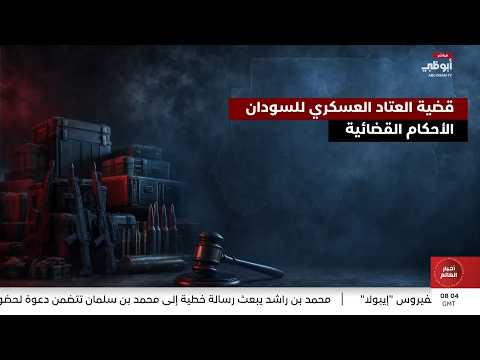
An Abu Dhabi appeals court sentenced eight people to life in prison on 29 October for running weapons and ammunition to Sudan's army through the United Arab Emirates. The list includes the army's armament chief, Yasser Al Atta, and its former intelligence director, Salah Gosh.

The ruling inverts the public accusation that has defined the war. Sudan's army has spent two years accusing Abu Dhabi of arming the Rapid Support Forces. The court found Sudanese army officers using Emirati companies, banks and forged cargo papers to fly ammunition to Port Sudan. Both claims can be true at once, which is what makes the arms trail so hard to map.

Why it matters

The ruling documents a Sudanese army arms route through the UAE while Khartoum accuses Abu Dhabi of arming its enemy.

Questions about this story

Free account needed to ask — your question is kept and asked for you right after sign-up. Answers are public.

No questions yet — be the first to ask.

Key Indicators

8
Life sentences
Eight defendants, including two senior Sudanese army figures, received life terms.
13
Defendants tried
The attorney general referred 13 people and six companies to trial in April 2026.
$13M
First deal value
Declared value of the military materiel deal struck outside the UAE, according to prosecutors.
$2M
Proceeds reused
Money from the first deal paid for the second, in which ammunition was bought in the Emirates.
Dh8M
Cash payment
Amount handed to broker Rashid Omar as part of one deal, the court found.
6
Companies fined
Each was fined Dh1 million for money laundering and had its licence cancelled.
2
Acquittals
Mubarak Ali Al Sheikh and Mus'ab Awad Al Karim Hassan were cleared.

Voices

Curated perspectives — historical figures and your fellow readers.

Sign up to generate historical perspectives on this story.

People Involved

Organizations Involved

Timeline

April 2023 October 2026

7 events Latest: 3 days ago
Tap a bar to jump to that date
  1. Sudan severs diplomatic ties with the UAE

    Diplomacy

    Sudan's Security and Defence Council withdraws its embassy and consulate general in the Emirates.

  2. Sudan's army and RSF begin fighting

    Conflict

    The war between the Sudanese Armed Forces and the Rapid Support Forces starts, creating the demand for weapons that runs through the case.

Scenarios

1

Top UAE court upholds the life sentences

Likely Resolves by Oct 29, 2027

Discussed by: WAM, the UAE state news agency, and the trial record

The convictions can be appealed. If a higher court affirms them, the case becomes a final legal finding that Sudanese army officers ran an arms pipeline through the Emirates. A reduction in sentence would still leave the core finding intact.

2

Sudan and the UAE restore diplomatic relations

Unlikely Resolves by End of 2027

Discussed by: Regional diplomats and Sudanese media

Sudan cut ties in May 2025 after the ICJ dismissed its case. The UAE said it did not recognise the cutoff and that Port Sudan did not represent Sudan's legitimate government. A settlement would likely require a change in Sudan's military leadership or a broader regional deal.

3

None of the convicted is transferred to UAE custody

Likely Resolves by Oct 29, 2027

Discussed by: UAE prosecutors and international police records

The eight include senior Sudanese officials who are presumably in Sudan or allied territory. The UAE has no extradition arrangement with Port Sudan and the two countries have no diplomatic ties. Enforcement would depend on a third country detaining one of them.

Historical Context

3 moments from history that rhyme with this story — and how they unfolded.

1985-1987

Iran-Contra affair (1985-1987)

U.S. officials secretly facilitated arms sales to Iran, then diverted proceeds to Contra rebels in Nicaragua. The operation ran through third-country intermediaries, front companies and Swiss bank accounts, with cargo manifests that hid the true destination.

Then

A special prosecutor secured convictions against senior officials, including National Security Adviser John Poindexter and Lt. Col. Oliver North.

Now

Most convictions were overturned on appeal because witnesses had testified under immunity. The affair shaped later disclosure rules for covert arms transfers.

Why this matters now

It shows how arms pipelines use intermediaries and falsified paperwork to keep the supplying state at arm's length, the same structure the Abu Dhabi court described.

1991-1995

Bosnia arms embargo (1991-1995)

The United Nations imposed an arms embargo on the former Yugoslavia. Weapons still reached Bosnia's government through Croatia and third-party channels, including shipments from Iran and other states. The embargo constrained the Bosnian army but did not stop the flow.

Then

The United States declined to enforce the embargo strictly, and NATO air strikes helped end the war in 1995.

Now

The episode shaped later debates over whether arms embargoes protect or harm civilians, and it set precedents for multilateral sanctions design.

Why this matters now

It shows that an arms embargo or a single court ruling rarely closes a supply route; the route shifts to another intermediary.

1985-2006

Al-Yamamah arms deal (1985-2006)

Britain and Saudi Arabia signed a multi-billion-pound arms deal. BAE Systems later faced allegations that it paid slush funds to Saudi officials through offshore accounts. The UK Serious Fraud Office investigated.

Then

The investigation was dropped in 2006 after the government cited national security and Saudi cooperation on counterterrorism.

Now

The case became a benchmark for how arms sales and corruption investigations collide with diplomatic interests.

Why this matters now

It shows why arms deals routed through intermediaries are hard to prosecute: the paperwork and the politics both protect the parties.

Sources

(10)