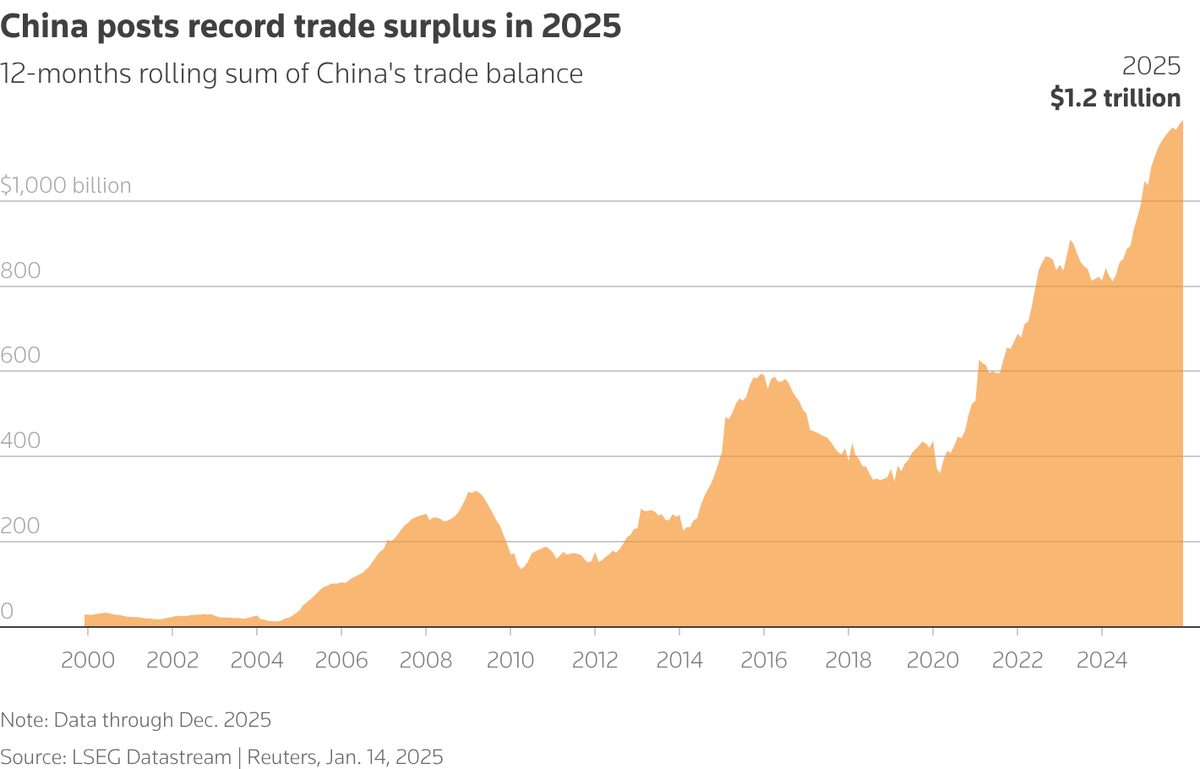
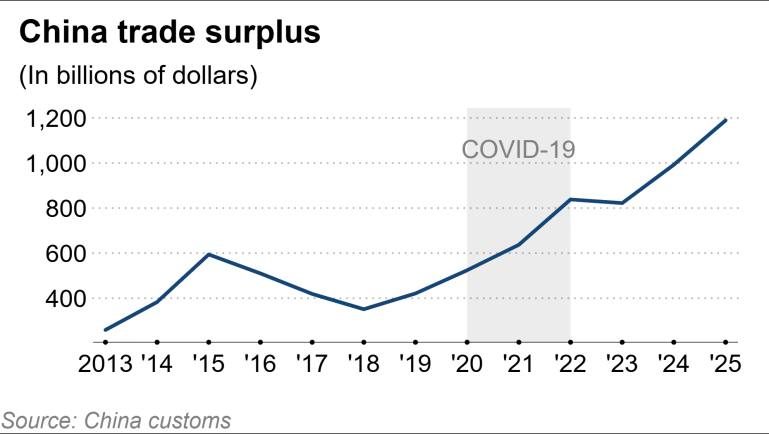
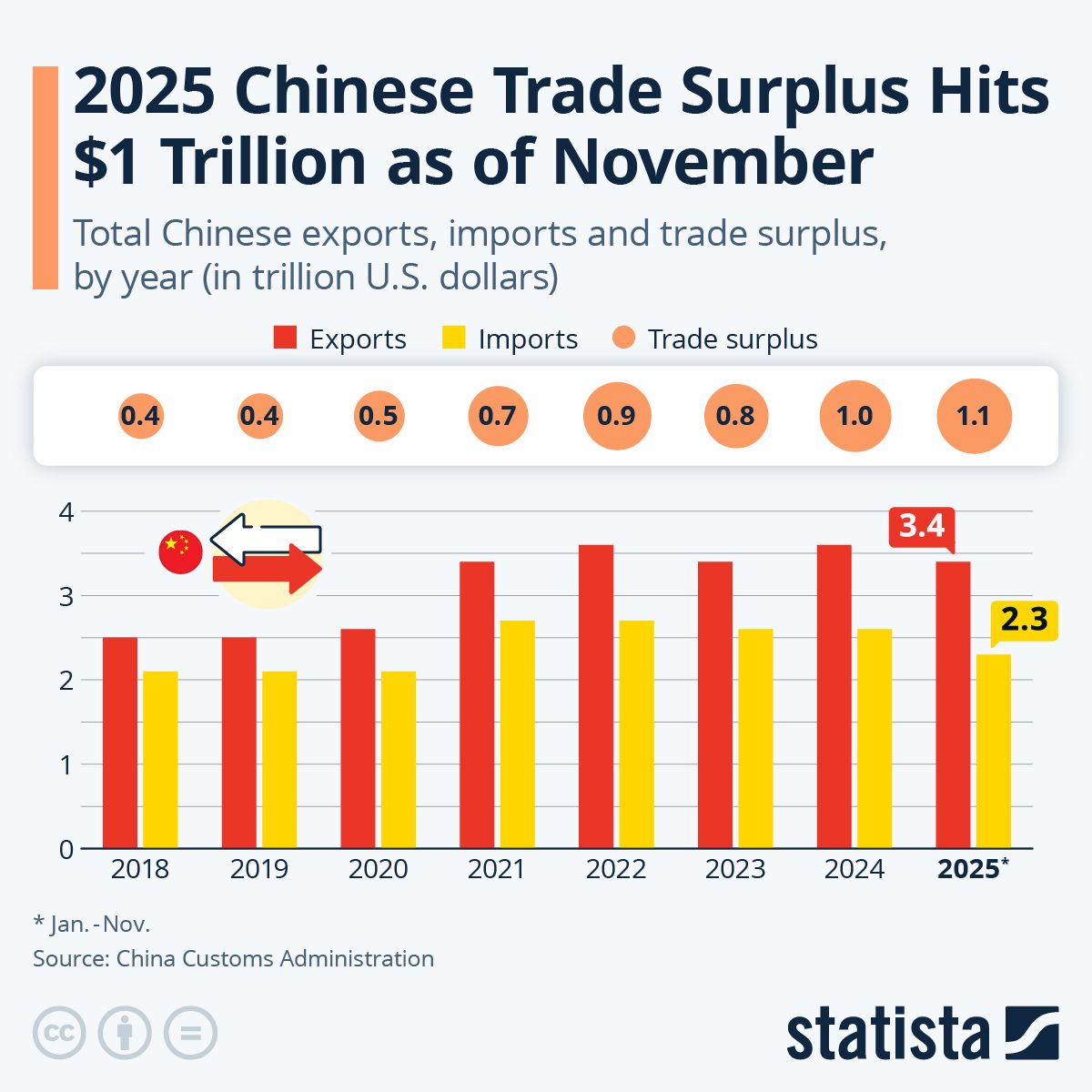
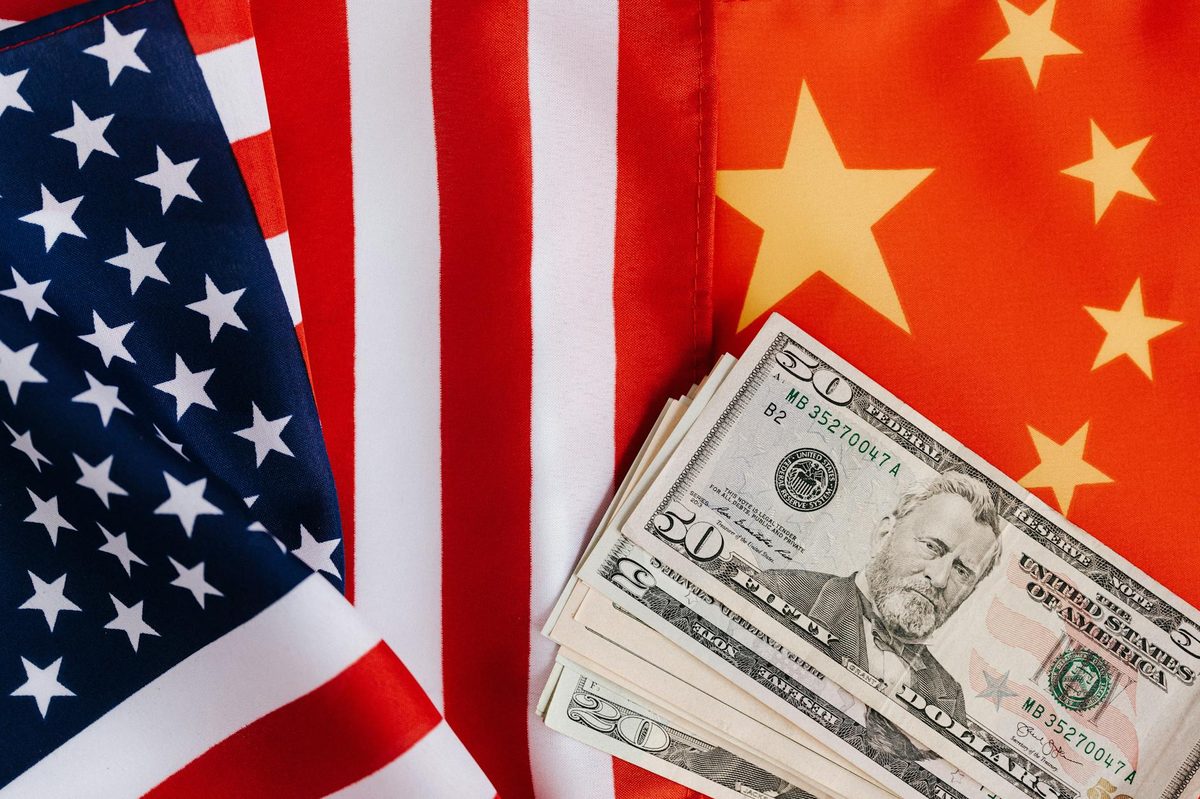
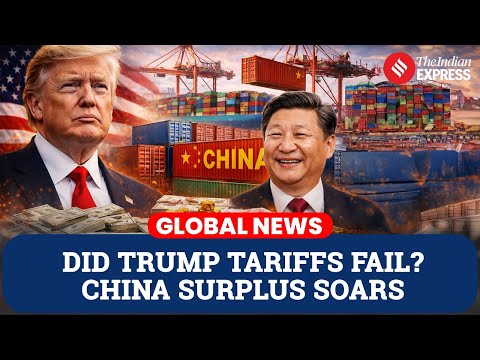
China posted a $1.2 trillion trade surplus for 2025, the largest any country has ever recorded. The number is roughly equal to Indonesia's GDP, the world's 16th-largest economy.
The surplus comes after seven years of U.S. tariffs meant to shrink it. Eight days before the surplus data was released, Canada struck a deal with Beijing that cut Chinese EV tariffs from 100% to 6.1%. Trump threatened 100% retaliatory tariffs on Canadian goods.
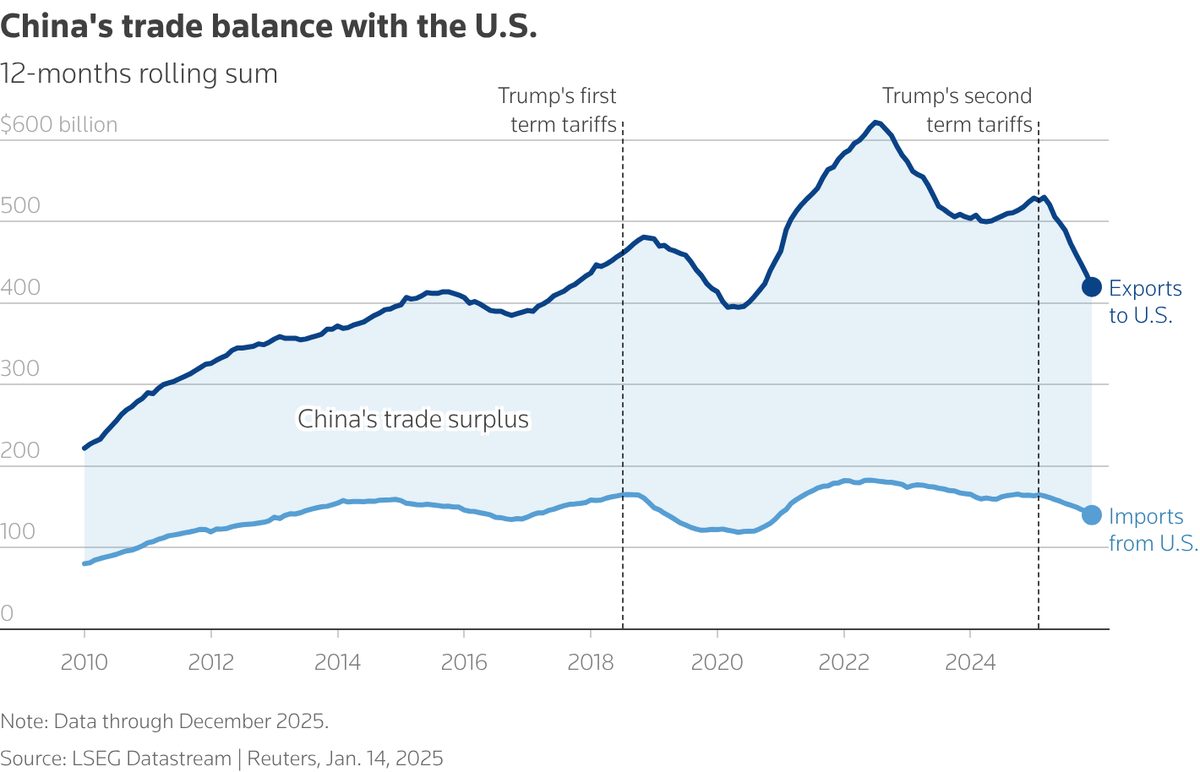
Chinese manufacturers replaced lost U.S. customers: U.S. exports fell 20% in 2025; Africa jumped 26%, Southeast Asia rose 14%, and Latin America grew 8%. Southeast Asia has surpassed the U.S. as China's top trading partner, and EV-driven auto exports surged 21% to more than 7 million units. China controls 70% of global EV production — a position that pushed Canada to cut EV tariffs after Trump threatened 25% tariffs on countries trading with Iran, where China is Tehran's largest trading partner.
Questions about this story
Free account needed to ask — your question is kept and asked for you right after sign-up. Answers are public.
No questions yet — be the first to ask.
Key Indicators
$1.2T
2025 Trade Surplus
Record surplus, up 20% from 2024's $992 billion
-20%
U.S. Export Decline
China's exports to the U.S. fell 20% year-over-year
+26%
Africa Export Growth
Fastest-growing regional market for Chinese goods
7M+
Auto Exports
Vehicle exports up 21%, with 65% electric or hybrid
17 events
Latest: January 26th, 2026 · 9 months ago
Showing 8 of 17
JK to step
Tap a bar to jump to that date
Jump to
January 2026
Carney Clarifies: No Free Trade Agreement Planned
LatestStatement
Canadian PM Mark Carney stated Canada has "no intention" of pursuing a free trade deal with China in response to Trump's 100% tariff threat, calling the January 16 agreement "tariff-quota arrangements" consistent with CUSMA.
Trump Threatens 100% Tariffs on Canada Over China Deal
Policy
Trump warned he would impose 100% tariffs on Canadian goods if Canada maintains its trade deal with China, stating China would try to use Canada as a "Drop Off Port" to avoid U.S. tariffs. This contradicted his earlier statement that the deal was "a good thing."
China Achieves 5% GDP Growth Target Despite Trade War
Data
China's National Bureau of Statistics reported 2025 GDP grew 5.0%, meeting the government target, with total GDP reaching 140.2 trillion yuan ($20 trillion). Q4 growth slowed to 4.5%, the weakest in nearly three years, as domestic consumption remained sluggish despite export strength.
Canada Slashes Chinese EV Tariffs in Major Pivot
Agreement
Canada and China announced trade deal reducing Canadian tariffs on Chinese EVs from 100% to 6.1% (quota of 49,000 vehicles annually) in exchange for China cutting canola tariffs from 85% to 15% by March 1. Prime Minister Mark Carney called it a "new strategic partnership" during first Canadian PM visit to Beijing since 2017.
U.S. Imposes 25% Semiconductor Tariffs
Policy
U.S. implemented 25% tariffs on certain advanced semiconductors under Section 232 authority, part of agreement allowing Nvidia to ship Taiwan-made AI processors to China. Effective tariffs on Chinese goods now average 37.4%.
Record $1.2 Trillion Surplus Announced
Data
China's customs administration reported 2025 trade surplus of $1.19 trillion, up 20% from 2024. Exports to U.S. fell 20% while exports to Africa rose 26%.
Trump Threatens 25% Tariffs on Iran Trading Partners
Policy
Trump announced U.S. will charge 25% tariffs on countries doing business with Iran, "effective immediately." China is Iran's largest trading partner, raising concerns about derailing the November 2025 tariff truce agreement.
December 2025
China Crosses $1 Trillion Surplus
Data
China's trade surplus exceeded $1 trillion for the first time in history, with two months still remaining in the year.
November 2025
Tariff Reduction Extended
Agreement
U.S. and China extended the 10% tariff rate through November 2026.
May 2025
90-Day Tariff Truce
Agreement
U.S. and China agreed to reduce bilateral tariffs from 125% to 10% for 90 days.
April 2025
"Liberation Day" Tariff Escalation
Policy
Trump unveiled sweeping tariffs on nearly all countries. U.S.-China tariffs escalated to 145% and 125% respectively.
February 2025
Trump Imposes New China Tariffs
Policy
President Trump signed executive order imposing 10% tariffs on China using International Emergency Economic Powers Act authority.
October 2024
EU Imposes EV Tariffs
Policy
European Commission implemented countervailing duties of up to 35.3% on Chinese electric vehicles, on top of existing 10% import duty.
January 2020
Phase One Deal Signed
Agreement
U.S. and China signed agreement requiring China to purchase $200 billion in additional U.S. goods over two years. China fell 60% short of commitments.
September 2018
Tariffs Expand to $200B
Policy
U.S. placed 10% tariffs on $200 billion of Chinese imports. China responded with duties on $60 billion of U.S. goods.
July 2018
Trade War Officially Begins
Policy
U.S. imposed 25% tariffs on $34 billion of Chinese imports. China retaliated with equivalent tariffs on U.S. goods.
March 2018
Trump Orders $50B in China Tariffs
Policy
President Trump signed a memorandum under Section 301 instructing tariffs on Chinese goods, citing intellectual property theft.
The November 2025 tariff extension holds through 2026. Chinese exports continue growing 3-5% annually as manufacturers deepen relationships with emerging markets. The surplus remains above $1 trillion but growth slows as Europe and developing nations implement their own trade barriers. The planned April 2026 Trump-Xi summit produces modest commitments but no structural changes.
2
New Tariff Escalation Disrupts Truce
Possible
Discussed by: CNBC, Modern Diplomacy analysts
Trump's threatened 25% tariffs on countries trading with Iran—including China, Tehran's largest trading partner—derail the fragile deal. Fresh tit-for-tat escalation resumes, potentially returning to 100%+ tariff levels. Chinese exports face disruption but continue pivoting to non-U.S. markets. The Supreme Court's pending ruling on tariff legality could also reshape the landscape.
3
Global Backlash Triggers Coordinated Trade Barriers
Possible
Discussed by: European Commission, MERICS, Centre for European Reform
Europe follows the U.S. in imposing broader tariffs as Chinese manufacturing overcapacity floods EU markets. EU tariffs expand beyond EVs to steel, solar panels, and machinery. Developing nations that absorbed diverted Chinese exports begin their own protectionist measures. China's surplus growth reverses as export markets close.
4
China Domestic Demand Surge Rebalances Economy
Unlikely
Discussed by: Economist Intelligence Unit, ING research
Beijing implements substantial stimulus measures that successfully boost domestic consumption. Chinese consumers absorb more domestic production, reducing export pressure and the trade surplus. This outcome requires policy shifts Beijing has so far avoided—moving from supply-side investment to demand-side stimulus.
5
Western Allies Form Separate China Trade Bloc
Possible
Discussed by: Washington Post, BNN Bloomberg, Al Jazeera analysts
Canada's January 2026 pivot emboldens other U.S. allies facing Trump's tariff threats to negotiate independent deals with China. European nations seeking EV supply chains, resource-dependent economies needing Chinese infrastructure investment, and agricultural exporters pivot East. A fragmented trade architecture emerges where traditional allies maintain political alignment with Washington but pursue economic integration with Beijing.
6
Trump's April China Visit Produces Durable Trade Deal
Possible
Discussed by: OMFIF, China Briefing analysts, AmCham China
Trump's planned April 2026 visit to China results in a comprehensive trade agreement that replaces the fragile stop-gap truces. Negotiations likely include expanded Chinese purchases of U.S. agricultural products, guaranteed access to Chinese rare earths, and renewed cooperation on fentanyl. The agreement could establish longer-term tariff certainty, though structural issues around industrial policy and overcapacity remain unresolved. Success depends on whether both sides prioritize stability over escalation ahead of the summit.
Historical Context
3 moments from history that rhyme with this story — and how they unfolded.
1 of 3
1981-1991
U.S.-Japan Trade Conflict (1980s)
Japan ran persistent trade surpluses with the U.S. that reached $40 billion by 1985—one-third of America's total trade deficit. The U.S. responded with tariffs on semiconductors, voluntary export quotas on automobiles and steel, and culminated in the 1985 Plaza Accord, which forced the yen to appreciate over 100% against the dollar.
Then
Japan agreed to limit exports and open its markets. The trade deficit with Japan was cut by roughly two-thirds by 1991.
Now
The yen appreciation triggered a stock and real estate bubble. When it burst in 1991, Japan entered its "Lost Decade" of economic stagnation. U.S. manufacturing decline continued despite the trade measures.
Why this matters now
The Japan precedent shows that currency and trade pressure can reduce bilateral deficits but may trigger broader economic disruption. Unlike Japan, China controls its own currency, runs a larger economy, and has demonstrated willingness to redirect exports rather than constrain them.
2 of 3
2001-2010
The First China Shock (2001-2010)
After joining the WTO in 2001, China flooded global markets with cheap manufactured goods—textiles, electronics, furniture. Economists estimate 550,000 to 2.4 million U.S. manufacturing jobs were lost to Chinese import competition. Manufacturing fell from 13% to 10% of U.S. GDP.
Then
U.S. manufacturing employment collapsed in affected regions. Consumer prices fell as imports expanded.
Now
Political backlash against free trade contributed to Trump's 2016 election. Germany, by contrast, thrived during this period by selling machinery to China's industrializing economy.
Why this matters now
The first China shock hit low-end manufacturing. The current situation is different: China now competes in high-end sectors like EVs, machinery, and industrial robots—directly challenging German and American manufacturers at the technological frontier.
3 of 3
2020-2025
Germany's Second China Shock (2020-Present)
After benefiting from China's industrialization for two decades, German industry now faces direct competition. China's manufacturing surplus reached 10% of its GDP. Chinese automakers captured market share in EVs while German manufacturers struggled to compete. An estimated 450,000 German manufacturing jobs depend on Chinese demand.
Then
The German economy has stagnated for five years, hit simultaneously by energy price increases from the Ukraine war and Chinese competition.
Now
Still unfolding. German automakers are racing to cut costs and pivot to EVs while China-made vehicles captured 6% of EU sales in early 2025.
Why this matters now
Germany's experience shows that countries which benefited from supplying China's growth now face disruption as China moves up the value chain. The EU's EV tariffs are an early response to this dynamic.