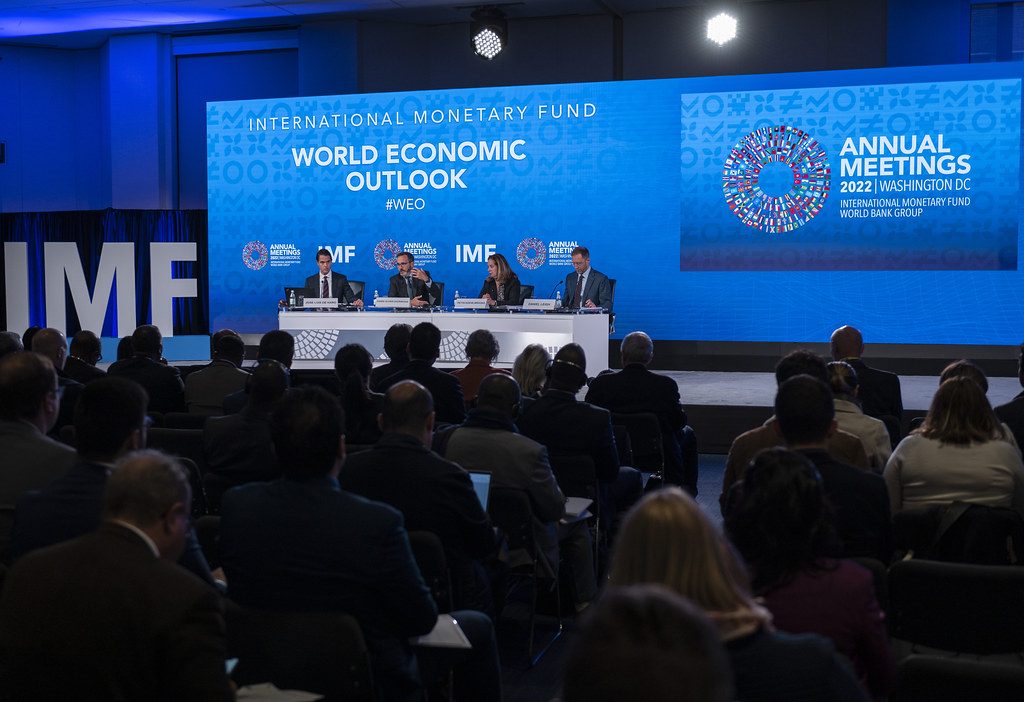
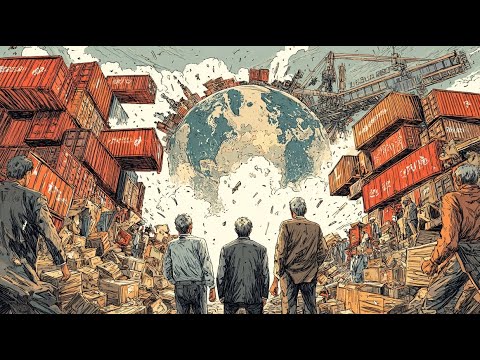
In April 2025, average US tariffs hit their highest level since 1943. Nine months later, the global economy is still growing. The IMF's January 2026 World Economic Outlook projects 3.3% global growth (slightly better than feared), thanks to supply-chain rerouting, surging AI investment, and a US-China truce pulling tariffs back from their 145% peak.
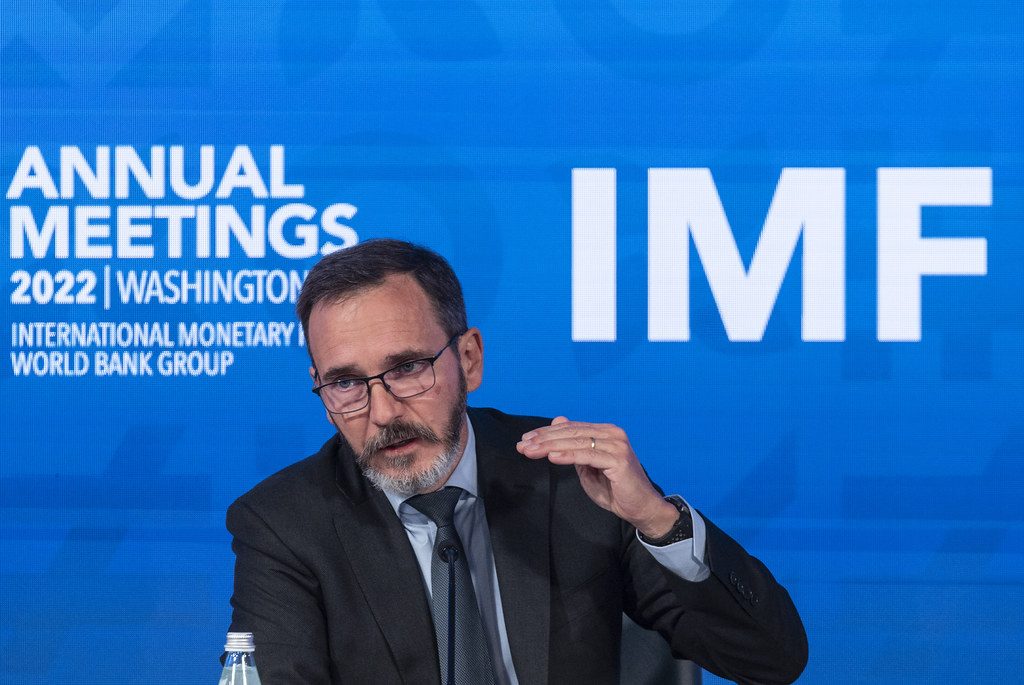
The relief may be temporary. The US-China deal expires November 10, 2026, and IMF chief economist Pierre-Olivier Gourinchas warns that risks remain 'tilted to the downside.'
If the truce lapses, tariffs could snap back. If AI fails to deliver productivity gains, a market correction could follow. The global economy survived the shock; whether it survives the aftershocks depends on decisions made in the next ten months.
Questions about this story
Free account needed to ask — your question is kept and asked for you right after sign-up. Answers are public.
No questions yet — be the first to ask.
Key Indicators
3.3%
2026 Global Growth Forecast
Up 0.2 percentage points from October estimate, exceeding pre-tariff projections
18.5%
Effective US Tariff Rate
Down from 25% projected in April 2025; still highest since 1943
$202B
2025 Global AI Investment
50% of all venture capital deployed worldwide
Nov 10
US-China Truce Expiration
Bilateral tariff reductions and export control pauses end November 2026
17 events
Latest: January 20th, 2026 · 9 months ago
Showing 8 of 17
JK to step
Tap a bar to jump to that date
Jump to
January 2026
Davos 2026: Trade Tensions Escalate as Trump Threatens European Tariffs
LatestSummit
At World Economic Forum, Trump threatened tariffs on eight European nations (Denmark, Norway, Sweden, France, Germany, UK, Netherlands, Finland) over Greenland dispute. European Commission President von der Leyen called tariffs 'a mistake especially between long-standing allies'; French President Macron denounced them as 'unacceptable.' Chinese Vice-Premier He Lifeng urged cooperation: 'tariffs and trade wars have no winners.'
Georgieva at Davos: 'Get Your Act Together' Warning to Europe
Statement
IMF Managing Director issued stark warning at Davos urging European leaders to finalize capital markets union, complete energy union, ease cross-EU labor mobility, and invest in research and innovation. Separately noted AI investment boom carries 'tsunami' risks including potential market correction if productivity gains don't materialize.
IMF January 2026 WEO Update: Growth Exceeds Pre-Crisis Expectations
Report
Global growth projected at 3.3% for 2026, up 0.2 points from October. Chief economist Gourinchas: economy 'shaking off' trade disruptions, now ahead of October 2024 forecasts made before tariff escalation.
US Business Optimism on China Rebounds After Trade Truce
Survey
American Chamber of Commerce survey showed 48% of US companies optimistic about China market growth over next two years—up 11 percentage points from previous year—reflecting confidence in October 2025 Trump-Xi trade framework despite looming November 2026 expiration.
IMF Managing Director met Ukrainian officials to discuss $8.1 billion loan program. Told reporters ahead of January 19 WEO release that world economy is 'remarkably resilient' and 'trade shock has not derailed global growth.'
World Bank Reports 'Surprising Shock-Proof' Economy
Report
Global Economic Prospects projected 2.6% growth for 2026, noting resilience despite 'historic' trade tensions but warning the 2020s will be the weakest growth decade since the 1960s.
November 2025
US-China Trade Framework Officially Announced
Policy
Deal extends reduced tariffs to November 10, 2026; suspends BIS Affiliates Rule; lifts rare earth export controls. China commits to $25B annual soybean purchases through 2028.
October 2025
Trump and Xi Meet in Busan, Reach Framework Deal
Summit
Bilateral summit produced a one-year framework covering tariff reductions, export control pauses, and Chinese agricultural purchases.
IMF October WEO: Damage 'At Modest End of Range'
Report
Global growth forecast revised up to 3.2% for 2025 as trade deals reduced tariffs, supply chains adapted, and most countries avoided retaliation.
August 2025
US-China Truce Extended Another 90 Days
Negotiation
Both parties agreed to extend reduced tariff rates while negotiations continued on a more comprehensive framework.
May 2025
Federal Court Rules Liberation Day Tariffs Exceeded Authority
Legal
US Court of International Trade ordered tariffs vacated, finding Trump overstepped authority under IEEPA. Appeals court stayed the ruling pending review.
US and China Announce 90-Day Tariff Truce
Negotiation
Both countries agreed to reduce April tariffs from 145%/125% to 30%/10% for 90 days pending further talks. First major de-escalation since Liberation Day.
April 2025
IMF Releases WEO with Tariff Damage Scenarios
Report
The Fund offered a range of estimates from modest to significant damage depending on tariff severity, projecting 3.0% global growth for 2025.
US-China Tariffs Peak at 145%/125%
Escalation
After tit-for-tat retaliation, US tariffs on Chinese goods reached 145%; China imposed 125% on US goods. Trade between the two economies nearly froze.
Trump Pauses Reciprocal Tariffs for 90 Days—Except China
Policy
Country-specific tariffs paused for all nations except China, which faced the full 145% rate. Baseline 10% tariff remained for all other countries.
Liberation Day: Trump Announces Sweeping Tariffs
Policy
President Trump announced a 10% baseline tariff on nearly all imports and higher country-specific rates, declaring a national emergency over the trade deficit. China-specific tariffs would eventually reach 145%.
Stock Markets Crash on Tariff Announcement
Market
S&P 500 fell 4.88% (second-largest daily point loss ever); Nasdaq dropped 5.97% (largest point loss in its history).
Scenarios
1
Truce Renewed: US-China Extend Deal Past November 2026
Both sides find sufficient benefit in the current arrangement to extend it. China continues redirecting exports to non-US markets; the US avoids inflationary tariff spikes before midterm elections. Agricultural purchases and export control pauses continue. Growth trajectory remains stable around 3.2-3.3%.
2
Tariffs Snap Back: Deal Expires Without Renewal
Possible
Discussed by: Bloomberg trade analysis, Congressional Research Service, Council on Foreign Relations
Bilateral tariffs return to pre-truce levels—potentially 145%/125%—if negotiations stall over semiconductor controls, Taiwan, or rare earth restrictions. The IMF estimates renewed tensions could cut global output by 0.3% in 2027. Supply chains that rerouted in 2025 face further disruption. Congressional national security hawks in both parties could push legislation hardening restrictions regardless of White House preferences.
3
AI Correction Triggers Broader Slowdown
Unlikely
Discussed by: IMF January 2026 WEO, Stanford HAI, Bank of America research
If productivity gains from $200+ billion in AI investment fail to materialize, equity valuations could correct sharply. The IMF flags this as a primary downside risk—AI currently accounts for nearly 1 percentage point of US GDP growth. A pullback in tech investment would remove a key offset to trade headwinds, potentially pushing global growth below 3%.
4
Partial Deal: Tariffs Reduced on Some Goods, Raised on Others
Likely
Discussed by: Wiley trade law analysis, CSIS, China Briefing
The most likely outcome according to trade lawyers tracking the negotiations. Semiconductor and rare earth tensions persist while consumer goods tariffs remain reduced. Effective US tariff rate stays between 15-25%. Neither side claims victory; businesses continue managing uncertainty rather than planning around stable rules.
5
Europe Retaliates: Transatlantic Tariff War Opens Second Front
Possible
Discussed by: European Commission President von der Leyen, French President Macron, EU trade officials
If Trump follows through on threatened tariffs over Greenland, EU activates its anti-coercion instrument and imposes retaliatory duties on US goods. This opens a second tariff front beyond US-China tensions, potentially reducing global growth by an additional 0.2-0.4 percentage points in 2027 according to trade economists. The November 2026 US-China truce becomes harder to extend as Washington faces pressure to maintain hard line across all trading partners.
Historical Context
3 moments from history that rhyme with this story — and how they unfolded.
1 of 3
June 1930
Smoot-Hawley Tariff Act (1930)
Congress raised tariffs on over 20,000 imported goods, increasing average rates from 40% to nearly 60%. President Hoover signed the bill despite a petition from 1,028 economists urging a veto. Henry Ford called it 'an economic stupidity.'
Then
Canada retaliated within weeks, hitting 30% of US exports. France, Italy, and a dozen other nations followed. World trade collapsed 66% by 1934.
Now
Widely credited with deepening the Great Depression. Unemployment rose from 8% to 25%. The debacle shifted tariff authority from Congress to the executive branch, leading to the 1934 Reciprocal Trade Agreements Act and eventual creation of GATT/WTO.
Why this matters now
The 2025 tariff escalation—with US rates hitting their highest since 1943—invited immediate Smoot-Hawley comparisons. A key difference: most countries did not retaliate, limiting the damage. The historical lesson shaped IMF advice urging restraint.
2 of 3
September 2008 - June 2009
Global Financial Crisis (2008-2009)
Lehman Brothers collapsed on September 15, 2008, triggering the worst financial crisis since the Great Depression. Global GDP fell 3.3% in 2009. World trade collapsed 18.6% as credit froze and demand evaporated.
Then
The IMF's April 2008 forecast of 3.9% growth proved wildly optimistic; by November 2008 the Fund projected -0.3% for 2009. Coordinated G20 stimulus and central bank intervention prevented a deeper spiral.
Now
Recovery was uneven—advanced economies regained pre-crisis output by 2011, but the eurozone debt crisis extended pain. The experience created the policy playbook (massive fiscal and monetary support) used during COVID-19 and referenced during the 2025 tariff shock.
Why this matters now
The 2008-2009 trade collapse (18.6% in the US alone) dwarfed the 2025 disruption. That the global economy absorbed 145% tariffs with only modest growth reductions reflects both improved supply chain flexibility and the precedent of coordinated policy response established in 2008-2009.
3 of 3
March-June 2020
COVID-19 Economic Shock (2020)
The pandemic triggered the sharpest global contraction since the Great Depression. IMF revised its growth forecast down 6.3 percentage points between January and April 2020—the largest revision in Fund history. Global GDP fell 3.3%.
Then
Unprecedented fiscal and monetary stimulus ($12 trillion globally) prevented a depression. Supply chains proved more resilient than feared as businesses adapted to lockdowns.
Now
Inflation surged in 2022-2023 as stimulus met constrained supply. Central banks raised rates aggressively. The experience demonstrated both the economy's capacity to absorb shocks and the lagged costs of massive intervention.
Why this matters now
The same pattern—initial shock, rapid adaptation, better-than-feared outcomes—repeated in the 2025 tariff crisis. IMF chief economist Gourinchas explicitly noted businesses had become 'agile' at rerouting supply chains, a capability developed during COVID disruptions.