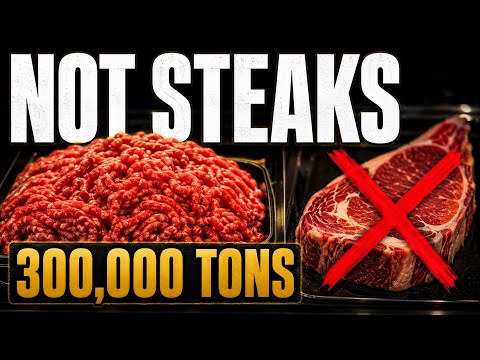
The final 100,000-ton tranche runs through Nov. 30. Customs data show the program far behind its 300,000-ton goal: about 37% of September's tranche arrived and about 30.5% of the second by the 60-day mark.
Farm Action's Nov. 10 review found prices for cull cows, the older animals used in ground beef, fell nearly 20%, about $319 a head, while retail ground beef barely moved. Utah State University economist Andrew Anderson built a statistical model to strip out normal seasonal swings and put the cull-cow drop at 7% to 9%, or $140 to $165 a head. He found no measurable savings for shoppers yet.
Why it matters
Trump promised imported beef at a 25% discount. With two weeks left, the quota is far from full and ranchers have taken the hit.
Questions about this story
Free account needed to ask — your question is kept and asked for you right after sign-up. Answers are public.
No questions yet — be the first to ask.
Key Indicators
59,423
Metric tons entered through Oct. 19
About 20% of the 300,000-ton quota, per U.S. Customs and Border Protection data.
20%
Share of quota filled through Oct. 19
The program remains far behind its 300,000-ton target with roughly two weeks to go.
37,486
Metric tons entered in September
About 37.5% of the first 100,000-ton tranche, per Customs and Border Protection data.
300,000
Metric tons added to 2026 beef import quota
Three tranches of 100,000 metric tons of lean beef trimmings at lower duty rates.
25%
Target discount below market
Trump's stated target for imported trimmings. Farm Action found consumer savings under 2% after the first 30 days.
Nearly 20%
Rancher price decline, Farm Action
Farm Action's 60-day analysis found prices for cattle used in ground beef fell nearly 20%, about $319 a head.
7–9%
Cull-cow drop below forecast, independent model
Utah State University economist Andrew Anderson estimated cull-cow prices ran 7.1% below predicted in September and 9.3% in October, about $140 to $165 a head.
$6.79
Average retail ground beef per pound, September
Bureau of Labor Statistics average for 100% ground beef; down from $6.92 in August, up from $6.32 a year earlier.
90
Program duration
Additional in-quota access runs from Sept. 1 to Nov. 30, 2026.
12 events
Latest: November 11th, 2026 · 1 week ago
Showing 8 of 12
JK to step
Tap a bar to jump to that date
Jump to
November 2026
Independent model estimates a smaller cull-cow price drop
LatestData
Utah State University economist Andrew Anderson, using models built on 2003-2026 data, estimated cull-cow prices ran 7.1% below forecast in September and 9.3% in October, about $140 to $165 a head. He found retail prices down only about 1% within the model's error range.
Farm Action finds rancher prices down nearly 20%
Data
Farm Action's 60-day analysis said prices for cattle used in ground beef fell nearly 20%, about $319 per head, while meatpackers paid 16.6% less for lean beef and consumer savings were small.
BLS reports September ground beef at $6.79 a pound
Data
The Bureau of Labor Statistics' average retail price for 100% ground beef fell from $6.92 in August but stayed above $6.32 a year earlier. USDA expects beef and veal prices to average 8.7% higher in 2026 than in 2025.
Third and final 100,000-ton tranche opens
Implementation
The last batch of duty-cut lean beef trimmings opened Nov. 2 and runs through Nov. 30, or until the quota fills, according to Customs and Border Protection.
October 2026
Halfway data show about a fifth of beef imports arrived
Data
U.S. Customs and Border Protection data showed 59,423 metric tons entered through Oct. 19, about 20% of the 300,000-ton quota. September imports were 37,486 tons and October was 21,937 tons through Oct. 19, while retail prices barely moved.
First import tranche about a third filled; retail prices barely move
Data
U.S. Customs and Border Protection data show 37,486 metric tons entered in September under the first 100,000-ton allocation, about a third of the amount allowed. Farm Bureau's survey of 41 stores found ground beef averaged $7.13 per pound on Sept. 23, down from $7.29 on Sept. 2, with prices unchanged at 30 stores.
Second tranche underway as ground beef holds near $7
Status
Reports document the tariff suspension in effect as ground beef prices remain near $7 a pound and cattle industry opposition continues.
Second 100,000-ton tranche opens
Implementation
Middle tranche of duty-cut beef trimmings opened, running through October 30 on a first come, first served basis.
September 2026
Bipartisan BEEF Act would nullify beef import expansion
Legislation
Rep. Zach Nunn (R-Iowa) and Rep. Gabe Vasquez (D-N.M.) introduced the Banning External Entry of Foreign Beef Act, which would void the proclamation unless Congress approves it and would create a beef supply advisory board.
First 100,000-ton tranche opens
Implementation
First tranche of lean beef trimmings became eligible for entry at the lower in-quota duty rate, running through September 30.
Proclamation added 300,000 metric tons of lean beef trimmings to the 2026 in-quota tariff rate, in three monthly tranches.
Trump announces 90-day tariff suspension on Truth Social
Announcement
Trump said the U.S. would pause higher tariffs on up to 300,000 metric tons of ground beef for 90 days.
Scenarios
1
Imported beef hits 25% discount, program runs full 90 days
Uncertain
Resolves by Nov 30, 2026
Discussed by: White House; The Financial Wire
All three tranches fill, and USDA and USTR confirm imported lean beef trimmings sell at 25% below market. Ground beef prices ease modestly ahead of the November 3 midterms. Economists note 300,000 tons is a small share of the U.S. market, limiting the retail impact.
2
Program cut short after imports miss discount target
Possible
Resolves by Nov 30, 2026
Discussed by: White House proclamation terms; Reuters
USDA and USTR find imported trimmings aren't selling at the required 25% below market. They notify Trump, who eliminates the remaining in-quota quantity before the third tranche closes on November 30. The program ends weeks early without a full test.
3
Tariff suspension expires without extension
Likely
Resolves by Dec 15, 2026
Discussed by: Reuters; TT News; U.S. cattle industry
The program runs through November 30 and is not renewed. Rancher opposition and criticism from Republican lawmakers in cattle states keep pressure high, and no new tranche is announced. Import access returns to the original 2026 quota levels.
4
Program expires with minimal consumer impact as imports underfill
Likely
Resolves by Nov 30, 2026
Discussed by: American Farm Bureau Federation; University of Arkansas economist James Mitchell; POLITICO
If import fill stays low through Nov. 30, the promised consumer relief never materializes. U.S. Customs data show 59,423 metric tons had entered through Oct. 19, about a fifth of the quota, and retail prices have barely budged from near $7 a pound. The White House says it is not planning to terminate the measure early, and Trump has indicated he will not extend it beyond November.
Historical Context
2 moments from history that rhyme with this story — and how they unfolded.
1 of 2
May 2022
Baby formula import waivers (2022)
After a major formula recall closed a Michigan plant, shelves went bare and prices spiked. The FDA and USDA relaxed import rules so foreign formula could reach U.S. stores quickly.
Then
Millions of cans from Europe and Mexico entered the U.S. within weeks, easing the worst shortages.
Now
The episode showed how quickly the government can waive import barriers to relieve consumer price pressure during a supply crunch.
Why this matters now
Like today's beef suspension, it used import access as a short-term lever against consumer prices during a domestic supply shortfall.
2 of 2
1964
Meat Import Act of 1964
Congress created a quota system on beef imports designed to moderate price swings: when domestic production drops, more foreign beef is allowed in, and the reverse when supply is ample.
Then
The law gave U.S. officials a formula-driven mechanism to adjust beef import levels.
Now
The tariff-rate quota framework in use today descends directly from this act, and Trump's proclamation is an unusual executive expansion of its flexibility.
Why this matters now
It explains the institutional machinery the White House invoked: a standing quota system that this proclamation temporarily enlarges.