

Pull to refresh
Logo
American Cancer Society recommends routine PSA screening for men 50 to 69

American Cancer Society recommends routine PSA screening for men 50 to 69

Rule Changes

A 16-year shift from shared decision-making to a direct recommendation, with Black men and men with strong family history starting at 45

Overview

Updated 36 minutes ago

The American Cancer Society recommended prostate cancer screening outright on November 12, 2026, dropping a 16-year posture of leaving the decision to individual doctor visits. Average-risk men aged 50 to 69 should get a prostate-specific antigen (PSA) blood test every two years. Black men and men with a strong family history should start at 45 and test annually.

The society's previous guideline, published in 2010, said most men should discuss testing with a clinician without recommending it. Two things changed: the evidence that PSA screening cuts deaths from the disease got stronger, and MRI and biomarker tests now help sort out which elevated readings actually need a biopsy. The society estimates 333,830 prostate cancer diagnoses and 36,320 deaths in the United States in 2026.

Why it matters

It makes a PSA blood test a routine part of turning 50 for most American men, and starts Black men at 45.

Questions about this story

Free account needed to ask — your question is kept and asked for you right after sign-up. Answers are public.

No questions yet — be the first to ask.

Key Indicators

333,830
Estimated U.S. prostate cancer diagnoses, 2026
American Cancer Society projection for the current year.
36,320
Estimated U.S. prostate cancer deaths, 2026
Prostate cancer is the second leading cause of cancer death in U.S. men.
67%
Higher prostate cancer incidence among Black men vs White men
Mortality is nearly double, according to the American Cancer Society.
50–69
Age range for two-yearly PSA screening, average risk
High-risk men screen annually from 45 to 69.
3.0 ng/mL
PSA level that triggers repeat testing in men 45 to 69
The threshold is 6.5 ng/mL for men aged 70 to 74.

Voices

Curated perspectives — historical figures and your fellow readers.

Sign up to generate historical perspectives on this story.

People Involved

Organizations Involved

Timeline

2010 November 2026

3 events Latest: Today
  1. ACS recommends routine PSA screening

    Today Guideline

    Every two years for men 50 to 69; annually from 45 for high-risk men.

  2. USPSTF recommends against PSA screening at any age

    Guideline

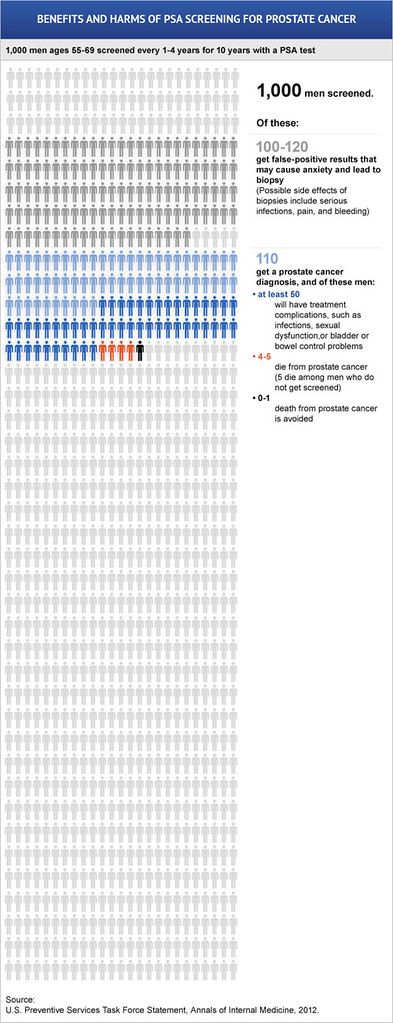
    The task force cited concerns that screening's harms outweighed its benefits.

  3. ACS issues prior prostate screening guideline

    Guideline

    It urged shared decision-making with a clinician rather than a direct screening recommendation.

Scenarios

1

USPSTF raises PSA screening to Grade B

Possible Resolves by End of 2027

Discussed by: Clinical groups and health-policy reporters who track task force grading, including the Washington Post's coverage of the split

A Grade B would put the task force behind routine screening for men 55 to 69 and, under the Affordable Care Act, require most private plans to cover PSA testing with no copay. It would also settle the inconsistency the ACS guideline creates for primary-care doctors deciding what to offer.

2

USPSTF keeps Grade C and coverage stays uneven

Likely Resolves by End of 2027

Discussed by: Screening skeptics and primary-care groups that have resisted a blanket recommendation

The task force took six years to move from Grade D to Grade C the last time. If it holds at individual decision-making, whether a man gets a PSA test keeps depending on his doctor and his plan, and the ACS guideline becomes one more input in a conversation rather than a standard of care.

3

PSA testing rises, and so do prostate biopsies

Uncertain Resolves by Q2 2029

Discussed by: Urologists and health-services researchers who study overtreatment

The society's bet is that MRI and biomarker tests will absorb the extra abnormal results without a matching jump in biopsies and treatment. If screening volume climbs faster than secondary testing capacity, the harms the 2010 guideline was written to avoid come back into view.

Historical Context

2 moments from history that rhyme with this story — and how they unfolded.

March 2009

Conflicting Prostate Screening Trials (2009)

Two large trials published the same year reached opposite conclusions. A European study of about 162,000 men reported roughly a 20% relative reduction in prostate cancer deaths with screening. A U.S. trial of about 76,000 men found no mortality benefit. The contradiction sat at the center of the screening debate for a decade.

Then

U.S. guidance turned cautious, culminating in the 2012 recommendation against routine PSA screening.

Now

Screening rates fell and diagnoses of advanced-stage disease later climbed, which the American Cancer Society cites as reason to screen again.

Why this matters now

The new guideline is the society's answer to that dispute: it treats the mortality benefit as established and pushes the harm reduction into the follow-up testing step.

2015–2016

Mammography Guideline Split (2015–2016)

The American Cancer Society recommended annual mammograms starting at 45. The U.S. Preventive Services Task Force recommended biennial screening starting at 50. Two credible bodies, two different answers, both aimed at the same disease.

Then

Insurers and clinicians absorbed conflicting advice, and coverage varied by plan.

Now

Guideline divergence became a normal feature of U.S. cancer screening rather than an exception.

Why this matters now

Prostate screening is now in the same position: the society's direct recommendation does not bind the task force, and the gap between them determines who gets tested without a copay.

Sources

(6)