Anchor

Astronomers detect a 10-sided decagon forming at Saturn's south pole
New CapabilitiesThe first large polygonal jet pattern in the planet's southern hemisphere, visible in archival images since 2023
3 days ago: Team announces decagon discovery in Science AdvancesNew here? Follow stories to track developments over time. Create a free account to get updates when stories you care about change.
Overview
Updated 1 hour agoSaturn's north pole has worn a six-sided hexagon for more than 40 years. Now Hubble Space Telescope images show a 10-sided decagon emerging at the planet's south pole — the first large polygonal jet pattern ever seen in that hemisphere.
The wave spans roughly 168,000 kilometers and sits near 60 degrees south latitude, riding an eastward jet stream that moves about 420 kilometers per hour. It rotates slowly, taking about 800 days for one full turn.
Amateur astronomers analyzing ground-based images first flagged the odd shape, and archival Hubble observations show the structure emerging as early as 2023. The decagon sharpened into a clear pattern by 2025. Scientists will track whether it stabilizes like the northern hexagon, breaks apart, or strengthens as Saturn's southern summer peaks in 2032.
Why it matters
The decagon is a live experiment in planetary atmosphere physics — watching a giant geometric wave either stabilize like Saturn's hexagon or break apart.
Questions about this story
Free account needed to ask — your question is kept and asked for you right after sign-up. Answers are public.
No questions yet — be the first to ask.
Key Indicators
10
Number of sides in the wave
The decagon is the first large polygonal jet pattern seen in Saturn's southern hemisphere.
~168,000 km
Width of the decagon
Each side measures about 16,800 kilometers.
~800 days
Time for one full rotation
The wave crawls compared to the 420 km/h jet stream carrying it.
2023
Year the structure began forming
Archival Hubble images show subtle hints of the decagon starting in 2023.
Related Media
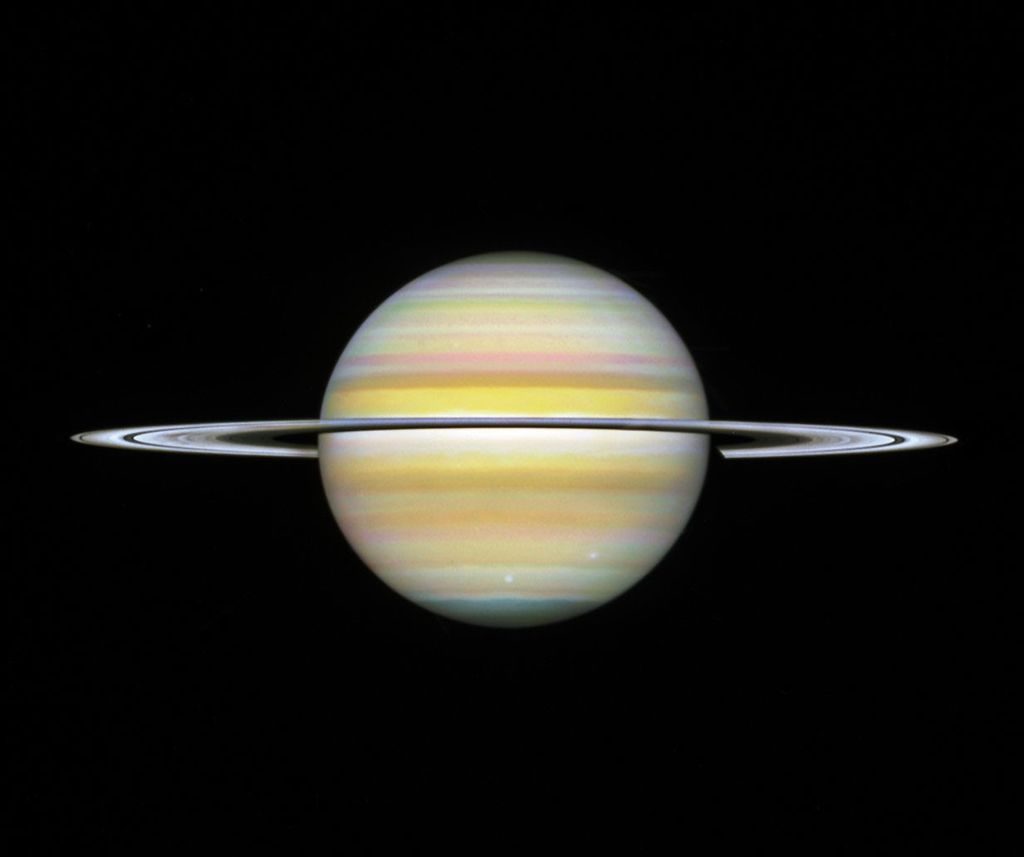
NASA's Hubble Tracks New Decagon Encircling Saturn's South Pole - NASA Science
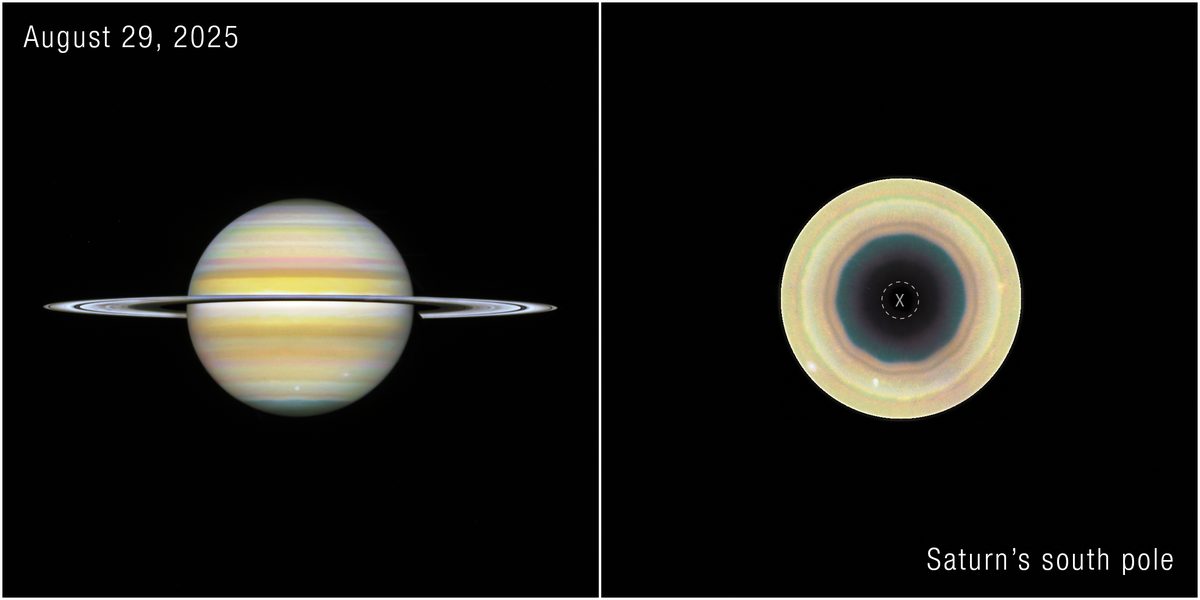
Decagon on Saturn's South Pole (Color) - NASA Science
Images from Openverse under Creative Commons licenses.
Voices
Curated perspectives — historical figures and your fellow readers.
Play
Exploring all sides of a story is often best achieved with Play.
Most of these play right now — no account needed. Sign up to save scores, keep a streak, and unlock Debate and Predict.
Log in
Sign Up
WHO SAID WHAT?
Can you match the quotes to the right people?
Rounds
People
Per question
Scoring
- points for each correct match.
- time bonus when you answer in under seconds.
- streak bonus once you hit correct in a row.
Score:
Round /
streak
— Who said this?
Tip: press 1– to answer.
Score:
Round /
streak
+
Base +
⚡ Speed +
🔥 Streak +
Streak reset · the answer was
No answer in time · it was
Next Up
Round
of
Score
points
Correct
Best Streak
Time Bonus
Avg. Time
points — sign up to put that on the leaderboard.
Now try on this story
Higher or Lower
A number from this story, against one from elsewhere in the news — guess which is bigger, then keep the chain going. 5 rounds, 3 strikes; a miss costs a strike and resets your streak.
Example
Anchor
EU tariff revenue
$52B
Big for this kind of number
Mystery
Pentagon AI contract
?
Round 1
Streak: 0
Mystery
?
Keyboard: ↓/L lower · ↑/H higher
0 pts
Best streak: 0 · Rounds: 0
0 points — sign up to put that on the leaderboard.
Now try on this story
Timeline
Astronomers detect a 10-sided decagon forming at Saturn's south pole
Order five events from this story, oldest at top. Each in the right slot scores 1 — neighbours within one slot count too. Your previous result — green ✓ for exact slots, yellow ~ for off by one. Cards now in true chronological order.
Loading puzzle…
Tap 💡 Free hint to lock the oldest into slot 1 — that leaves just four to order. Type pills are clues.
0/5
Exact slot
0/5
Within 1
Sign up to save your score and track a streak across stories.
Now try on this story
Connections
Sixteen names from the news. Find the four hidden groups of four. Four mistakes max.
Loading today's puzzle…
0/4 groups
Mistakes
Sign up to keep a daily streak — a new puzzle lands every day.
Now try on this story
Exit debate?
Your progress in this debate will be lost.
How it works
- 1 Two AI personas square off on this story.
- 2 You predict who'll win each round — correct picks earn XP.
- 3 One crossfire question is yours to fire. Pick it carefully.
Couldn't generate a topic
Select Your Champions
Choose one persona for each side of the debate
DEBATE TOPIC
Choose personas with different perspectives for a more dynamic debate.
SIDE A (PRO)
Select debater for this side:
No debate personas available right now.
SIDE B (CON)
Select debater for this side:
No debate personas available right now.
VS
Get ready to make your prediction...
Round of
Claim
Evidence
Stakes
Crossfire Answer
Closing Statement
Claim
Evidence
Stakes
Crossfire Answer
Closing Statement
Your Crossfire Question
Generating arguments...
Who's Got This Round?
Make your prediction before the referee scores
The referee scores both sides on
Correct predictions earn +20 XP
· Press 1 or 2 to pick
Evidence
40%
Logic
30%
Detail
20%
Style
10%
Round Results
Your Pick
Not this time
(%)
Overall Score
/10
Your Pick
Not this time
(%)
Overall Score
/10
Set the Crossfire
Pick the question both personas must answer in the final round
Crafting crossfire questions...
Choosing a question earns +10 XP crossfire bonus
🏆
Total XP Earned
Cred Change
Predictions
Debate Oracle! You called every round!
Sharp Instincts! You know your debaters!
The Coin Flip Strategist! Perfectly balanced!
The Contrarian! Bold predictions!
Inverse Genius! Try betting the opposite next time!
XP Breakdown
Base completion
+20 XP
Rounds played ( rounds x 5 XP)
+ XP
Correct predictions ( correct x 20 XP)
+ XP
Crossfire bonus
+10 XP
Accuracy
%
Prediction History
Round
You picked:
✓
✗
Now try on this story
Keep debating to level up your credibility and unlock achievements
People Involved
Agustin Sanchez-Lavega
Lead author of the decagon study, planetary scientist
Leading the team tracking the wave's evolution
Amy Simon
OPAL principal investigator, NASA Goddard Space Flight Center
Co-author of the decagon study
Michael Wong
Planetary scientist, UC Berkeley Space Sciences Laboratory
Co-author of the decagon study
Organizations Involved
Hubble Space Telescope
Space telescope
Primary instrument tracking the decagon
Space telescope operated by NASA and ESA that has photographed the outer planets annually since 2014 through the OPAL program.
NASA Goddard Space Flight Center
Federal research center
Leads the OPAL program, co-authored the decagon study
NASA center that leads Hubble's Outer Planet Atmospheres Legacy program and co-authored the decagon study.
University of the Basque Country
Public university
Lead institution for the decagon study
Public university in Bilbao, Spain, whose planetary scientists led the decagon study.
UC Berkeley Space Sciences Laboratory
University research lab
Co-authored the decagon study, analyzed the anticyclone
Research lab that co-authored the decagon study and analyzed the anticyclone vortex possibly driving the wave.
Timeline
November 1980 September 2026
5 events
Latest: 3 days ago
Tap a bar to jump to that date
-
Team announces decagon discovery in Science Advances
Latest PublicationResearchers from Spain, NASA, and UC Berkeley publish the decagon's characterization, dynamics, and formation hypothesis.
-
Anticyclone at 55 degrees south darkens, decagon sharpens
ObservationA compact anticyclone vortex darkens sharply, and the decagon pattern becomes clearly defined in Hubble images.
-
Archival Hubble images show first subtle hints of decagon
ObservationHubble's OPAL program images begin to show faint traces of a 10-sided pattern near 60 degrees south latitude.
-
Cassini observes partial southern hemisphere structure
ObservationThe Cassini spacecraft observed a partial polygonal structure in Saturn's southern hemisphere, but its dynamics were never characterized.
-
Voyager 1 flies past Saturn, reveals north polar hexagon
DiscoveryVoyager 1's flyby captured the six-sided jet pattern at Saturn's north pole, later confirmed by Voyager 2 in 1981 and identified in the data by 1988.
Historical Context
3 moments from history that rhyme with this story — and how they unfolded.
1831-present
Jupiter's Great Red Spot (1831-present)
Astronomers have continuously observed Jupiter's Great Red Spot, an anticyclone wider than Earth, since the 1830s. It has shrunk in recent decades but remains a distinct feature after nearly two centuries.
Then
The spot became the benchmark for long-lived planetary storms.
Now
It fed the assumption that giant-planet weather features persist for very long stretches, which the decagon now challenges.
Why this matters now
The study team notes features like the Great Red Spot create the impression that outer planets are timeless. Saturn's decagon, appearing and changing within a few years, shows how changeable these planets can be.
1980-1988
Saturn's north polar hexagon (1980-1988)
Voyager 1 and 2 flew past Saturn in 1980 and 1981 and photographed a striking six-sided cloud pattern circling the north pole. Researchers identified the hexagon in the Voyager data by 1988. The Cassini mission later confirmed it with decades of close observations.
Then
Scientists spent years trying to explain how a jet stream could carve a near-perfect hexagon.
Now
The hexagon became the benchmark for polygonal planetary weather and has persisted through every observation since.
Why this matters now
The newly discovered decagon is the first large polygonal wave found in Saturn's southern hemisphere. Its evolution will show whether such patterns are common on gas giants or a one-off.
1989-1994
Neptune's Great Dark Spot (1989-1994)
Voyager 2 photographed a large dark storm in Neptune's atmosphere in 1989. When the Hubble Space Telescope looked again in 1994, the spot had vanished.
Then
The spot was the first major planetary storm observed to disappear between campaigns.
Now
It proved giant-planet weather features can be transient, appearing and vanishing within a few years.
Why this matters now
The decagon may be similarly transient. Its fate will show which planetary weather patterns endure and which evaporate.
Sources
(10)Related Stories
Saturn's moon empire: 128 new worlds in a single day
New Capabilities
Updated May 19
The exoplanet revolution: 30 years, 6,000 worlds
New Capabilities
Updated May 19
TESS reveals the universe's tightest-packed quadruple star system
New Capabilities
Updated May 30
2026 astronomical events: a year of rare celestial phenomena
New Capabilities
Updated May 29
Hall effect works with in-plane magnetic fields, Carnegie Mellon team shows
New Capabilities
Updated 1 hour ago
NASA builds its next flagship space telescope to map the dark universe
New Capabilities
Updated May 31